
JPL
Careers
Education
Science & Technology
JPL Logo
JPL Logo
Asteroids and Comets
.2 min read

Lectures Highlight JPL's Next Solar System Mission: Deep Space 1 

Jet Propulsion Laboratory https://www.jpl.nasa.gov/ Aug. 10, 1998
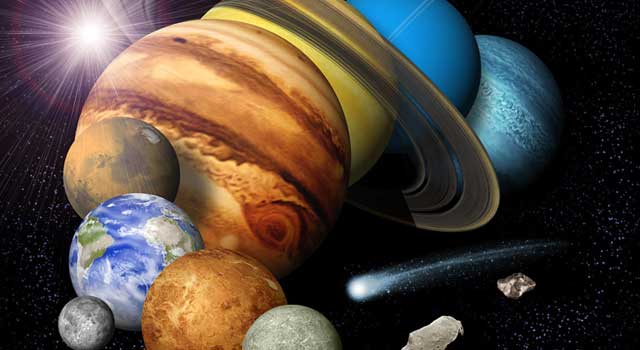
Montage of our solar system.
Credit: NASA/JPL

NASA's Deep Space 1, the next solar system mission to be managed by the Jet Propulsion Laboratory, is the focus of two free public lectures this month. The first takes place on Thursday, August 20, at 7 p.m. in JPL's von Karman Auditorium, and the second follows on Friday, August 21, at 7 p.m. in the Forum at Pasadena City College. Reservations are not necessary, and parking is free.

NASA's Deep Space 1, the next solar system mission to be managed by the Jet Propulsion Laboratory, is the focus of two free public lectures this month. The first takes place on Thursday, August 20, at 7 p.m. in JPL's von Karman Auditorium, and the second follows on Friday, August 21, at 7 p.m. in the Forum at Pasadena City College. Reservations are not necessary, and parking is free.

Deep Space 1 is the first flight of NASA's New Millennium Program, all of whose deep space and Earth-orbiting missions are designed to test new technologies so that they can be confidently used on science missions of the 21st century.

The low-cost, high-risk Deep Space 1 mission will validate such new technologies as an ion propulsion engine similar to those described in futuristic science fiction works. The engine is one of 12 innovative technologies to be tested during the mission, scheduled to be launched October 15 from Cape Canaveral, Florida.

Most of the validation of Deep Space 1's technologies occurs within two months of launch. After that the diminutive spacecraft, reaching just 1.5 meters (4.9 feet) in height, will continue testing its two new science instruments while flying by a near-Earth asteroid, 1992 KD, in July 1999. The instruments will send back visible images and infrared and ultraviolet spectral images while the spacecraft flies closer to an asteroid than has ever been attempted before, perhaps as low as 5 kilometers (three miles).

Deep Space 1 Chief Mission Engineer Dr. Marc Rayman will present the illustrated talk. Rayman, whose doctorate in physics is from the University of Colorado, combined his technical training with his lifelong study of space exploration by joining the JPL staff in 1986. In 1994, he helped initiate the New Millennium Program; he has served in his current Deep Space 1 role since 1995 and will assume the title of deputy mission manager after launch.

An overview of the Deep Space 1 mission is available on the Internet at http://nmp.jpl.nasa.gov/ds1/ . Rayman's entertaining New Millennium Program facts can be found at http://spaceplace.jpl.nasa.gov/facts.htm , an educational site for children developed by JPL in collaboration with the International Technology Education Association.

JPL is a division of the California Institute of Technology. This lecture is part of the monthly von Karman Lecture Series, sponsored by the JPL Media Relations Office. A web site about the series is located at http://www.jpl.nasa.gov/lecture/ . Information is also available by calling (818) 354-5011.


818-354-5011

1998-9879

Related News

Mars.

NASA’s Perseverance, Curiosity Panoramas Capture Two Sides of Mars

Mars.

NASA’s Curiosity Finds Organic Molecules Never Seen Before on Mars

Solar System.

NASA Shuts Off Instrument on Voyager 1 to Keep Spacecraft Operating

Earth.

NASA-ISRO Satellite Captures Pacific Northwest Through Clouds

Earth.

See NASA’s GUARDIAN Catch a Tsunami

Asteroids and Comets.

NASA’s DART Mission Changed Orbit of Asteroid Didymos Around Sun

Earth.

US-French Satellite Takes Stock of World’s River Water

Mars.

NASA’s Curiosity Rover Sees Martian ‘Spiderwebs’ Up Close

Mars.

NASA’s Perseverance Now Autonomously Pinpoints Its Location on Mars

Mars.

NASA’s Perseverance Rover Completes First AI-Planned Drive on Mars

About JPL
Who We Are
Directors
Careers
Internships
The JPL Story
JPL Achievements
Documentary Series
JPL Annual Report
Executive Council
Missions
Current
Past
Future
All
News
All
Earth
Solar System
Stars and Galaxies
Eyes on the News
Subscribe to JPL News
Galleries
Images
Videos
Audio
Podcasts
Apps
Visions of the Future
Slice of History
Robotics at JPL
Events
Lecture Series
Speakers Bureau
Calendar
Visit
Public Tours
Virtual Tour
Directions and Maps
Topics
JPL Life
Solar System
Mars
Earth
Climate Change
Exoplanets
Stars and Galaxies
Robotics
More
Asteroid Watch
NASA's Eyes Visualizations
Universe - Internal Newsletter
Social Media
Accessibility at NASA
Contact Us
Get the Latest from JPL
Follow Us

JPL is a federally funded research and development center managed for NASA by Caltech.

More from JPL
Careers
Education
Science & Technology
Acquisition
JPL Store
Careers
Education
Science & Technology
Acquisition
JPL Store
Related NASA Sites
Basics of Spaceflight
NASA Kids Science - Earth
Earth / Global Climate Change
Exoplanet Exploration
Mars Exploration
Solar System Exploration
Space Place
NASA's Eyes Visualization Project
Voyager Interstellar Mission
NASA
Caltech
Privacy
Image Policy
FAQ
Feedback
Version: v3.1.0 - 409b2d2
Site Managers:Emilee Richardson, Alicia Cermak
Site Editors:Naomi Hartono, Steve Carney
CL#:21-0018