
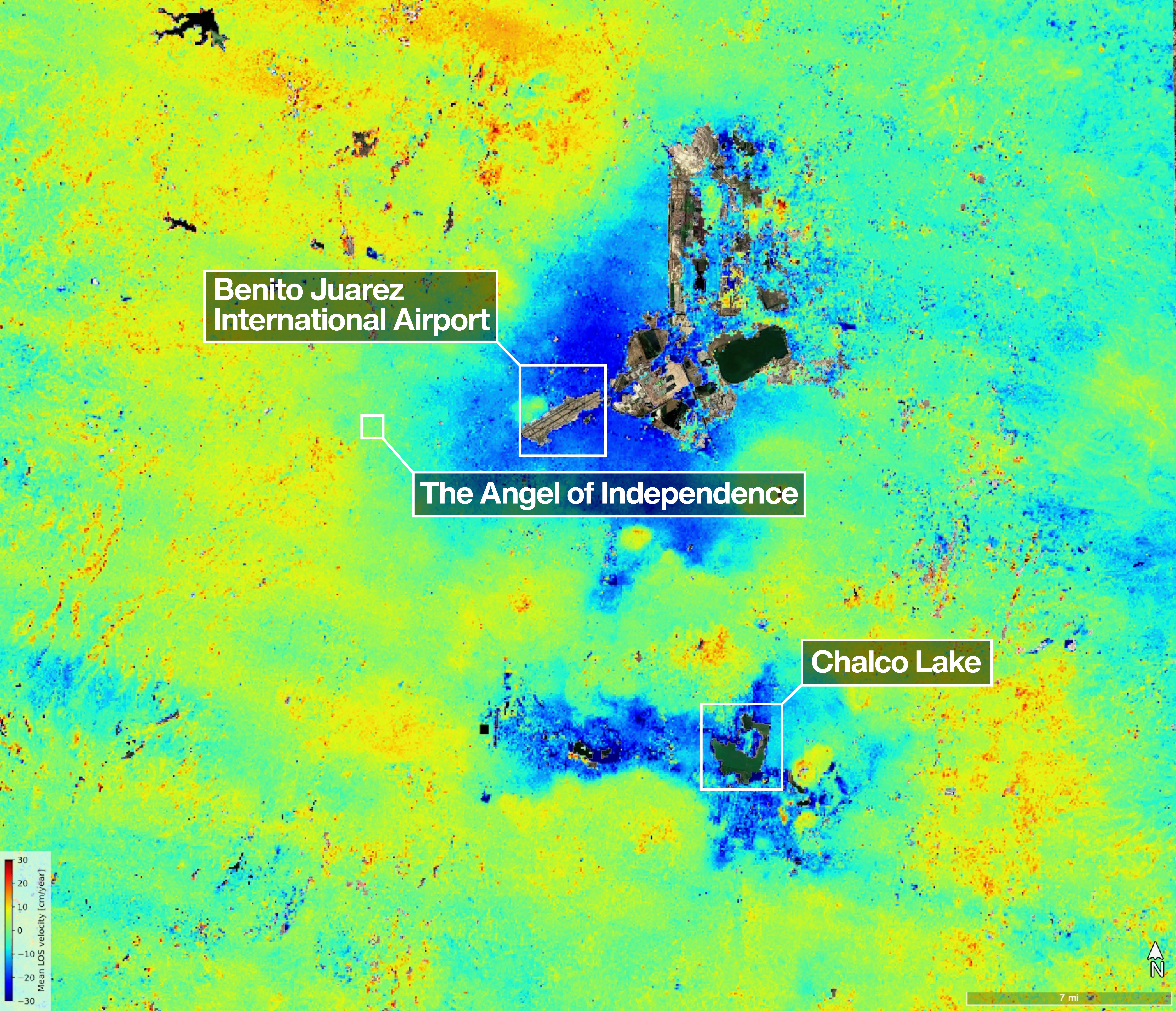
One of the most powerful radar systems ever launched into space has mapped the ground moving beneath one of fastest subsiding capitals in the world: Mexico City. The findings show how quickly and reliably the NISAR (NASA-ISRO Synthetic Aperture Radar) satellite can track real-time changes across Earth’s surface from orbit, unhindered by clouds or vegetation that impede optical sensors and higher-frequency radars.
Home to some 20 million people, the Mexico City area is built atop an aquifer. Extensive groundwater pumping, combined with the weight of urban development, has resulted in the compaction of the ancient lakebed beneath the city for more than a century. An engineer first documented the issue in 1925, and by the 1990s and 2000s, parts of the metropolitan area were sinking by around 14 inches (35 centimeters) per year, damaging infrastructure including the Metro, one of the largest rapid transit systems in the Americas.
Several generations of space-based radar have tracked Mexico City on the move. The NISAR mission, launched in July 2025, is now advancing these efforts, analyzing fast-changing areas that are challenging to survey from space. Capable of working day and night, rain or shine, NISAR’s L-band synthetic aperture radar is designed to track subtle motions such as land sinking and rising, glaciers sliding, and croplands growing, as it passes overhead multiple times a month.
“Images like this confirm that NISAR’s measurements align with expectations,” said Craig Ferguson, deputy project manager at NASA Headquarters in Washington. “NISAR’s long wavelength L-band radar will make it possible to detect and track land subsidence in more challenging and densely vegetated regions such as coastal communities where they may have the compounding effects of both land subsidence and sea level rise.”
The new analysis is based on preliminary measurements taken by NISAR between October 2025 and January 2026, during Mexico City’s dry season. Parts of the region found to be subsiding by more than half an inch (more than 2 centimeters) per month are shown in dark blue. The yellow and red areas are likely residual noise signals that are expected to decrease as NISAR collects more data. The structure near the center of the image is Benito Juarez International Airport, with Lake Nabor Carrillo visible as a dark green oblong to the northeast.
One area landmark — the Angel of Independence along the Paseo de la Reforma — is a visible indicator of subsidence. Built in 1910 to commemorate 100 years of Mexico’s independence, the towering monument stands 114 feet (36 meters) high and has had 14 steps added to its base as the land around it gradually sinks.
“Mexico City is a well-known hot spot when it comes to subsidence, and images like this are just the beginning for NISAR,” said David Bekaert, a project manager at the Flemish Institute for Technological Research and a member of the NISAR science team. “We’re going to see an influx of new discoveries from all over the world, given the unique sensing capabilities of NISAR and its consistent global coverage.”
Get the JPL Newsletter
From Mars to the Milky Way—never miss a discovery! Delivered straight to your inbox.
A joint mission developed by NASA and the Indian Space Research Organisation (ISRO), NISAR launched from Satish Dhawan Space Centre on India’s southeastern coast. Managed by Caltech, NASA’s Jet Propulsion Laboratory in Southern California leads the United States component of the project and provided the satellite’s L-band SAR and antenna reflector. The spacecraft bus and its S-band SAR were provided by ISRO.
The NISAR satellite is the first to carry two SAR instruments at different wavelengths and is monitoring Earth’s land and ice surfaces twice every 12 days, collecting data using the spacecraft’s giant drum-shaped reflector, which measures 39 feet (12 meters) wide — the largest radar antenna reflector NASA has ever sent into space.
To learn more about NISAR, visit: