
JPL
Careers
Education
Science & Technology
JPL Logo
JPL Logo
2 min read

JPL Astrophysicist Wins 1985 Rossi Prize

Jet Propulsion Laboratory https://www.jpl.nasa.gov/ Jan. 16, 1986
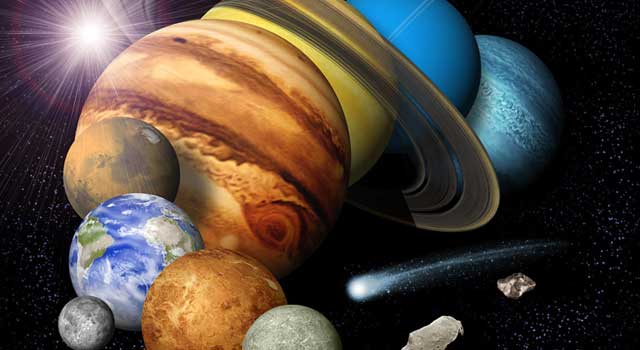
Montage of our solar system.
Credit: NASA/JPL

The High Energy Astrophysics Division of the American Astronomical Society has named Jet Propulsion Laboratory astrophysicist Dr. Allan S. (Bud) Jacobson the winner of the 1985 Rossi Prize.

The High Energy Astrophysics Division of the American Astronomical Society has named Jet Propulsion Laboratory astrophysicist Dr. Allan S. (Bud) Jacobson the winner of the 1985 Rossi Prize.

The prize, named in honor of Professor Bruno Rossi, was awarded for Dr. Jacobson's discoveries of radioactive aluminum-26 in the interstellar medium of the Milky Way Galaxy, and the discovery of variability of the 0.511 MeV (mega-electron volt) line from the direction of the center of the galaxy.

The prize consists of certificate and $500. Dr. Jacobson will make presentation of his work, for which the prize was awarded, at the June meeting of the American Astronomical Society in Ames, Iowa.

In 1980, Dr. Jacobson was awarded the NASA Medal for Exceptional Scientific Achievement for development of high resolution gamma-ray spectrometer launched the previous year aboard NASA's High Energy Astronomy Observatory (HEAO 3). This instrument, with which the discoveries were made, was designed and proposed in 1969, his first year at JPL.

Dr. Jacobson is native of Chattanooga, Tenn. He was graduated from UCLA in 1962 with Honors and elected to Phi Beta Kappa. He received his Master's degree (1964) and Doctorate in Physics (1968) from University of California, San Diego.

His discovery of radioactive aluminum-26 was the first direct evidence that elements of intermediate weight are presently being produced in our galaxy.

The element is unstable and spontaneously decays to another element, magnesium-26. "It is during this decay process that the characteristic gamma-ray is emitted which allowed the material to be detected," he said.

Dr. Jacobson's experiment also determined the variations in the 0.511 MeV line observed from the direction of the center of the galaxy. It has unique energy characteristic of the process in which an electron and an anti-electron, or positron, collide and mutually annihilate in burst of gamma-radiation.

In two HEAO 3 observations, six months apart, the experiment determined the intensity of the line had decreased by about one-third. This variation, he said, indicates the emission region must be relatively small when compared to expected scales of galactic structure.

"This lends support to the idea that there is black hole at the center of our galaxy," Dr. Jacobson said.


818-354-5011

1986-1084

Latest News

Asteroids and Comets.

NASA’s Next-Gen Near-Earth Asteroid Space Telescope Takes Shape

Earth.

US-Indian Space Mission Maps Extreme Subsidence in Mexico City

Technology.

NASA Fires Up Powerful Lithium-Fed Thruster for Trips to Mars

Mars.

NASA’s Perseverance, Curiosity Panoramas Capture Two Sides of Mars

Mars.

NASA’s Curiosity Finds Organic Molecules Never Seen Before on Mars

Solar System.

NASA Shuts Off Instrument on Voyager 1 to Keep Spacecraft Operating

Stars and Galaxies.

‘Interstellar Glaciers’: NASA’s SPHEREx Maps Vast Galactic Ice Regions

Technology.

NASA Unveils Initiatives to Achieve America’s National Space Policy

Exoplanets.

NASA Research Proposes Technology to Seek Earth-Like Exoplanets

Earth.

NASA-ISRO Satellite Captures Pacific Northwest Through Clouds

About JPL
Who We Are
Directors
Careers
Internships
The JPL Story
JPL Achievements
Documentary Series
JPL Annual Report
Executive Council
Missions
Current
Past
Future
All
News
All
Earth
Solar System
Stars and Galaxies
Eyes on the News
Subscribe to JPL News
Galleries
Images
Videos
Audio
Podcasts
Apps
Visions of the Future
Slice of History
Robotics at JPL
Events
Lecture Series
Speakers Bureau
Calendar
Visit
Public Tours
Virtual Tour
Directions and Maps
Topics
JPL Life
Solar System
Mars
Earth
Climate Change
Exoplanets
Stars and Galaxies
Robotics
More
Asteroid Watch
NASA's Eyes Visualizations
Universe - Internal Newsletter
Social Media
Accessibility at NASA
Contact Us
Get the Latest from JPL
Follow Us

JPL is a federally funded research and development center managed for NASA by Caltech.

More from JPL
Careers
Education
Science & Technology
Acquisition
JPL Store
Careers
Education
Science & Technology
Acquisition
JPL Store
Related NASA Sites
Basics of Spaceflight
NASA Kids Science - Earth
Earth / Global Climate Change
Exoplanet Exploration
Mars Exploration
Solar System Exploration
Space Place
NASA's Eyes Visualization Project
Voyager Interstellar Mission
NASA
Caltech
Privacy
Image Policy
FAQ
Feedback
Version: v3.1.0 - 9d64141
Site Managers:Emilee Richardson, Alicia Cermak
Site Editors:Naomi Hartono, Steve Carney
CL#:21-0018