
JPL
Careers
Education
Science & Technology
JPL Logo
JPL Logo
2 min read

25th Anniversary of NASA's First Planetary Mission

Jet Propulsion Laboratory https://www.jpl.nasa.gov/ Dec. 10, 1987
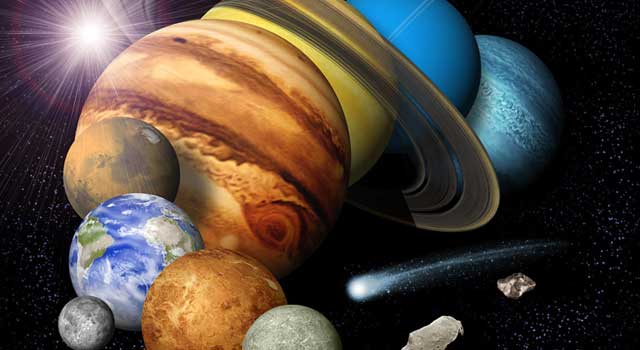
Montage of our solar system.
Credit: NASA/JPL

A quarter-century of exploring the solar system will be marked Monday, Dec. 14, on the 25th anniversary of NASA's first planetary mission

A quarter-century of exploring the solar system will be marked Monday, Dec. 14, on the 25th anniversary of NASA's first planetary mission.

Mariner 2, built at the Jet Propulsion Laboratory, executed flyby of Venus on Dec. 14, 1962. The mission was the first time spacecraft visited another planet.

Since then, more than dozen U.S. spacecraft have explored the planets from Mercury to Uranus, with Neptune to be added during Voyager 2's encounter in 1989. In addition, more than 20 missions to planets -- and, more recently, to Comet Halley -- have been launched in the past 25 years by the Soviet Union, Japan and the European Space Agency.

Mariner 2, launched on August 27, 1962, was one of two early spacecraft built for NASA by JPL to fly by Venus. Its twin craft, Mariner 1, was destroyed when faulty guidance software took its booster off-course during launch on July 22, 1962.

The 447-pound Mariner 2 flew by Venus at distance of 21,600 miles after traveling 180 million miles over 109 days. During its flight it became the first spacecraft to execute trajectory correction maneuver, in which thrusters are fired to correct spacecraft's course.

Among findings from its six science experiments, Mariner 2 confirmed then-theory that Venus was very hot planet with surface temperature of about 800 degrees F. on both its light and dark sides. The spacecraft also relayed data on radiation conditions in the inner solar system.

Later highlights of NASA's planetary program have included Mariner 5 to Venus; Mariners 4, 6, 7, 8 and 9 to Mars; Mariner 10 to Venus and Mercury; Pioneers 10 and 11 to Jupiter and Saturn; Vikings 1 and 2 to Mars; Voyagers 1 and 2 to Jupiter, Saturn, Uranus and Neptune; and Pioneers 12 and 13 to Venus.

NASA's next mission to Venus will be Magellan, scheduled for launch from the Space Shuttle Atlantis on April 27, 1989. The JPL-managed spacecraft will relay high- resolution maps of Venus using synthetic-aperture radar to pierce the planet's thick cloud cover.

Other JPL projects scheduled for launch include Galileo to Jupiter, Oct. 8, 1989; Ulysses, joint mission with the European Space Agency to study the Sun, Oct. 5, 1990; and Mars Observer, August 1992.

NASA/JPL scientists will also collaborate with their Soviet counterparts by tracking and contributing an experiment to the USSR's Phobos mission, which will be launched to study Mars and its moon Phobos in 1988.

JPL planetary projects are funded by NASA's Office of Space Science and Applications.


818-354-5011

1987-1173

Latest News

Asteroids and Comets.

NASA’s Next-Gen Near-Earth Asteroid Space Telescope Takes Shape

Earth.

US-Indian Space Mission Maps Extreme Subsidence in Mexico City

Technology.

NASA Fires Up Powerful Lithium-Fed Thruster for Trips to Mars

Mars.

NASA’s Perseverance, Curiosity Panoramas Capture Two Sides of Mars

Mars.

NASA’s Curiosity Finds Organic Molecules Never Seen Before on Mars

Solar System.

NASA Shuts Off Instrument on Voyager 1 to Keep Spacecraft Operating

Stars and Galaxies.

‘Interstellar Glaciers’: NASA’s SPHEREx Maps Vast Galactic Ice Regions

Technology.

NASA Unveils Initiatives to Achieve America’s National Space Policy

Exoplanets.

NASA Research Proposes Technology to Seek Earth-Like Exoplanets

Earth.

NASA-ISRO Satellite Captures Pacific Northwest Through Clouds

About JPL
Who We Are
Directors
Careers
Internships
The JPL Story
JPL Achievements
Documentary Series
JPL Annual Report
Executive Council
Missions
Current
Past
Future
All
News
All
Earth
Solar System
Stars and Galaxies
Eyes on the News
Subscribe to JPL News
Galleries
Images
Videos
Audio
Podcasts
Apps
Visions of the Future
Slice of History
Robotics at JPL
Events
Lecture Series
Speakers Bureau
Calendar
Visit
Public Tours
Virtual Tour
Directions and Maps
Topics
JPL Life
Solar System
Mars
Earth
Climate Change
Exoplanets
Stars and Galaxies
Robotics
More
Asteroid Watch
NASA's Eyes Visualizations
Universe - Internal Newsletter
Social Media
Accessibility at NASA
Contact Us
Get the Latest from JPL
Follow Us

JPL is a federally funded research and development center managed for NASA by Caltech.

More from JPL
Careers
Education
Science & Technology
Acquisition
JPL Store
Careers
Education
Science & Technology
Acquisition
JPL Store
Related NASA Sites
Basics of Spaceflight
NASA Kids Science - Earth
Earth / Global Climate Change
Exoplanet Exploration
Mars Exploration
Solar System Exploration
Space Place
NASA's Eyes Visualization Project
Voyager Interstellar Mission
NASA
Caltech
Privacy
Image Policy
FAQ
Feedback
Version: v3.1.0 - 9d64141
Site Managers:Emilee Richardson, Alicia Cermak
Site Editors:Naomi Hartono, Steve Carney
CL#:21-0018