

Lesson .
.Pi in the Sky 9

Overview
In the ninth installment of the "Pi in the Sky" illustrated problem set, students use the mathematical constant pi to solve real-world science and engineering problems. Students will use pi to detect frost in lunar craters, determine the density of Mars' liquid core, calculate the powered output from a dam, and find out how far a spacecraft travels as it returns data to Earth.
Materials
- Pi in the Sky 9 poster – Download PDF
- Pi in the Sky 9 handouts – Download PDF
- Pi in the Sky 9 answer key – Download PDF
- Pi in the Sky 9 answer handouts – Download PDF (also available as a text-only doc)
- "Pi in the Sky" series slideshow (mobile, tablet and screen-reader friendly)
Background
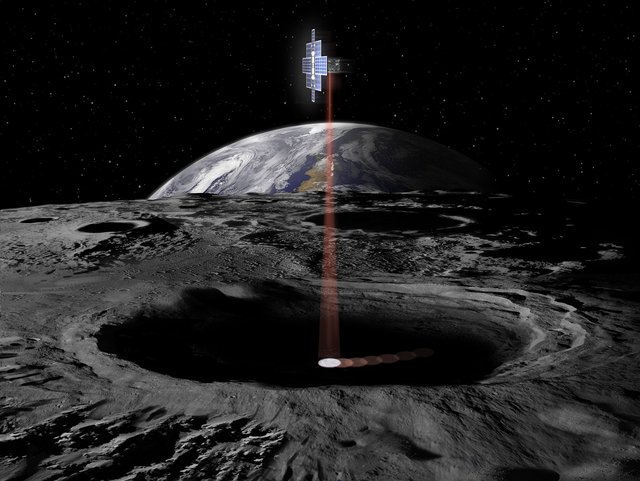
Lunar Logic
NASA’s Lunar Flashlight mission is a small satellite that will seek out signs of frost in deep, permanently shadowed craters around the Moon’s south pole. By sending infrared laser pulses to the surface and measuring how much light is reflected back, scientists can determine which areas of the lunar surface contain frost and which are dry. Knowing the locations of water-ice on the Moon could be key for future crewed missions to the Moon, when water will be a precious resource. In Lunar Logic, students use pi to find out how much surface area Lunar Flashlight will measure with a single pulse from one of its lasers.
Core Conundrum
Since 2018, the InSight lander has studied the interior of Mars by measuring vibrations from marsquakes and the “wobble” of the planet as it rotates on its axis. Through careful analysis of the data returned from InSight, scientists were able to measure the size of Mars’ liquid core for the first time and estimate its density. In Core Conundrum, students use pi to do some of the same calculations, determining the volume and density of the Red Planet’s core and comparing it to that of Earth’s core.
Dam Deduction
The Surface Water and Ocean Topography, or SWOT mission will conduct NASA's first global survey of Earth's surface water. SWOT’s state-of-the-art radar will measure the elevation of water in major lakes, rivers, wetlands, and reservoirs while revealing unprecedented detail on the ocean surface. This data will help scientists track how these bodies of water are changing over time and improve weather and climate models. In Dam Deduction, students learn how data from SWOT can be used to assess the environmental impact of dams. Students then use pi to do their own analysis, finding the powered output of a dam based on the water height of its reservoir and inferring potential impacts of this quick-flowing water.
Telescope Tango
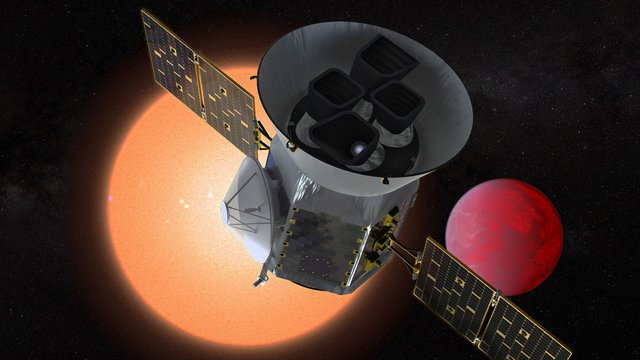
The Transiting Exoplanet Survey Satellite, or TESS, is designed to survey the sky in search of planets orbiting bright, nearby stars. TESS does this while circling Earth in a unique, never-before-used orbit that brings the spacecraft close to Earth about every two weeks to transmit its data. This special orbit keeps TESS stable while giving it an unobstructed view of space. In its first two years, TESS identified more than 2,600 possible exoplanets in our galaxy with thousands more discovered during its extended mission. In Telescope Tango, students will use pi to calculate the distance traveled by TESS each time it sends data back to Earth.

Procedures
Lunar Logic
NASA’s Lunar Flashlight mission will observe and map the location of frost within permanently shadowed craters in the Moon’s south polar region. Knowing how much frost is in these craters and where to find it can help us prepare for extended missions on the Moon, when water will be a valuable resource.
The spacecraft, a backpack-size cubesat, will collect data during 10 orbits over a two-month period, making repeated measurements over multiple points to map ice in these dark craters. To take measurements, Lunar Flashlight will send infrared laser pulses to the surface of the Moon and measure the signal that is reflected. The amount of light that is reflected back will help scientists determine where the lunar surface is dry and where it contains water-ice.
At 20 km altitude, the spacecraft's infrared lasers have a radius of 17.5 meters when they reach the surface of the Moon.
How much area do they cover in a single pulse?

Core Conundrum
The InSight Mars lander is equipped with several tools to help scientists learn more about the interior of the Red Planet, including a seismometer that detects marsquakes. By measuring the vibrations that travel across the surface of Mars and through its interior layers, scientists were able to accurately measure the size of Mars’ liquid core and estimate its density. Knowing the size and density of Mars' core will help us learn more about how the planet formed, how its magnetic field developed, and what materials make up the core, which will ultimately lead to a better understanding of how Earth and other planets form.
If Mars' core has a mass of 1.54 x 10²³ kg and a radius of 1,830 km, as measured by InSight, what is the density of the core?
How does that compare to the density of Earth’s core, which ranges from 10 to 13 g/cm3?
What does that tell us about the makeup of Mars’ core?

Dam Deduction
Water exiting a hydropower dam is called non-powered or powered outflow. Non-powered outflow exits via a spillway, on top of the dam. Powered outflow, which is used to generate electricity, travels through penstocks, pipes at the bottom of a dam. Powered outflow is usually colder and travels at a higher velocity, so it can disturb sediments, temperatures, and water quality of downstream rivers, especially when it’s a high percentage of the total outflow.
The SWOT mission, a satellite designed to survey all of Earth’s surface water, including lakes, rivers, oceans, and reservoirs, can help scientists better analyze these impacts.
A dam has 3 penstocks with diameters of 6.2 meters and a measured total outflow of 1,350 m3/s. If SWOT measured the reservoir’s water depth (H) at 100 m above the penstocks, compute the velocity (m/s) of the powered outflow using V=√(2gH).
What is the powered outflow if 1 penstock is open?
Is this a high or low percentage of the total outflow?
What can this tell you about the potential environmental impacts?

Telescope Tango
NASA's TESS mission is designed to survey the entire sky in search of exoplanets, or planets orbiting stars other than our Sun. In its two-year primary mission, TESS identified more than 2,600 possible exoplanets and counting.
To locate exoplanets, the space telescope flies in a highly eccentric elliptical orbit, which had never been attempted before. This orbit, called P/2, minimizes the amount of time that light and heat from Earth and the Moon can interfere with data collection. And it still allows the spacecraft to make close passes by Earth to transmit data about its findings back to scientists. The spacecraft's 13.7 day orbit has an axis of 376,000 km at apogee and an axis of 108,400 km at perigee. Each downlink from TESS takes about three hours to complete.
While TESS actually moves at different speeds throughout its orbit – from 0.5 km/s at apogee to 4 km/s at perigee – if its velocity stayed uniform, how many kilometers would TESS need to travel to successfully transmit its data?


Assessment

Extensions
Participate
Join the conversation and share your Pi Day Challenge answers with @NASAJPL_Edu on social media using the hashtag #NASAPiDayChallenge


