
JPL
Careers
Education
Science & Technology
JPL Logo
JPL Logo
Eels hero 2
Robotics at JPL .

EELS (Exobiology Extant Life Surveyor)

Robot Statistics

EELS 1.0 Mass

100000Grams

EELS 1.0 Length

4.4Meters

Status

In Development

Potential Destinations

Moon, Earth, Icy Moons

Animal Analog: Snake

About EELS (Exobiology Extant Life Surveyor)

EELS is designed to go places no one has ever seen before, on its own, without real-time human input. The concept for this self-propelled, autonomous robot was inspired by the desire to descend the narrow, geyser-spewing vents in the icy crust of Saturn’s moon Enceladus in order to look for signs of life in the ocean below.
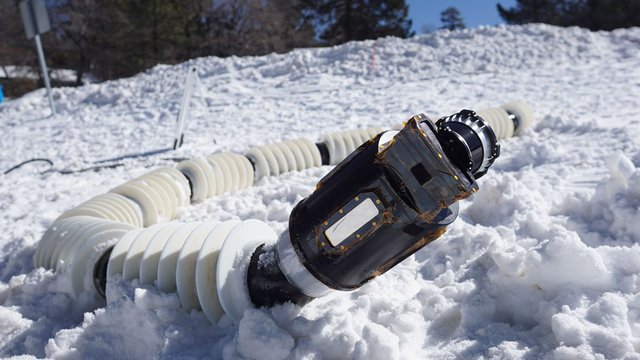
A version of JPL’s EELS robot raises its sensor head during a field test in the snow at a ski resort in the San Bernardino Mountains of Southern California in February 2023.
Factoid

3D Situational Awareness

The EELS head "sees" and interprets the world using lidar and four stereo camera pairs, creating a 3D map of its environment.

Active Skin Locomotion
Factoid

Active Skin Locomotion

Independently actuated counter-rotating screws provide propulsion, traction, and grip on icy terrain and in unconsolidated material like snow and sand.

EELS: Varied environments
Factoid

Many Degrees of Freedom

EELS is able to adopt multiple shape configurations to adapt to varied environments in real time.

Intelligent agent
Factoid

Intelligent Agent

EELS’ risk-aware autonomy software is designed so the robot can pick the best path through uncertain terrain and make decisions to keep itself safe.
A version of JPL’s EELS robot raises its sensor head during a field test in the snow at a ski resort in the San Bernardino Mountains of Southern California in February 2023.
Factoid

3D Situational Awareness

The EELS head "sees" and interprets the world using lidar and four stereo camera pairs, creating a 3D map of its environment.

Active Skin Locomotion
Factoid

Active Skin Locomotion

Independently actuated counter-rotating screws provide propulsion, traction, and grip on icy terrain and in unconsolidated material like snow and sand.

EELS: Varied environments
Factoid

Many Degrees of Freedom

EELS is able to adopt multiple shape configurations to adapt to varied environments in real time.

Intelligent agent
Factoid

Intelligent Agent

EELS’ risk-aware autonomy software is designed so the robot can pick the best path through uncertain terrain and make decisions to keep itself safe.
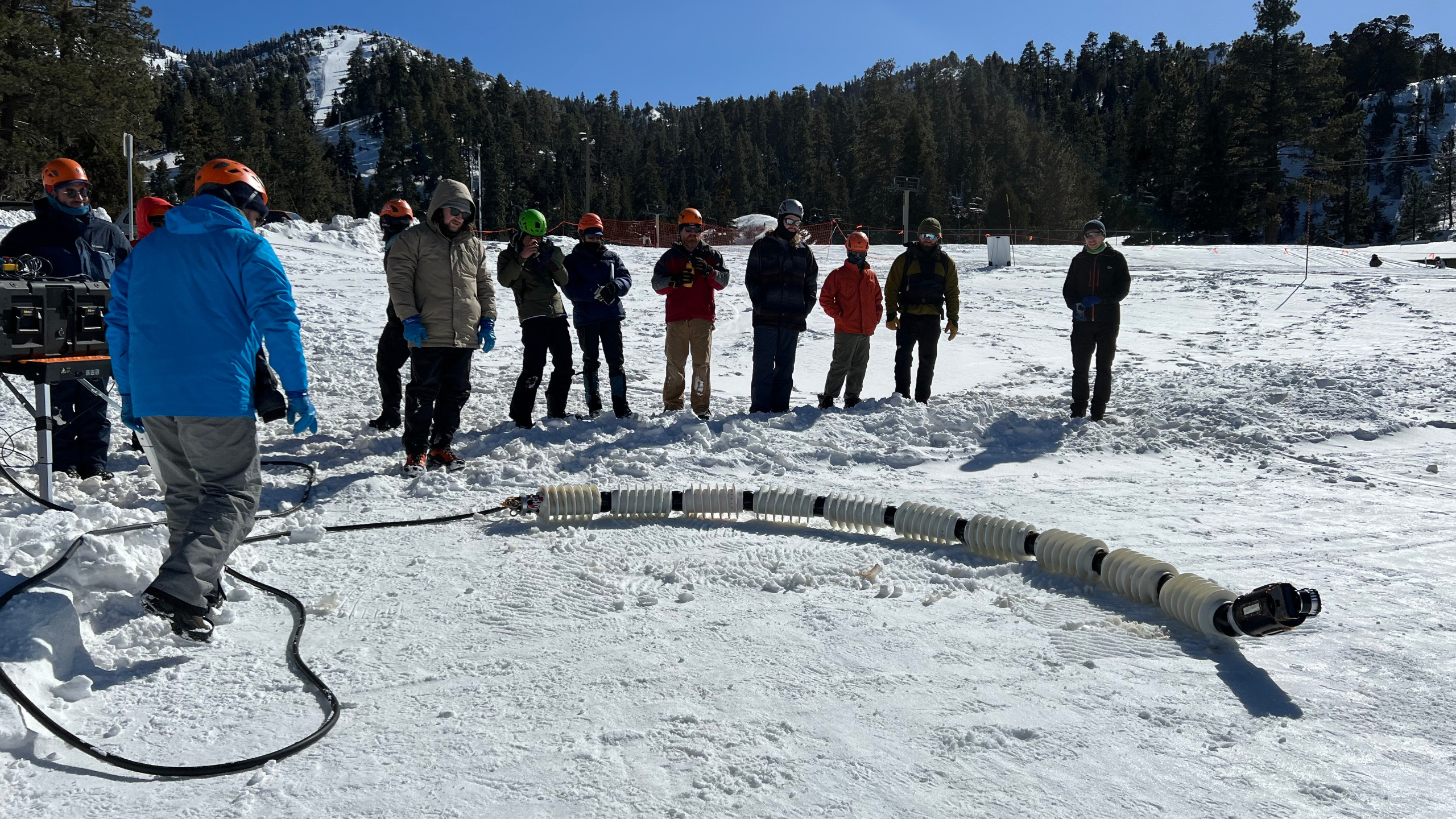
Team members from JPL test EELS at a ski resort in the Southern California mountains in February 2023. Designed to sense its environment, calculate risk, travel, and gather data without real-time human input, EELS could eventually explore destinations throughout the solar system.

Credit: NASA/JPL-Caltech
Interns Jack Naish, left, and Guglielmo Daddi work on a version of the EELS robot

Interns Jack Naish, left, and Guglielmo Daddi work on a version of the EELS robot during an April 2023 test in the Mars Yard at NASA’s Jet Propulsion Laboratory.

Credit: NASA/JPL-Caltech

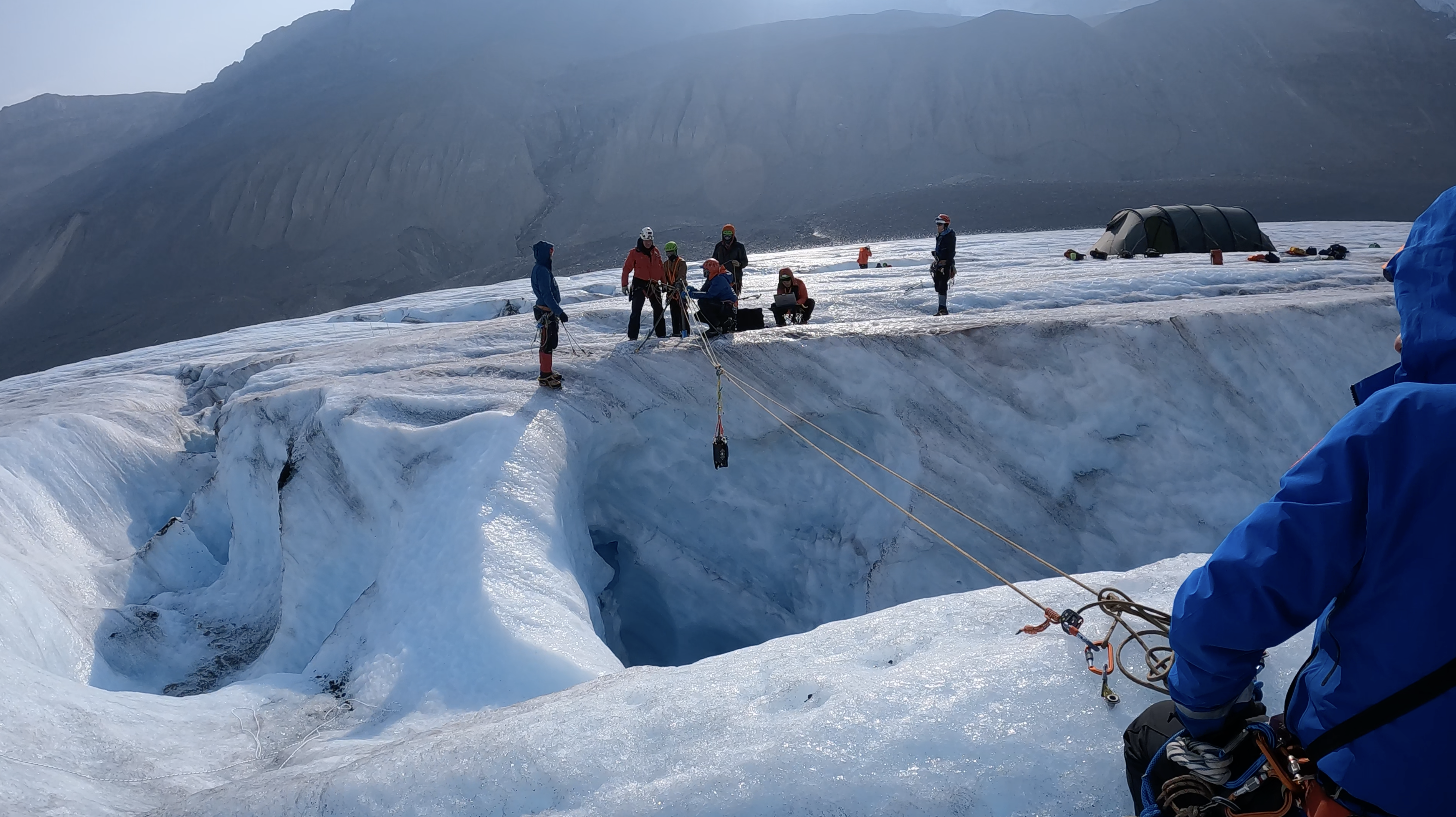
Members of JPL’s EELS team lower the robot’s sensor head – which uses lidar and stereo cameras to map its environment – into a vertical shaft called a moulin on Athabasca Glacier in Alberta in September 2022. The team will return to the location in 2023 and 2024 for additional tests with versions of the full snake robot.

Credit: NASA/JPL-Caltech
From left, EELS team members Hiro Ono, Rohan Thakker, Marlin Strub, and Michael Paton carry a prototype of the robot onto the ice for a field test at an ice rink in Pasadena in August 2022.

From left, EELS team members Hiro Ono, Rohan Thakker, Marlin Strub, and Michael Paton carry a prototype of the robot onto the ice for a field test at an ice rink in Pasadena in August 2022.

Credit: NASA/JPL-Caltech
rincipal Investigator Hiro Ono, just right of center, and members of JPL’s EELS team celebrate the first field test of a prototype of the robot

Principal Investigator Hiro Ono, just right of center, and members of JPL’s EELS team celebrate the first field test of a prototype of the robot at an ice rink in Pasadena, California, in August 2022.

Credit: NASA/JPL-Caltech
A version of JPL’s EELS robot raises its sensor head during a field test in the snow at a ski resort in the San Bernardino Mountains of Southern California in February 2023.

A version of JPL’s EELS robot raises its sensor head during a field test in the snow at a ski resort in the San Bernardino Mountains of Southern California in February 2023.

Credit: NASA/JPL-Caltech
JPL’s EELS robot

JPL’s EELS robot (version 1.5, designed for testing subsurface autonomy software) gets lowered by rope into a vertical shaft in the ice on Athabasca Glacier in Alberta, Canada, during a field test in September 2023.

Credit: NASA/JPL-Caltech

Version 1.0 of JPL’s EELS robot raises its sensor head during a field test at Athabasca Glacier in Alberta, Canada, in September 2023. The operators in the background are sending commands and monitoring the robot’s activities.

Credit: NASA/JPL-Caltech

Members of the field test team for JPL’s EELS project prepare to test version 1.5 of the robot – seen on a metal stand at right – at Athabasca Glacier in Alberta, Canada, in September 2023.

Credit: NASA/JPL-Caltech

Members of the field test team for JPL’s EELS robotics project move version 1.5 of the robot across the ice on a sled at Athabasca Glacier in Alberta, Canada, in September 2023.

Credit: NASA/JPL-Caltech

Morgan Cable, science lead of JPL’s EELS robotics project, lowers herself into a glacial shaft called a moulin during field testing of the robot at Athabasca Glacier in Alberta, Canada, in September 2023.

Credit: NASA/JPL-Caltech

Inside a glacial shaft called a moulin, Morgan Cable, right, science lead for JPL’s EELS robotics project, and Alex Gardner, Earth science lead for the project, look at data on a cellphone during a field test at Athabasca Glacier in Alberta, Canada, in September 2023.

Credit: NASA/JPL-Caltech

Sarah Yearicks, left, field logistics coordinator for JPL’s EELS field test, waits inside an opening in the ice called a moulin while version 1.5 of the robot, center, is prepared for a field test at Athabasca Glacier in Alberta, Canada, in September 2023.

Credit: NASA/JPL-Caltech

Members of the EELS field test team prepare version 1.5 of the EELS robot to be lowered into an opening in the ice called a moulin for a field test at Athabasca Glacier in Alberta, Canada, in September 2023.

Credit: NASA/JPL-Caltech

Morgan Cable, science lead for JPL’s EELS robotics project, works inside a glacial channel during a field test at Athabasca Glacier in Alberta, Canada, in September 2023.

Credit: NASA/JPL-Caltech

A member of the field safety team works inside a shaft in the ice called a moulin during a field test for JPL’s EELS robotics project at Athabasca Glacier in Alberta, Canada, in September 2023.

Credit: NASA/JPL-Caltech

Tomas Drevinskas, a member of JPL’s EELS team, works on a prototype instrument inside a tent at Athabasca Glacier in Alberta, Canada, in September 2023. Designed to fit into the EELS robot’s science payload segment, the capillary electrophoresis instrument would look for signs of life by analyzing the chemical makeup of samples taken from surrounding ice and water.

Credit: NASA/JPL-Caltech

Version 1.0 of JPL’s EELS robot raises its head from the icy surface of Athabasca Glacier in Alberta, Canada, during field testing in September 2023. An early technology development project, EELS is being built to autonomously explore a variety of terrain conditions too challenging for robots currently used for solar system exploration.

Credit: NASA/JPL-Caltech

Michael Paton, far right, EELS field test lead and deputy autonomy lead, works with EELS field team members to prepare the snake robot for a test at Athabasca Glacier in Alberta, Canada, in September 2023. From left, Guglielmo Daddi, Christian Stenner, Marlin Strub, and Paton.

Credit: NASA/JPL-Caltech

Members of JPL’s EELS team pose in front of the vehicle that transported them onto Athabasca Glacier in Alberta, Canada, in September 2023 for two weeks of field testing.

Credit: NASA/JPL-Caltech

Version 1.0 of JPL’s EELS robot is seen at Athabasca Glacier in the Canadian Rockies during a field test in September 2023.

Credit: NASA/JPL-Caltech

JPL’s EELS (Exobiology Extant Life Surveyor) was conceived of as an autonomous snake robot that would descend narrow vents in the icy crust of Saturn’s moon Enceladus to explore the ocean hidden below. But prototypes of have been put to the test to prepare the robot for a variety of environments.

Credit: NASA/JPL-Caltech

This 2022 narrated animation shows the concept of operations for JPL’s EELS robot on Saturn’s moon Enceladus, which was the initial inspiration for the project.

Credit: NASA/JPL-Caltech

Find Out More

  • JPL’s EELS Slithers Into New Robotics Terrain
  • EELS media reel

More Robots

NeBula-Husky

Rollocopter

BRUIE

NeBula-SPOT

RoMan

LLAMA

Freeclimber: LEMUR 3

DuAxel

A-PUFFER

RoboSimian

About JPL
Who We Are
Directors
Careers
Internships
The JPL Story
JPL Achievements
Documentary Series
JPL Annual Report
Executive Council
Missions
Current
Past
Future
All
News
All
Earth
Solar System
Stars and Galaxies
Eyes on the News
Subscribe to JPL News
Galleries
Images
Videos
Audio
Podcasts
Apps
Visions of the Future
Slice of History
Robotics at JPL
Events
Lecture Series
Speakers Bureau
Calendar
Visit
Public Tours
Virtual Tour
Directions and Maps
Topics
JPL Life
Solar System
Mars
Earth
Climate Change
Exoplanets
Stars and Galaxies
Robotics
More
Asteroid Watch
NASA's Eyes Visualizations
Universe - Internal Newsletter
Social Media
Accessibility at NASA
Contact Us
Get the Latest from JPL
Follow Us

JPL is a federally funded research and development center managed for NASA by Caltech.

More from JPL
Careers
Education
Science & Technology
Acquisition
JPL Store
Careers
Education
Science & Technology
Acquisition
JPL Store
Related NASA Sites
Basics of Spaceflight
NASA Kids Science - Earth
Earth / Global Climate Change
Exoplanet Exploration
Mars Exploration
Solar System Exploration
Space Place
NASA's Eyes Visualization Project
Voyager Interstellar Mission
NASA
Caltech
Privacy
Image Policy
FAQ
Feedback
Version: v3.0.29 - d0d131d
Site Managers:Emilee Richardson, Alicia Cermak
Site Editors:Naomi Hartono, Steve Carney
CL#:21-0018