

NASA research is revealing there’s more to flowers than meets the human eye. A recent analysis of wildflowers in California shows how aircraft- and space-based instruments can use color to track seasonal flower cycles. The results suggest a potential new tool for farmers and natural-resource managers who rely on flowering plants.
In their study, the scientists surveyed thousands of acres of nature preserve using a technology built by NASA’s Jet Propulsion Laboratory in Southern California. The instrument — an imaging spectrometer — mapped the landscape in hundreds of wavelengths of light, capturing flowers as they blossomed and aged over the course of months.

In this illustration, an imaging spectrometer aboard a research plane measures sunlight reflecting off California coastal scrub. In the data cube below, the top panel shows the true-color view of the area. Lower panels depict the spectral fingerprint for every point in the image, capturing the visible range of light (blue, green, and red wavelengths) to the near-infrared (NIR) and beyond. Spatial resolution is around 16 feet (5 meters).
It was the first time the instrument had been deployed to track vegetation steadily through the growing season, making this a “first-of-a-kind study,” said David Schimel, a research scientist at JPL.
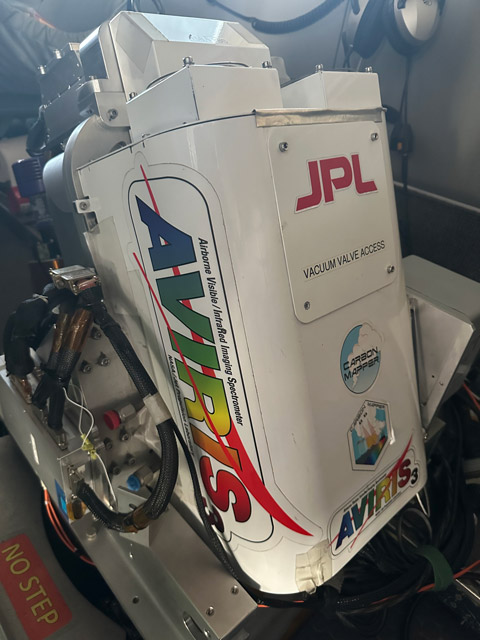
NASA’s AVIRIS sensors have been used to study wildfires, World Trade Center wreckage, and critical minerals, among numerous airborne missions over the years. AVIRIS-3 is seen here on a field campaign in Panama, where it helped analyze vegetation in many wavelengths of light not visible to human eyes.
For many plant species from crops to cacti, flowering is timed to seasonal swings in temperature, daylight, and precipitation. Scientists are taking a closer look at the relationship between plant life and seasons — known as vegetation phenology — to understand how rising temperatures and changing rainfall patterns may be impacting ecosystems.
Typically, wildflower surveys rely on boots-on-the-ground observations and tools such as time-lapse photography. But these approaches cannot capture broader changes that may be happening in different ecosystems around the globe, said lead author Yoseline Angel, a scientist at the University of Maryland-College Park and NASA’s Goddard Space Flight Center in Greenbelt, Maryland.
“One challenge is that compared to leaves or other parts of a plant, flowers can be pretty ephemeral,” she said. “They may last only a few weeks.”
To track blooms on a large scale, Angel and other NASA scientists are looking to one of the signature qualities of flowers: color.
Mapping Native Shrubs
Flower pigments fall into three major groups: carotenoids and betalains (associated with yellow, orange, and red colors), and anthocyanins (responsible for many deep reds, violets, and blues). The different chemical structures of the pigments reflect and absorb light in unique patterns.
Spectrometers allow scientists to analyze the patterns and catalog plant species by their chemical “fingerprint.” As all molecules reflect and absorb a unique pattern of light, spectrometers can identify a wide range of biological substances, minerals, and gases.
Handheld devices are used to analyze samples in the field or lab. To survey moons and planets, including Earth, NASA has developed increasingly powerful imaging spectrometers over the past 45 years.
Get the Latest JPL News
One such instrument is called AVIRIS-NG (short for Airborne Visible/InfraRed Imaging Spectrometer-Next Generation), which was built by JPL to fly on aircraft. In 2022 it was used in a large ecology field campaign to survey vegetation in the Jack and Laura Dangermond Preserve and the Sedgwick Reserve, both in Santa Barbara County. Among the plants observed were two native shrub species — Coreopsis gigantea and Artemisia californica — from February to June.
The scientists developed a method to tease out the spectral fingerprint of the flowers from other landscape features that crowded their image pixels. In fact, they were able to capture 97% of the subtle spectral differences among flowers, leaves, and background cover (soil and shadows) and identify different flowering stages with 80% certainty.
Predicting Superblooms
The results open the door to more air- and space-based studies of flowering plants, which represent about 90% of all plant species on land. One of the ultimate goals, Angel said, would be to support farmers and natural resource managers who depend on these species along with insects and other pollinators in their midst. Fruit, nuts, many medicines, and cotton are a few of the commodities produced from flowering plants.
Angel is working with new data collected by AVIRIS’ sister spectrometer that orbits on the International Space Station. Called EMIT (Earth Surface Mineral Dust Source Investigation), it was designed to map minerals around Earth’s arid regions. Combining its data with other environmental observations could help scientists study superblooms, a phenomenon where vast patches of desert flowers bloom after heavy rains.
One of the delights of researching flowers, Angel said, is the enthusiasm from citizen scientists. “I have social media alerts on my phone,” she added, noting one way she stays on top of wildflower activity around the world.
The wildflower study was supported as part of the Surface Biology and Geology High-Frequency Time Series (SHIFT) campaign. An airborne and field research effort, SHIFT was jointly led by the Nature Conservancy, the University of California, Santa Barbara, and JPL. Caltech, in Pasadena, manages JPL for NASA.
The AVIRIS instrument was originally developed through funding from NASA’s Earth Science Technology Office.