

In a first, researchers from NASA and Virginia Tech used satellite data to measure the height and speed of potentially hazardous flood waves traveling down U.S. rivers. The three waves they tracked were likely caused by extreme rainfall and by a loosened ice jam. While there is currently no database that compiles satellite data on river flood waves, the new study highlights the potential of space-based observations to aid hydrologists and engineers, especially those working in communities along river networks with limited flood control structures such as levees and flood gates.
Unlike ocean waves, which are ordinarily driven by wind and tides, and roll to shore at a steady clip, river waves (also called flood or flow waves) are temporary surges stretching tens to hundreds of miles. Typically caused by rainfall or seasonal snowmelt, they are essential to shuttling nutrients and organisms down a river. But they can also pose hazards: Extreme river waves triggered by a prolonged downpour or dam break can produce floods.
“Ocean waves are well known from surfing and sailing, but rivers are the arteries of the planet. We want to understand their dynamics,” said Cedric David, a hydrologist at NASA’s Jet Propulsion Laboratory in Southern California and a coauthor of a new study published May 14 in Geophysical Research Letters.
Measuring Speed and Size
To search for river waves for her doctoral research, lead author Hana Thurman of Virginia Tech turned to a spacecraft launched in 2022. The SWOT (Surface Water and Ocean Topography) satellite is a collaboration between NASA and the French space agency CNES (Centre National d’Études Spatiales). It is surveying the height of nearly all of Earth’s surface waters, both fresh and salty, using its sensitive Ka-band Radar Interferometer (KaRIn). The instrument maps the elevation and width of water bodies by bouncing microwaves off the surface and timing how long the signal takes to return.
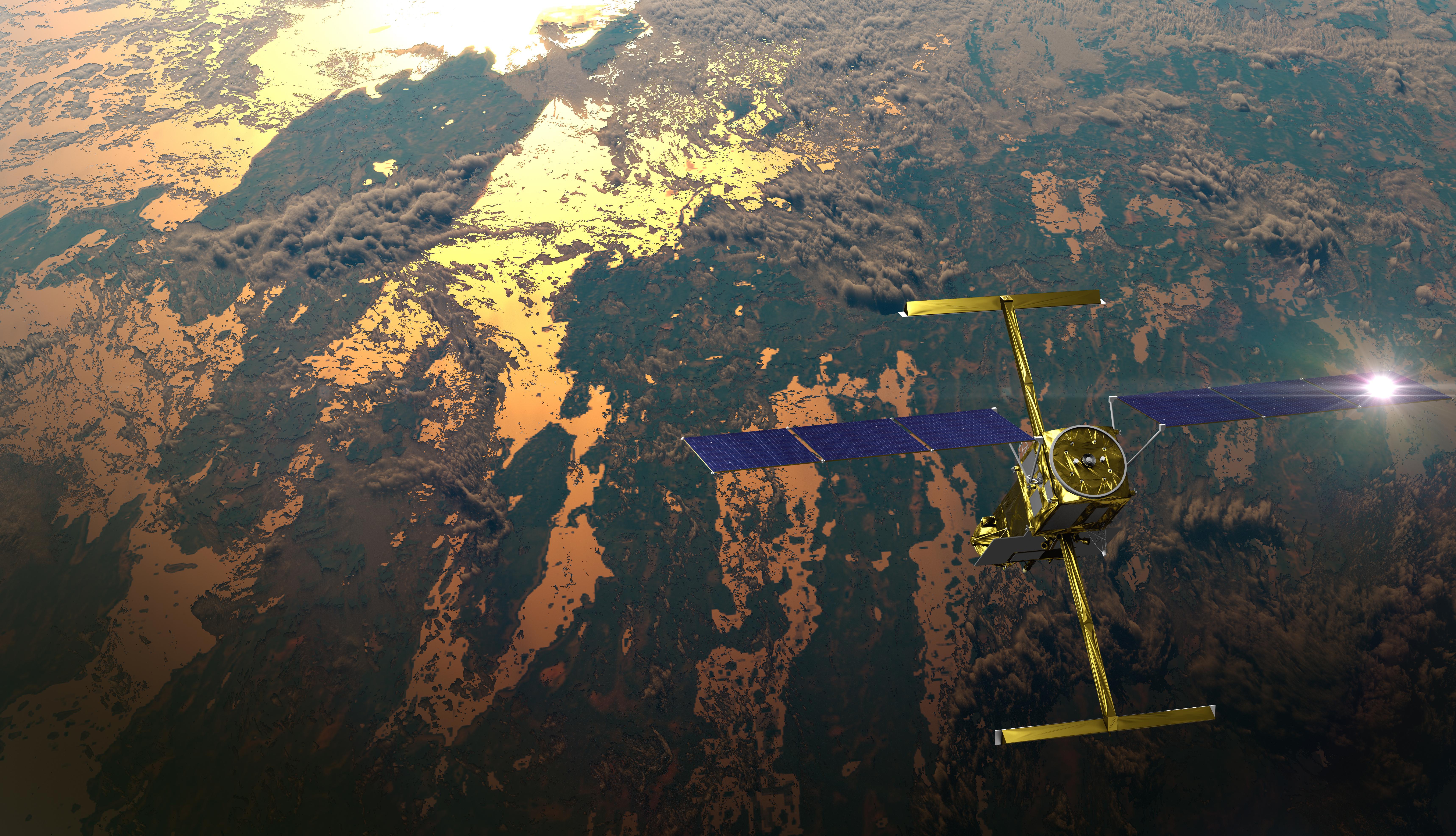
SWOT is depicted in orbit in this artist’s concept, with sunlight glinting off one of its solar panels and both antennas of its key instrument — the Ka-band Radar Interferometer (KaRIn) — extended. The antennas collect data along a swath 30 miles (50 kilometers) wide on either side of the satellite.
“In addition to monitoring total storage of waters in lakes and rivers, we zoom in on dynamics and impacts of water movement and change,” said Nadya Vinogradova Shiffer, SWOT program scientist at NASA Headquarters in Washington.
Thurman knew that SWOT has helped scientists track rising sea levels near the coast, spot tsunami slosh, and map the seafloor, but could she identify river height anomalies in the data indicating a wave on the move?
She found that the mission had caught three clear examples of river waves, including one that arose abruptly on the Yellowstone River in Montana in April 2023. As the satellite passed overhead, it observed a 9.1-foot-tall (2.8-meter-tall) crest flowing toward the Missouri River in North Dakota. It was divided into a dramatic 6.8-mile-long (11-kilometer-long) peak followed by a more drawn‐out tail. These details are exciting to see from orbit and illustrate the KaRIn instrument’s uniquely high spatial resolution, Thurman said.
Sleuthing through optical Sentinel-2 imagery of the area, she determined that the wave likely resulted from an ice jam breaking apart upstream and releasing pent-up water.
The other two river waves that Thurman and the team found were triggered by rainfall runoff. One, spotted by SWOT starting on Jan. 25, 2024, on the Colorado River south of Austin, Texas, was associated with the largest flood of the year on that section of river. Measuring over 30 feet (9 meters) tall and 166 miles (267 kilometers) long, it traveled around 3.5 feet (1.07 meters) per second for over 250 miles (400 kilometers) before discharging into Matagorda Bay.
The other wave originated on the Ocmulgee River near Macon, Georgia, in March 2024. Measuring over 20 feet (6 meters) tall and extending more than 100 miles (165 kilometers), it traveled about a foot (0.33 meters) per second for more than 124 miles (200 kilometers).
“We’re learning more about the shape and speed of flow waves, and how they change along long stretches of river,” Thurman said. “That could help us answer questions like, how fast could a flood get here and is infrastructure at risk?”
Complementary Observations
Engineers and water managers measuring river waves have long relied on stream gauges, which record water height and estimate discharge at fixed points along a river. In the United States, stream gauge networks are maintained by agencies including the U.S. Geological Survey. They are sparser in other parts of the world.
“Satellite data is complementary because it can help fill in the gaps,” said study supervisor George Allen, a hydrologist and remote sensing expert at Virginia Tech.
If stream gauges are like toll booths clocking cars as they pass, SWOT is like a traffic helicopter taking snapshots of the highway.
Get the JPL Newsletter
From Mars to the Milky Way—never miss a discovery! Delivered straight to your inbox.
The wave speeds that SWOT helped determine were similar to those calculated using gauge data alone, Allen said, showing how the satellite could help monitor waves in river basins without gauges. Knowing where and why river waves develop can help scientists tracking changing flood patterns around the world.
Orbiting Earth multiple times each day, SWOT is expected to observe some 55% of large-scale floods at some stage in their life cycle. “If we see something in the data, we can say something,” David said of SWOT’s potential to flag dangerous floods in the making. “For a long time, we’ve stood on the banks of our rivers, but we’ve never seen them like we are now.”
More About SWOT
The SWOT satellite was jointly developed by NASA and CNES, with contributions from the Canadian Space Agency (CSA) and the UK Space Agency. NASA’s Jet Propulsion Laboratory, managed for the agency by Caltech in Pasadena, California, leads the U.S. component of the project. For the flight system payload, NASA provided the Ka-band radar interferometer (KaRIn) instrument, a GPS science receiver, a laser retroreflector, a two-beam microwave radiometer, and NASA instrument operations. The Doppler Orbitography and Radioposition Integrated by Satellite system, the dual frequency Poseidon altimeter (developed by Thales Alenia Space), the KaRIn radio-frequency subsystem (together with Thales Alenia Space and with support from the UK Space Agency), the satellite platform, and ground operations were provided by CNES. The KaRIn high-power transmitter assembly was provided by CSA.