

Are we alone in the universe? An answer to that age-old question has seemed tantalizingly within reach since the discovery of ice-encrusted moons in our solar system with potentially habitable subsurface oceans. But looking for evidence of life in a frigid sea hundreds of millions of miles away poses tremendous challenges. The science equipment used must be exquisitely complex yet capable of withstanding intense radiation and cryogenic temperatures. What’s more, the instruments must be able to take diverse, independent, complementary measurements that together could produce scientifically defensible proof of life.
To address some of the difficulties that future life-detection missions might encounter, a team at NASA’s Jet Propulsion Laboratory in Southern California has developed OWLS, a powerful suite of science instruments unlike any other. Short for Oceans Worlds Life Surveyor, OWLS is designed to ingest and analyze liquid samples. It features eight instruments – all automated – that, in a lab on Earth, would require the work of several dozen people.

JPL’s OWLS combines powerful chemical-analysis instruments that look for the building blocks of life with microscopes that search for cells. This version of OWLS would be miniaturized and customized for use on future missions. Credit: NASA/JPL-Caltech
One vision for OWLS is to use it to analyze frozen water from a vapor plume erupting from Saturn’s moon Enceladus. “How do you take a sprinkling of ice a billion miles from Earth and determine – in the one chance you’ve got, while everyone on Earth is waiting with bated breath – whether there’s evidence of life?” said Peter Willis, the project’s co-principal investigator and science lead. “We wanted to create the most powerful instrument system you could design for that situation to look for both chemical and biological signs of life.”
OWLS has been funded by JPL Next, a technology accelerator program run by the Lab’s Office of Space Technology. In June, after a half-decade of work, the project team tested its equipment – currently the size of a few filing cabinets – on the salty waters of Mono Lake in California’s Eastern Sierra. OWLS found chemical and cellular evidence of life, using its built-in software to identify that evidence without human intervention.
“We have demonstrated the first generation of the OWLS suite,” Willis said. “The next step is to customize and miniaturize it for specific mission scenarios.”
The science autonomy software on JPL’s OWLS tracks particles as water flows past the microscope, using machine-learning algorithms to look for evidence of lifelike motion. Here, particle tracks that the autonomy believes belong to “motile” organisms are colored magenta.
Challenges, Solutions
A key difficulty the OWLS team faced was how to process liquid samples in space. On Earth, scientists can rely on gravity, a reasonable lab temperature, and air pressure to keep samples in place, but those conditions don’t exist on a spacecraft hurtling through the solar system or on the surface of a frozen moon. So the team designed two instruments that can extract a liquid sample and process it in the conditions of space.
Since it’s not clear what form life might take on an ocean world, OWLS also needed to include the broadest possible array of instruments, capable of measuring a size range from single molecules to microorganisms. To that end, the project joined two subsystems: one that employs a variety of chemical analysis techniques using multiple instruments, and one with several microscopes to examine visual clues.
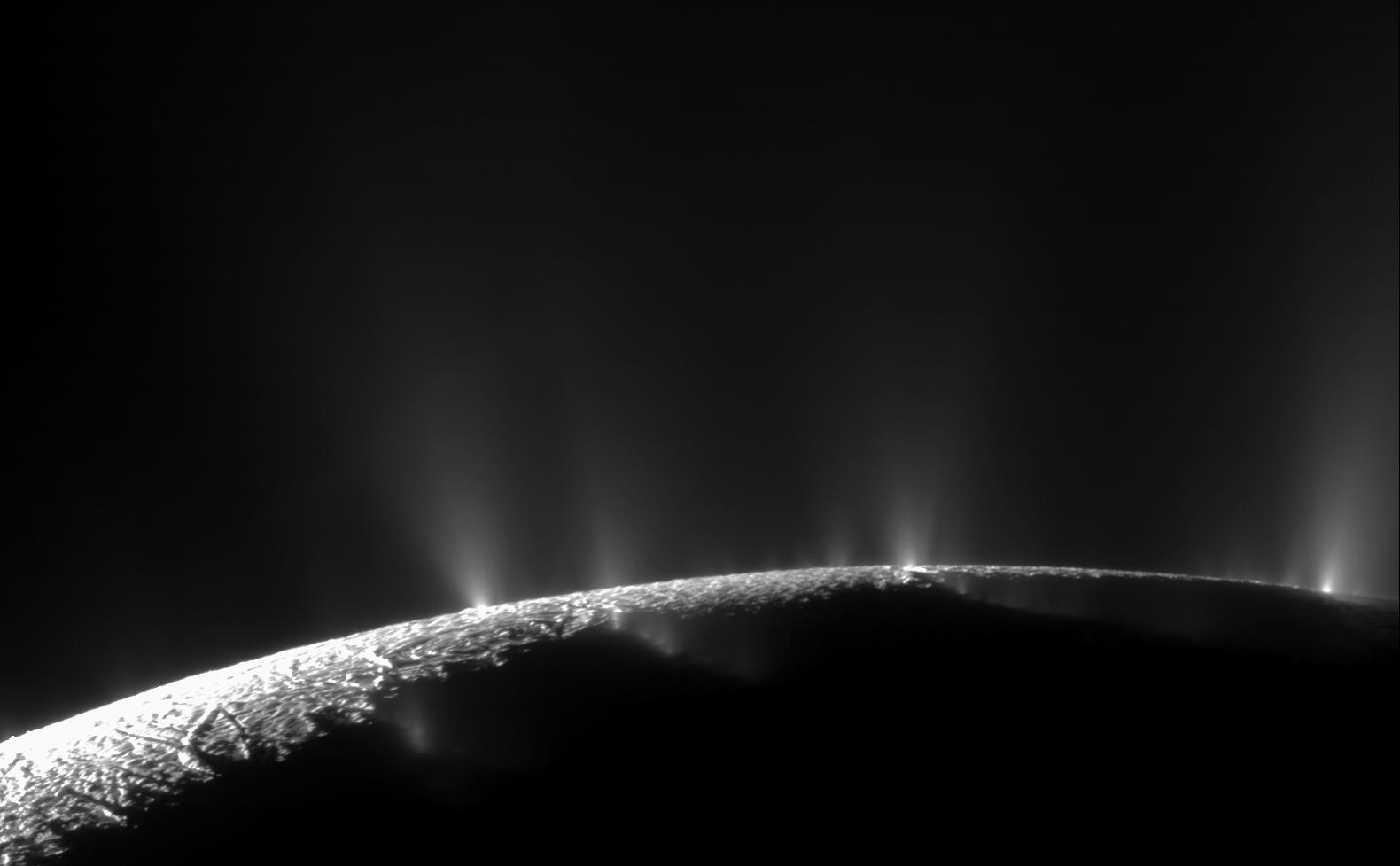
Water ice and vapor are seen spraying from Saturn’s frozen moon Enceladus, which hosts a hidden subsurface ocean, in this image captured by NASA’s Cassini mission during a 2010 flyby. OWLS is designed to ingest and analyze liquid samples from such plumes.
OWLS’ microscope system would be the first in space capable of imaging cells. Developed in conjunction with scientists at Portland State University in Oregon, it combines a digital holographic microscope, which can identify cells and motion throughout the volume of a sample, with two fluorescent imagers, which use dyes to observe chemical content and cellular structures. Together, they provide overlapping views at a resolution of less than a single micron, or about 0.00004 inches.
Dubbed Extant Life Volumetric Imaging System (ELVIS), the microscope subsystem has no moving parts – a rarity. And it uses machine-learning algorithms to both home in on lifelike movement and detect objects lit up by fluorescent molecules, whether naturally occurring in living organisms or as added dyes bound to parts of cells.
“It’s like looking for a needle in a haystack without having to pick up and examine every single piece of hay,” said co-principal investigator Chris Lindensmith, who leads the microscope team. “We’re basically grabbing big armfuls of hay and saying, ‘Oh, there’s needles here, here, and here.’”
To examine much tinier forms of evidence, OWLS uses its Organic Capillary Electrophoresis Analysis System (OCEANS), which essentially pressure-cooks liquid samples and feeds them to instruments that search for the chemical building blocks of life: all varieties of amino acids, as well as fatty acids and organic compounds. The system is so sensitive, it can even detect unknown forms of carbon. Willis, who led development of OCEANS, compares it to a shark that can smell just one molecule of blood in a billion molecules of water – and also tell the blood type. It would be only the second instrument system to perform liquid chemical analysis in space, after the Microscopy, Electrochemistry, and Conductivity Analyzer (MECA) instrument on NASA’s Phoenix Mars Lander.
Get the Latest JPL News
OCEANS uses a technique called capillary electrophoresis – basically, running an electric current through a sample to separate it into its components. The sample is then routed to three types of detectors, including a mass spectrometer, the most powerful tool for identifying organic compounds.
Sending It Home
These subsystems produce massive amounts of data, just an estimated 0.0001% of which could be sent back to faraway Earth because of data transmission rates that are more limited than dial-up internet from the 1980s. So OWLS has been designed with what’s called “onboard science instrument autonomy.” Using algorithms, computers would analyze, summarize, prioritize, and select only the most interesting data to be sent home while also offering a “manifest” of information still on board.
“We’re starting to ask questions now that necessitate more sophisticated instruments,” said Lukas Mandrake, the project’s instrument autonomy system engineer. “Are some of these other planets habitable? Is there defensible scientific evidence for life rather than a hint that it might be there? That requires instruments that take a lot of data, and that’s what OWLS and its science autonomy is set up to accomplish.”
For more about JPL’s OWLS project, go to: