JPL
Careers
Education
Science & Technology
JPL Logo
JPL Logo
Technology
.1 min read

NASA’s SunRISE Mission Targets No Earlier Than Mid-2027 Launch

Jet Propulsion Laboratory https://www.jpl.nasa.gov/ Oct. 6, 2026
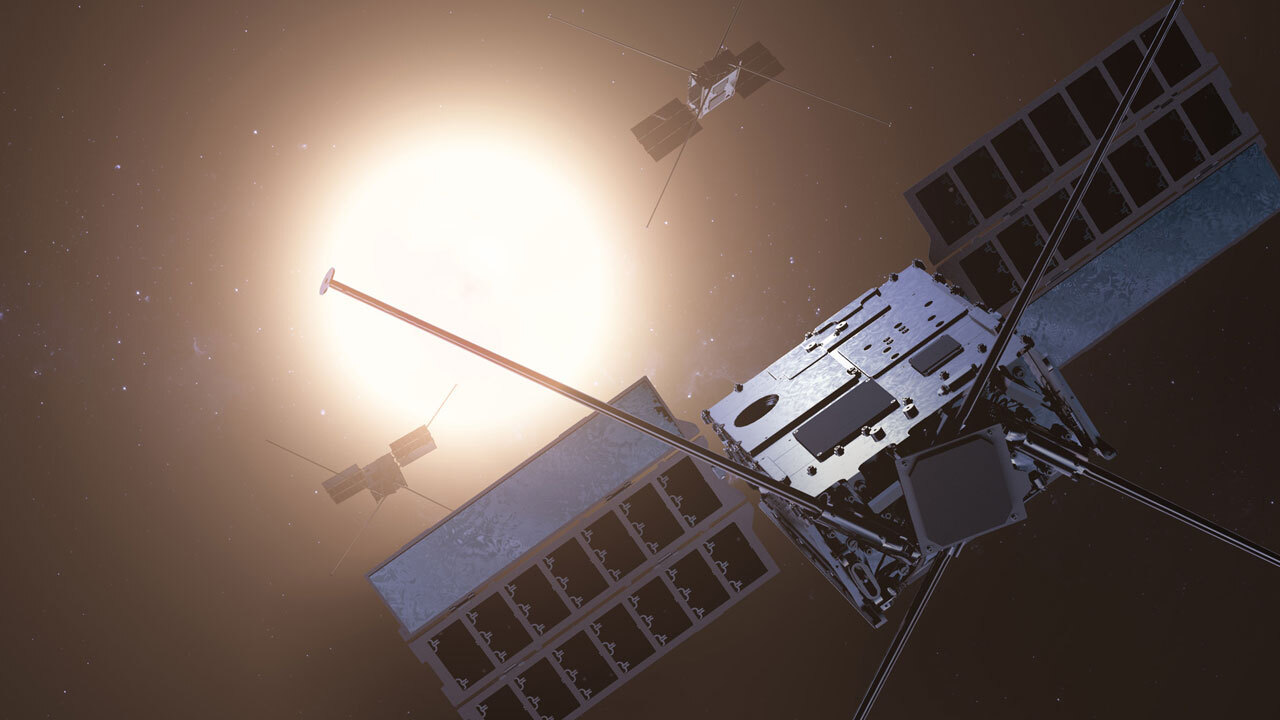
An illustration shows three small cube-shaped satellites with extended solar panels and long wire antennas orbiting in space against a brightly glowing, hazy sun.

NASA’s SunRISE mission is comprised of six small satellites that will fly in formation, as depicted in part in this artist’s concept. They will work as one large radio telescope to track the solar radio bursts generated by energetic particle events that may pose a hazard to satellites and astronauts.

Credit: Space Dynamics Laboratory

Six satellites, each the size of a toaster oven, will operate as a single giant radio dish to study the Sun.

NASA’s SunRISE (Sun Radio Interferometer Space Experiment) mission will launch no earlier than mid-2027. The heliophysics mission will hitch a ride on a SpaceX Falcon Heavy rocket from the agency’s Kennedy Space Center in Florida as a rideshare with a payload sponsored by the United States Space Force’s Space Systems Command.

The mission’s six toaster-oven-size small satellites, or SmallSats, will operate as one giant radio dish slightly above geosynchronous orbit, which is about 22,000 miles (35,000 kilometers) in altitude, and will track the rumbles of radio bursts coming from within the Sun’s atmosphere, or corona.

Read more here:

NASA SunRISE Launch Announcement


Get the JPL Newsletter

From Mars to the Milky Way—never miss a discovery! Delivered straight to your inbox.


Email Groups

Related News

Stars and Galaxies.

NASA’s SPHEREx Telescope Sees Menagerie of Brown Dwarfs

Technology.

NASA Selects Far-Infrared Telescope as First in New Mission Class

Earth.

How 2 US, European Satellites Are Studying Hurricanes During El Niño

Technology.

New Next-Gen Dish Adds Muscle to NASA’s Deep Space Network

Technology.

NASA Awards 2026 Innovative Technology Concepts

Technology.

NASA’s Quantum Lab Aboard Space Station Gets Chilly Upgrade

CubeSats and SmallSats.

NASA’s INCUS Mission on Road to Launch, Study Storms From Space

Earth.

NASA-developed AI Could Help Track Harmful Algae

Technology.

Hello Universe: NASA’s Next-Gen Space Processor Undergoes Testing

Mars.

NASA Pushes Next-Gen Mars Helicopter Rotor Blades Past Mach 1

About JPL
Who We Are
Directors
Careers
Internships
The JPL Story
JPL Achievements
Documentary Series
JPL Annual Report
Executive Council
Missions
Current
Past
Future
All
News
All
Earth
Solar System
Stars and Galaxies
Eyes on the News
Subscribe to JPL News
Galleries
Images
Videos
Audio
Podcasts
Apps
Visions of the Future
Slice of History
Robotics at JPL
Events
Lecture Series
Speakers Bureau
Calendar
Explore JPL
Visit
Public Tours
Virtual Tour
Directions and Maps
Explore JPL
Topics
JPL Life
Solar System
Mars
Earth
Climate Change
Exoplanets
Stars and Galaxies
Robotics
More
Asteroid Watch
NASA's Eyes Visualizations
Universe - Internal Newsletter
Social Media
Accessibility at NASA
Contact Us
Get the Latest from JPL
Follow Us

JPL is a federally funded research and development center managed for NASA by Caltech.

More from JPL
Careers
Education
Science & Technology
Acquisition
JPL Store
Careers
Education
Science & Technology
Acquisition
JPL Store
Related NASA Sites
Basics of Spaceflight
NASA Kids Science - Earth
Earth / Global Climate Change
Exoplanet Exploration
Mars Exploration
Solar System Exploration
Space Place
NASA's Eyes Visualization Project
Voyager Interstellar Mission
NASA
Caltech
Privacy
Image Policy
FAQ
Feedback
Version: v3.2.0 - 38db01a
Site Managers:Emilee Richardson, Alicia Cermak
Site Editors:Steve Carney
CL#:21-0018