
JPL
Careers
Education
Science & Technology
JPL Logo
JPL Logo
Asteroids and Comets
.1 min read

Dawn Maneuvering to Third Science Orbit

Jet Propulsion Laboratory https://www.jpl.nasa.gov/ July 17, 2015
This artist concept shows NASA's Dawn spacecraft above dwarf planet Ceres, as seen in images from the mission. NASA/JPL-Caltech › Full image and caption

NASA's Dawn spacecraft is using its ion propulsion system to descend to its third mapping orbit at Ceres, and all systems are operating well.

Mission Status Report

NASA's Dawn spacecraft is using its ion propulsion system to descend to its third mapping orbit at Ceres, and all systems are operating well. The spiral maneuvering over the next five weeks will take the spacecraft to an altitude of about 900 miles (less than 1,500 kilometers) above the dwarf planet.

The spacecraft experienced a discrepancy in its expected orientation on June 30, triggering a safe mode. Engineers traced this anomaly to the mechanical gimbal system that swivels ion engine #3 to help control the spacecraft's orientation during ion-thrusting. Dawn has three ion engines and uses only one at a time.
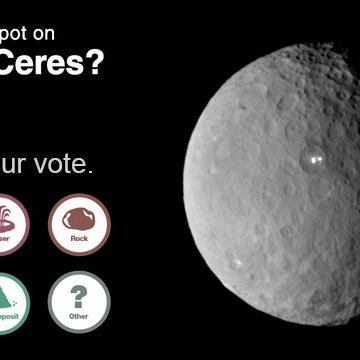
Guess what the bright spots are

Dawn's engineering team switched to ion engine #2, which is mounted on a different gimbal, and conducted tests with it from July 14 to 16. They have confirmed that the spacecraft is ready to continue with the exploration of Ceres.

By the end of the day on July 17, Dawn will have descended to an altitude of about 2,400 miles (3,900 kilometers). After arrival at its next mapping orbit -- called the High-Altitude Mapping Orbit, or HAMO -- in August, Dawn will begin taking images and other data at unprecedented resolution.

More information on the Dawn mission is online at:

http://www.nasa.gov/dawn

http://dawn.jpl.nasa.gov

News Media Contact

Elizabeth Landau

NASA Headquarters, Washington

202-358-0845

elandau@nasa.gov

2015-238

Related News

Mars.

NASA’s Psyche Mission to Fly by Mars for Gravity Assist

Asteroids and Comets.

NASA’s Next-Gen Near-Earth Asteroid Space Telescope Takes Shape

Mars.

NASA’s Perseverance, Curiosity Panoramas Capture Two Sides of Mars

Mars.

NASA’s Curiosity Finds Organic Molecules Never Seen Before on Mars

Solar System.

NASA Shuts Off Instrument on Voyager 1 to Keep Spacecraft Operating

Asteroids and Comets.

NASA’s DART Mission Changed Orbit of Asteroid Didymos Around Sun

Mars.

NASA’s Curiosity Rover Sees Martian ‘Spiderwebs’ Up Close

Mars.

NASA’s Perseverance Now Autonomously Pinpoints Its Location on Mars

Mars.

NASA’s Perseverance Rover Completes First AI-Planned Drive on Mars

Solar System.

NASA’s Juno Measures Thickness of Europa’s Ice Shell

About JPL
Who We Are
Directors
Careers
Internships
The JPL Story
JPL Achievements
Documentary Series
JPL Annual Report
Executive Council
Missions
Current
Past
Future
All
News
All
Earth
Solar System
Stars and Galaxies
Eyes on the News
Subscribe to JPL News
Galleries
Images
Videos
Audio
Podcasts
Apps
Visions of the Future
Slice of History
Robotics at JPL
Events
Lecture Series
Speakers Bureau
Calendar
Visit
Public Tours
Virtual Tour
Directions and Maps
Topics
JPL Life
Solar System
Mars
Earth
Climate Change
Exoplanets
Stars and Galaxies
Robotics
More
Asteroid Watch
NASA's Eyes Visualizations
Universe - Internal Newsletter
Social Media
Accessibility at NASA
Contact Us
Get the Latest from JPL
Follow Us

JPL is a federally funded research and development center managed for NASA by Caltech.

More from JPL
Careers
Education
Science & Technology
Acquisition
JPL Store
Careers
Education
Science & Technology
Acquisition
JPL Store
Related NASA Sites
Basics of Spaceflight
NASA Kids Science - Earth
Earth / Global Climate Change
Exoplanet Exploration
Mars Exploration
Solar System Exploration
Space Place
NASA's Eyes Visualization Project
Voyager Interstellar Mission
NASA
Caltech
Privacy
Image Policy
FAQ
Feedback
Version: v3.1.0 - 9d64141
Site Managers:Emilee Richardson, Alicia Cermak
Site Editors:Naomi Hartono, Steve Carney
CL#:21-0018