
JPL
Careers
Education
Science & Technology
JPL Logo
JPL Logo
Image

Curiosity Captures a 360-Degree View at ‘Nevado Sajama’
Jet Propulsion Laboratory https://www.jpl.nasa.gov/ April 27, 2026
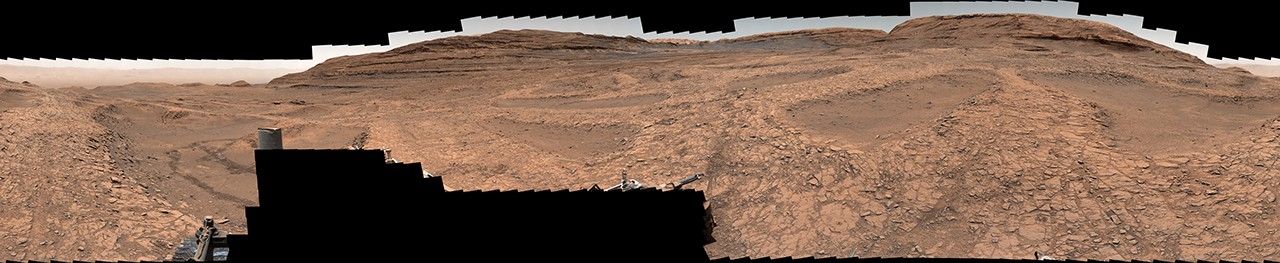
Description NASA’s Curiosity Mars rover captured this 360-degree view of a region filled with low ridges called boxwork formations between Nov. 9 and Dec. 7, 2025 (the 4,714th to 4,741st Martian days, or sols, of the mission). At 1.5 billion pixels,...

Figure A (PNG - 1.79 GB)

Figure B (PNG - 276.01 MB)

NASA’s Curiosity Mars rover captured this 360-degree view of a region filled with low ridges called boxwork formations between Nov. 9 and Dec. 7, 2025 (the 4,714th to 4,741st Martian days, or sols, of the mission). At 1.5 billion pixels, this is one of the largest panoramas Curiosity has ever taken (the rover’s largest panorama of all time is 1.8 billion pixels). This newer panorama is made up of 1,031 individual images captured by Curiosity’s Mastcam using its right camera, which has a 100-millimeter focal length lens. The images were later sent to Earth and stitched together into the full panorama.

The images were taken at a ridgetop site nicknamed “Nevado Sajama,” where Curiosity collected a rock sample using a drill on the end of its robotic arm. Since May 2025, Curiosity has been exploring a region full of geologic formations called boxwork, which crisscross the surface for miles and look like giant spiderwebs when viewed from space. The new panorama shows them as they really are: low ridges standing roughly 3 to 6 feet (1 to 2 meters) tall and about 30 feet (9 meters) across with sandy hollows in between.

Figure A is a high-resolution version of this panorama (1.8 gigabytes).

Figure B is a lower-resolution version of the panorama (276 megabytes) captured by Mastcam’s left camera, which has a 34-millimeter focal length lens. This version includes the rover’s deck, which is often left out of such imagery in order to reduce the amount of data relayed back to Earth.

Curiosity was built by NASA’s Jet Propulsion Laboratory, which is managed by Caltech in Pasadena, California. JPL leads the mission on behalf of NASA’s Science Mission Directorate in Washington as part of NASA’s Mars Exploration Program portfolio. Malin Space Science Systems in San Diego built and operates Mastcam.

To learn more about Curiosity, visit:

science.nasa.gov/mission/msl-curiosity

Download JPG
Mission
  • Curiosity Rover
Target
  • Mars
Spacecraft
  • Curiosity
Instrument
  • Mastcam
Credit
NASA/JPL-Caltech/MSSS

Keep Exploring

Six Years of Curiosity’s Wheels on the Move

Curiosity Surveys the Boxwork Region

Curiosity Studies Nodules on Boxwork Formations

About JPL
Who We Are
Directors
Careers
Internships
The JPL Story
JPL Achievements
Documentary Series
JPL Annual Report
Executive Council
Missions
Current
Past
Future
All
News
All
Earth
Solar System
Stars and Galaxies
Eyes on the News
Subscribe to JPL News
Galleries
Images
Videos
Audio
Podcasts
Apps
Visions of the Future
Slice of History
Robotics at JPL
Events
Lecture Series
Speakers Bureau
Calendar
Visit
Public Tours
Virtual Tour
Directions and Maps
Topics
JPL Life
Solar System
Mars
Earth
Climate Change
Exoplanets
Stars and Galaxies
Robotics
More
Asteroid Watch
NASA's Eyes Visualizations
Universe - Internal Newsletter
Social Media
Accessibility at NASA
Contact Us
Get the Latest from JPL
Follow Us

JPL is a federally funded research and development center managed for NASA by Caltech.

More from JPL
Careers
Education
Science & Technology
Acquisition
JPL Store
Careers
Education
Science & Technology
Acquisition
JPL Store
Related NASA Sites
Basics of Spaceflight
NASA Kids Science - Earth
Earth / Global Climate Change
Exoplanet Exploration
Mars Exploration
Solar System Exploration
Space Place
NASA's Eyes Visualization Project
Voyager Interstellar Mission
NASA
Caltech
Privacy
Image Policy
FAQ
Feedback
Version: v3.1.3 - 5e83a9a
Site Managers:Emilee Richardson, Alicia Cermak
Site Editors:Naomi Hartono, Steve Carney
CL#:21-0018