

Ocean Worlds Life Surveyor
Does life exist beyond Earth?
For decades, many have sought to answer this question. Uncovering the truth not only broadens our understanding of the universe but also has the potential to yield vital information about the formation of our planet. How did life begin on Earth, how will life evolve, and how will our planet change as life develops? NASA’s quest for life beyond Earth is an ongoing effort spread across multiple studies and missions designed to answer this very question. And with the opportunity to look towards ocean worlds, the answer may not be as distant as expected.
Why is OWLS an answer?
The ocean worlds of Europa, Enceladus, Titan, Ganymede, and Ceres are some of the primary candidates in the search for life in our Solar System. Their watery and icy environments resemble those on Earth at various points in its history.
The Ocean Worlds Life Surveyor (OWLS) is the first life detection suite to explore a wide range of size scales, from single molecules to microscopic organisms, in a water sample.
OWLS is an integrated, portable, and autonomous life-detection instrument suite designed to identify and characterize life on ocean worlds.
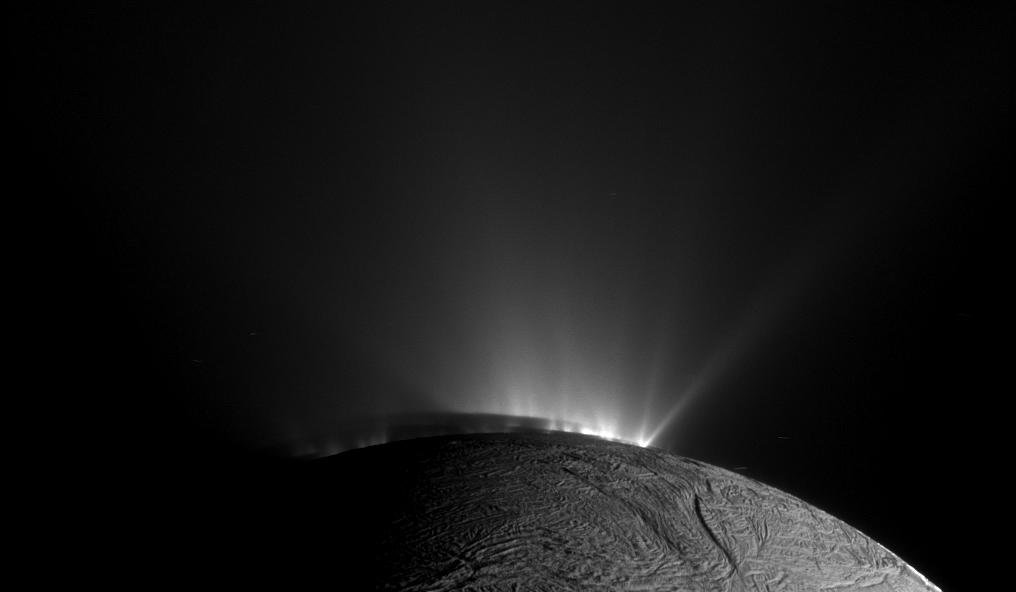
The OWLS instrument suite detects evidence of life in the form of molecules and cells. These lines of evidence are required in the search for life on ocean worlds such as Enceladus. Missions of exploration to Enceladus (shown above) are highlighted as top priorities in the Planetary Science and Astrobiology Decadal Survey 2023-2032. (Image of Enceladus taken with the Cassini narrow angle camera on November 30, 2010.)
Once a water sample is collected, OWLS identifies evidence for life at molecular and cellular levels by combining chemical analysis with high-resolution microscopy.

OWLS searches for evidence of life at a wide range of size scales. Chemical analysis identifies organic building blocks of life, while microscopy, aided by fluorescent dyes, observes cell properties and motion.
The chemical analysis system uses separation science coupled with multiple detection modes, including mass spectrometry. These modes provide a broad range and highly sensitive characterization of potential biomolecules in a collected sample.
The microscopy uses both holographic and lightfield techniques to enable high-resolution and fluorescent imaging of large sample volumes.
While operating on distant ocean worlds, any evidence of life must be communicated with minimal data volume. To achieve 1000X reduction in data, the instrument suite relies on science autonomy algorithms that summarize and prioritize onboard data, ensuring that the most compelling evidence is downlinked to scientists first.
OWLS will integrate two state-of-the-art instrument subsystems: the Organic Capillary Electrophoresis Analysis System (OCEANS) and the Extant Life Volumetric Imaging System (ELVIS).

Some liquid samples are sent to the ELVIS microscope suite, while others undergo the extraction process and are then sent to OCEANS for chemical analysis.