JPL
Careers
Education
Science & Technology
JPL Logo
JPL Logo
Solar System.

Voyager Image Gallery

45 Years of Voyager I and II

Launched in 1977, NASA’s twin Voyager spacecraft inspired the world with pioneering visits to Jupiter, Saturn, Uranus, and Neptune. Their journey continues 45 years later as both probes explore interstellar space, the region outside the protective heliosphere created by our Sun. Researchers – some younger than the spacecraft – are now using Voyager data to solve mysteries of our solar system and beyond.

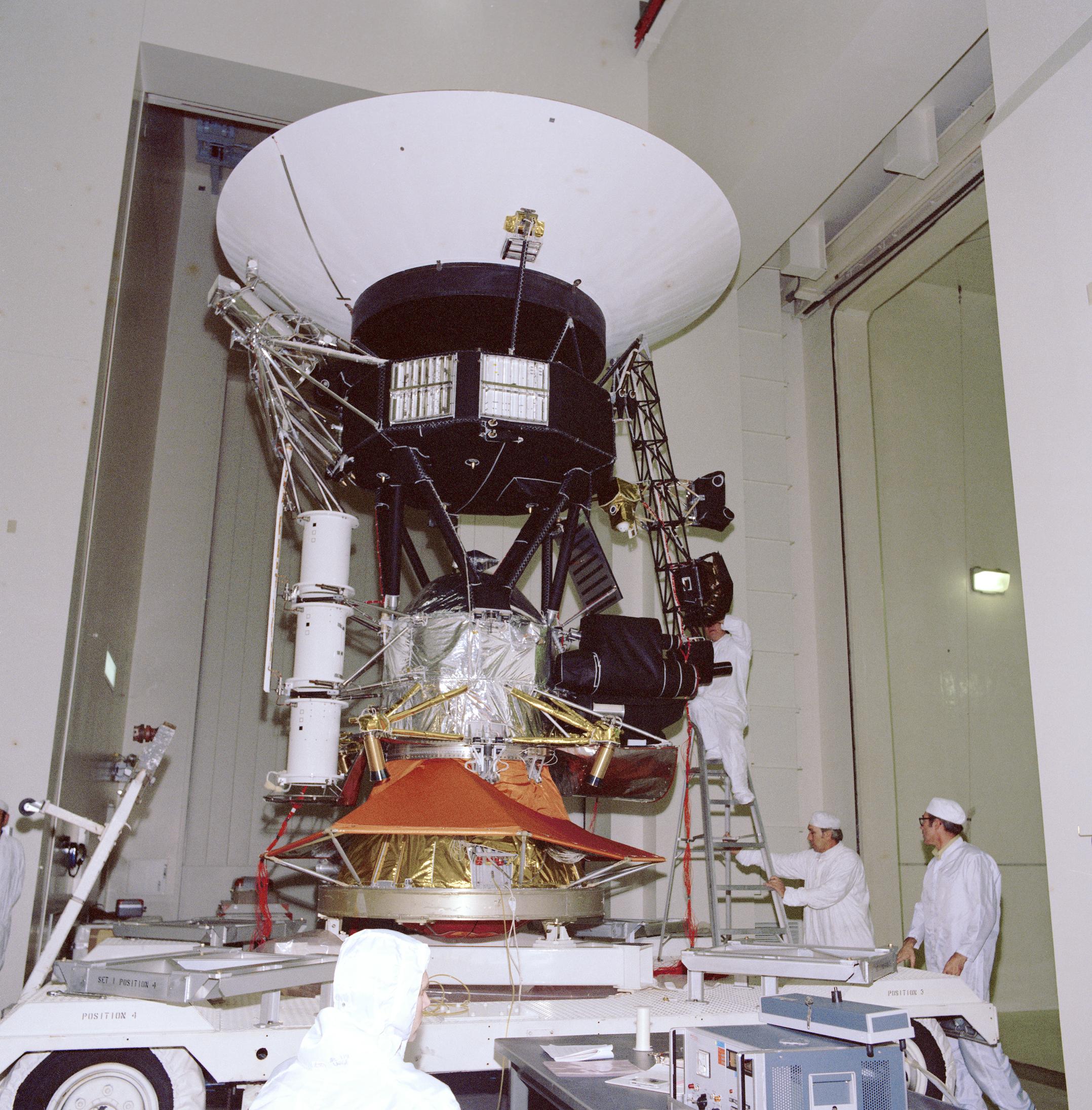
This archival photo shows engineers working on vibration acoustics and pyro shock testing of NASA's Voyager on November 18, 1976.

This archival photo shows engineers working on vibration acoustics and pyro shock testing of NASA’s Voyager on Nov. 18, 1976.

Credit: NASA/JPL-Caltech
Full Image Details
This image highlights the special cargo onboard NASA's Voyager spacecraft: the Golden Record. Each of the two Voyager spacecraft launched in 1977 carry a 12-inch gold-plated phonograph record with images and sounds from Earth.
Credit: NASA/JPL-Caltech
Full Image Details
This processed color image of Jupiter was produced in 1990 by the U.S. Geological Survey from a Voyager image captured in 1979. Zones of light-colored, ascending clouds alternate with bands of dark, descending clouds.
Credit: NASA/JPL/USGS
Full Image Details
This photo of Jupiter was taken by NASA's Voyager 1 on the evening of March 1, 1979, from a distance of 2.7 million miles (4.3 million kilometers). The photo shows Jupiter's Great Red Spot (top) and one of the white ovals.
Credit: NASA/JPL
Full Image Details
Volcanic explosion on Io: NASA's Voyager 1 acquired this image of Io on March 4 at 5:30 p.m. (PST) about 11 hours before closest approach to the Jupiter moon.

NASA’s Voyager 1 acquired this image of a volcanic explosion on Io on March 4, 1979, about 11 hours before the spacecraft’s closest approach to the moon of Jupiter.
Credit: NASA/JPL
Full Image Details
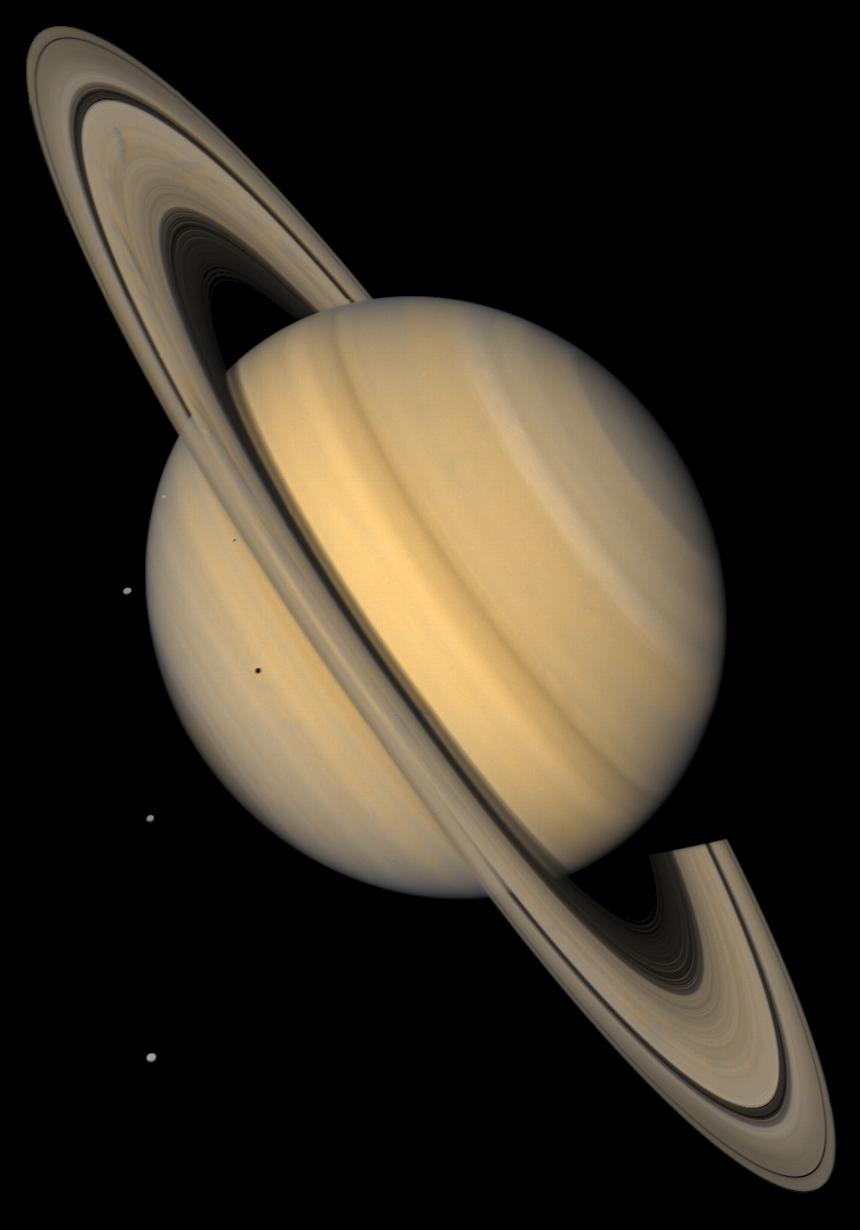
This approximate natural-color image from NASA's Voyager 2 shows Saturn, its rings, and four of its icy satellites. Three satellites Tethys, Dione, and Rhea are visible against the darkness of space.
Credit: NASA/JPL/USGS
Full Image Details
Neptune's blue-green atmosphere is shown in greater detail than ever before by NASA's Voyager 2 spacecraft as it rapidly approaches its encounter with the giant planet. This color image shows several complex and puzzling atmospheric features.
Credit: NASA/JPL
Full Image Details
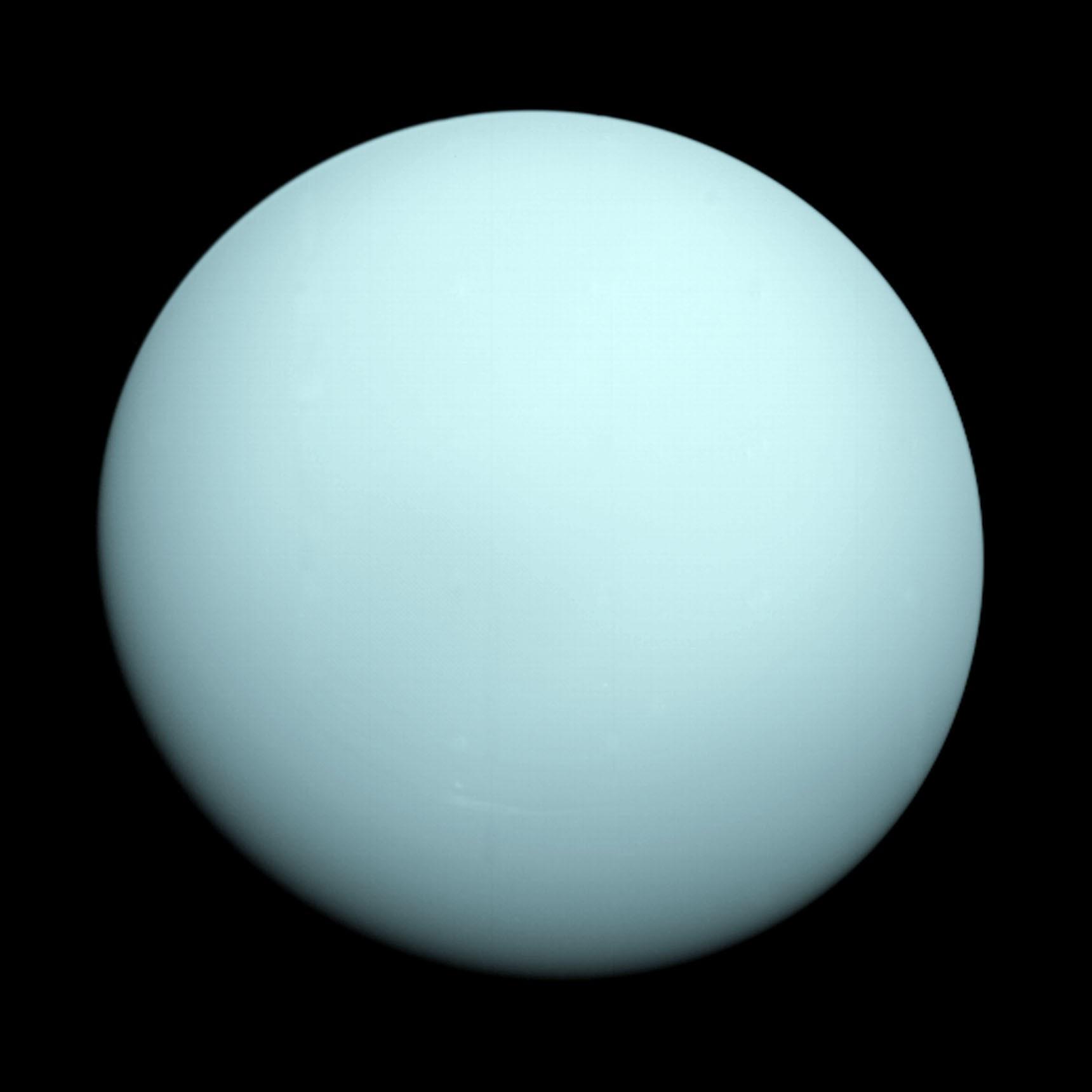
This is an image of the planet Uranus taken by the spacecraft Voyager 2 in 1986.
Credit: NASA/JPL-Caltech
Full Image Details
This image, taken by NASA's Voyager 2 early in the morning of Aug. 23, 1989, is a false color image of Triton, Neptune's largest satellite; mottling in the bright southern hemisphere is present.
Credit: NASA/JPL
Full Image Details
This image shows an updated version of the iconic Pale Blue Dot image taken by the Voyager 1 spacecraft.

This updated version of the iconic "Pale Blue Dot" image taken by the Voyager 1 spacecraft uses modern image-processing software and techniques to revisit the well-known Voyager view while attempting to respect the original data and intent of those who planned the images.
Credit: NASA/JPL-Caltech
Full Image Details
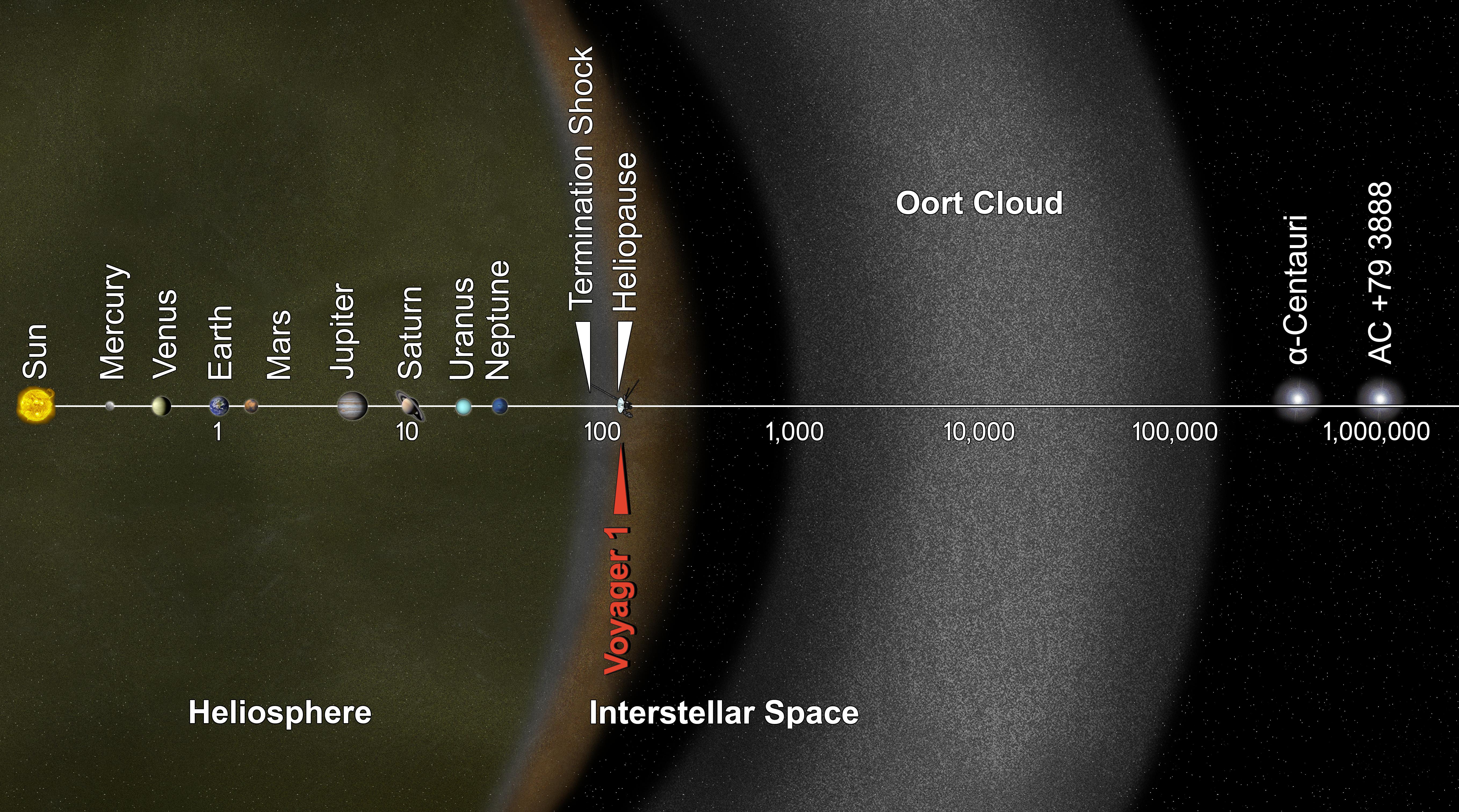
Voyager 1 has entered interstellar space. NASA's spacecraft, which rose from Earth on a September morning 36 years ago, has traveled farther than anyone, or anything, in history.

This illustrated graphic was made to mark Voyager 1’s entry into interstellar space in 2012. It puts solar system distances in perspective, with the scale bar in astronomical units and each set distance beyond 1 AU (the average distance between the Sun and Earth) representing 10 times the previous distance.
Credit: NASA/JPL-Caltech
Full Image Details
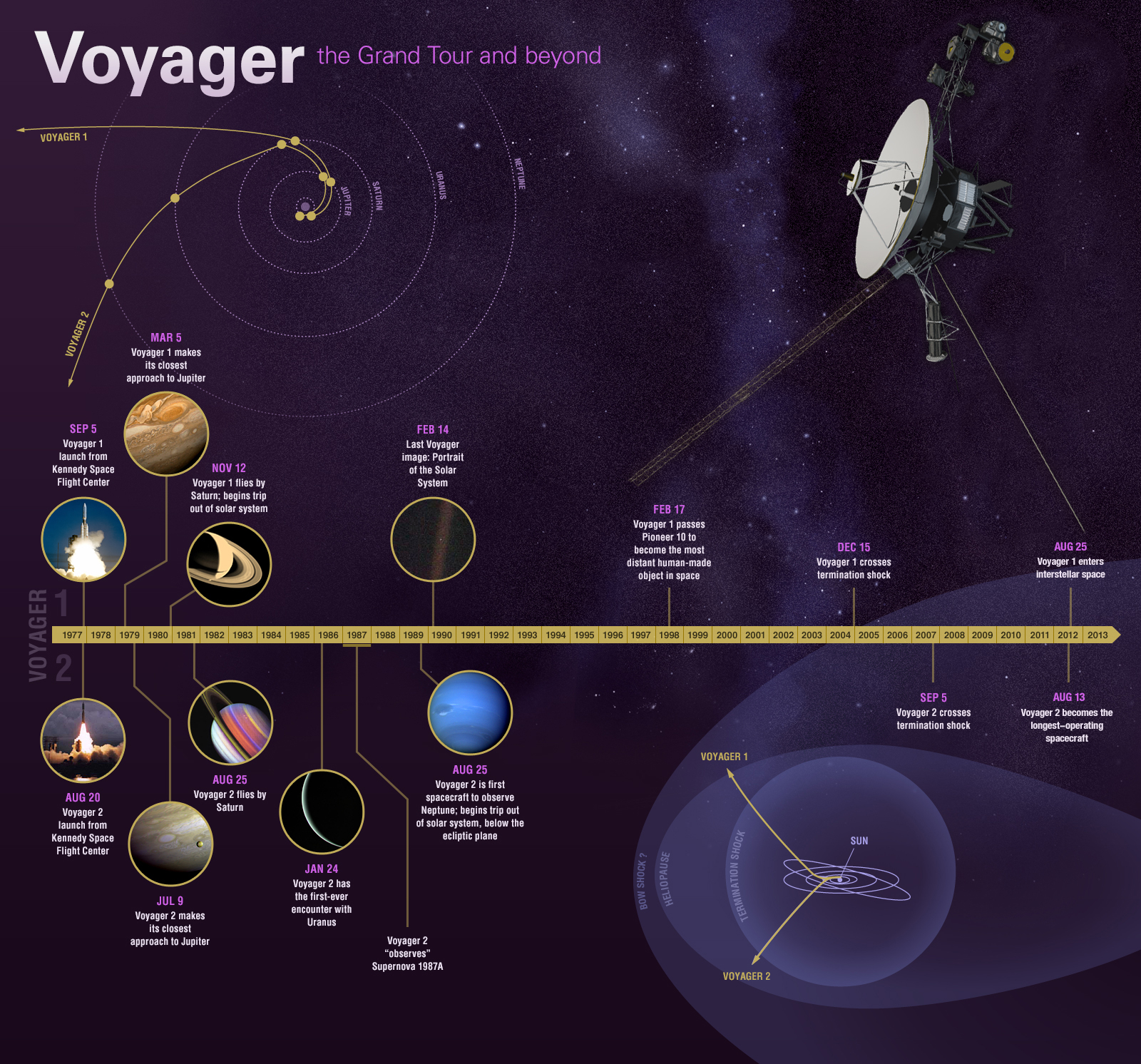
Voyager Mission Timeline

This graphic highlights some of the Voyager mission’s key accomplishments. Credit: NASA/JPL-Caltech
Full image details

Voyager 2: By the Numbers

This graphic provides some of the mission’s key statistics from 2018, when NASA’s Voyager 2 probe exited the heliosphere. Credit: NASA/JPL-Caltech Full image details

About JPL
Who We Are
Directors
Careers
Internships
The JPL Story
JPL Achievements
Documentary Series
JPL Annual Report
Executive Council
Missions
Current
Past
Future
All
News
All
Earth
Solar System
Stars and Galaxies
Eyes on the News
Subscribe to JPL News
Galleries
Images
Videos
Audio
Podcasts
Apps
Visions of the Future
Slice of History
Robotics at JPL
Events
Lecture Series
Speakers Bureau
Calendar
Visit
Public Tours
Virtual Tour
Directions and Maps
Topics
JPL Life
Solar System
Mars
Earth
Climate Change
Exoplanets
Stars and Galaxies
Robotics
More
Asteroid Watch
NASA's Eyes Visualizations
Universe - Internal Newsletter
Social Media
Accessibility at NASA
Contact Us
Get the Latest from JPL
Follow Us

JPL is a federally funded research and development center managed for NASA by Caltech.

More from JPL
Careers
Education
Science & Technology
Acquisition
JPL Store
Careers
Education
Science & Technology
Acquisition
JPL Store
Related NASA Sites
Basics of Spaceflight
NASA Kids Science - Earth
Earth / Global Climate Change
Exoplanet Exploration
Mars Exploration
Solar System Exploration
Space Place
NASA's Eyes Visualization Project
Voyager Interstellar Mission
NASA
Caltech
Privacy
Image Policy
FAQ
Feedback
Version: v3.0.29 - 4bc7967
Site Managers:Emilee Richardson, Alicia Cermak
Site Editors:Naomi Hartono, Steve Carney
CL#:21-0018