
Science papers and poster presentations on Voyager's encounter with Neptune were scheduled Dec. 4-5, the first two days of the 5-day 1989 Fall Meeting of the American Geophysical Union at San Francisco.
Members of the Voyager science teams from various institutions in addition to NASA's Jet Propulsion Laboratory, have been analyzing Voyager 2 data since the August encounter in preparation for first publication of their papers in Science magazine in December.
Dr. Edward Stone of the California Institute of Technology, project scientist for the Voyager 1 and 2 missions, is to chair the day long sessions, and additionally planned public presentation on the encounter at the Cathedral Hill Hotel Tuesday night, Dec. 5.
The spacecraft made its closest approach to Neptune Aug. 25, observed the large moon Triton few hours later and then continued downward from the ecliptic plane for the final part of its mission, to search for the end of the sun's influence in space.
During its final planetary encounter at Neptune, Voyager 2 passed by the swirling blue cloud-tops of the planet at little more than 3,000 miles. It sailed past icy, pink and blue Triton, returning images of the surface of the moon and at least two 5mile high geysers.
Voyager science data has determined Neptune's rotation of 16 hours, 7 minutes. It revealed probable interior of mixture of liquified gases, melted ice and melted rock with an outer layer of hydrogen, helium and methane.
Voyager also revealed that Neptune is the densest of the four giant outer planets, about 64 percent denser than if it were composed entirely of water.
Earth-based telescope observations had hinted for years at cloud systems on Neptune, but Voyager 2's cameras returned spectacular images of southern latitude storm system, called by scientists the Great Dark Spot.
About as large as Earth's diameter, 8,000 miles across, the storm circles Neptune in retrograde direction, opposite the planet's rotation. It is in an atmospheric zone with winds of more than 700 miles per hours.
The Voyager 2 spacecraft found six new moons and confirmed that Neptune does have complete rings, not just ring arcs, as had been thought.
The most surprising find, however, were the volcano-like geysers on the frozen surface of Triton probably driven by gaseous nitrogen.
Stone said it is surprising that geysers would be active in the moon's surface temperature of minus 400 degrees Fahrenheit and surface pressure of only 14 microbars, or 14-millionths of the sea-level pressure on Earth.
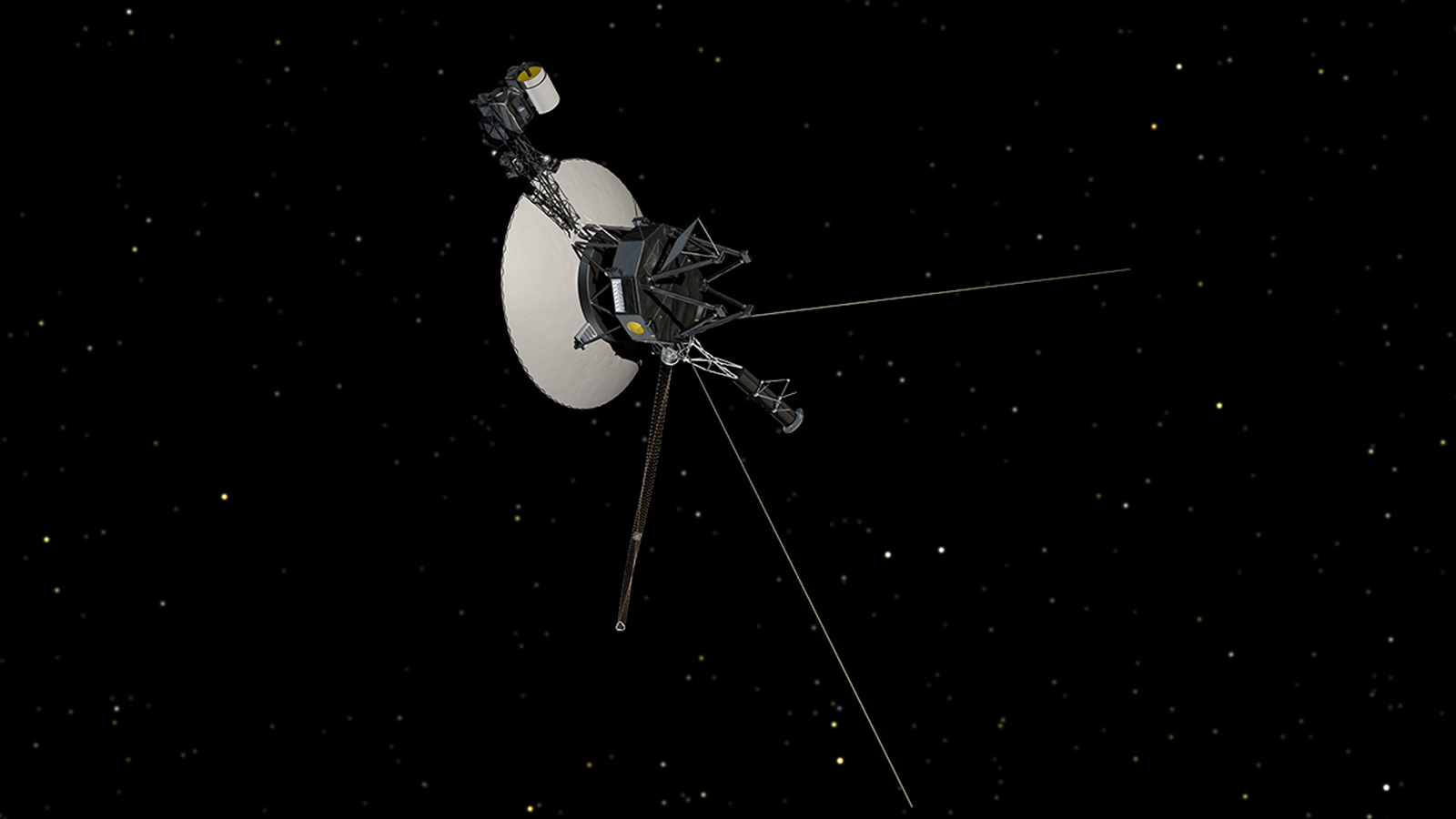
The Neptune encounter marked the end of the Voyager 2 planetary exploration phase and the beginning of its interstellar mission. Voyager 1 completed its planetary exploration phase as it left Saturn in 1980 and is currently searching above the ecliptic plane for the outer boundary of the solar wind.
The Voyagers are controlled, and their data returned, through NASA's Deep Space Network complexes in California's Mojave Desert, near Madrid, Spain, and near Canberra, Australia.
The Voyager project is managed by the Jet Propulsion Laboratory in Pasadena, Calif., for NASA's Office of Space Science and Applications.
818-354-5011