
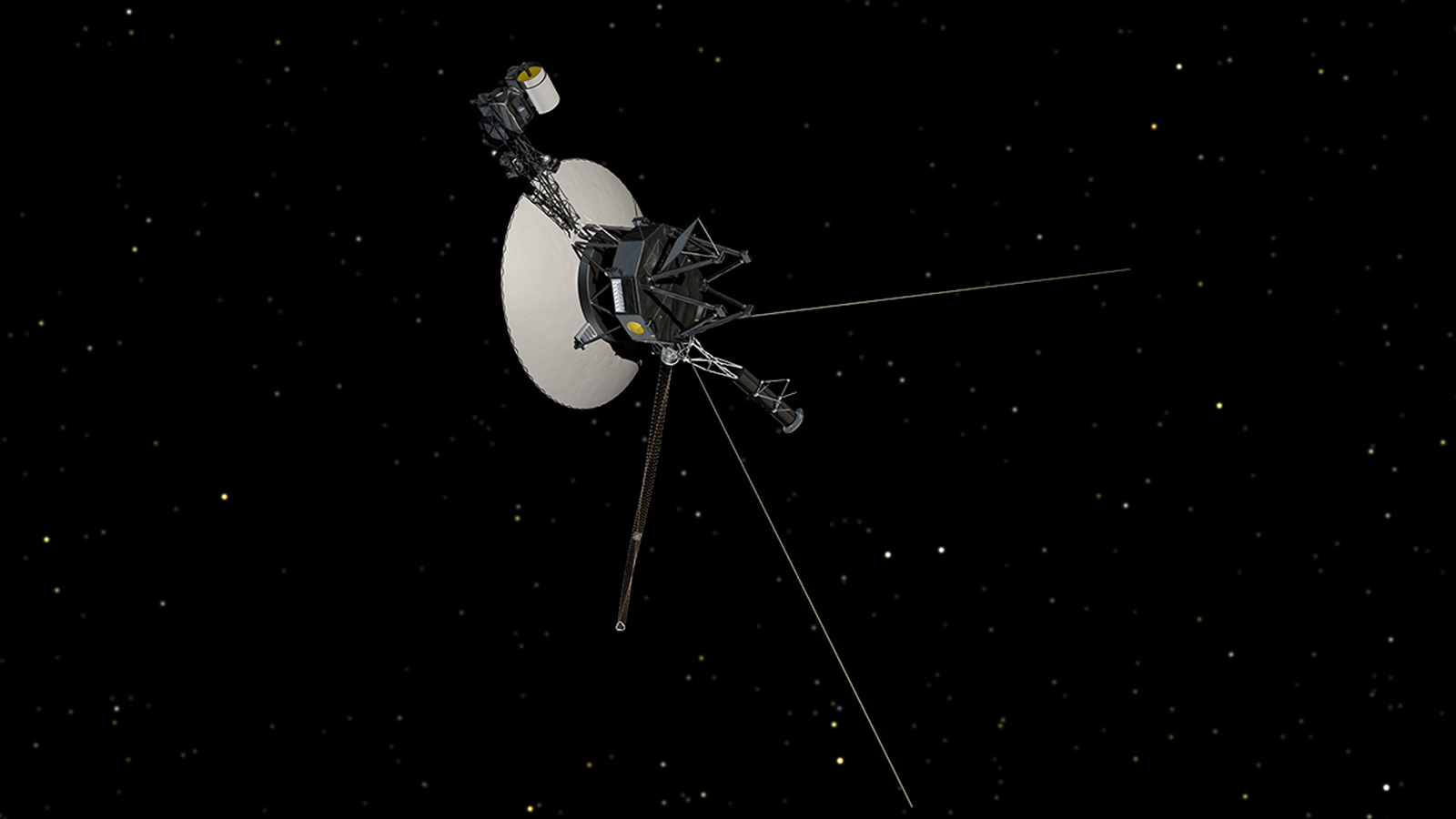
With one of its two spacecraft en route to distant Neptune and the other exploring the outer solar system, the Voyager Mission celebrates its 10th anniversary of launch on Aug. 20.
Voyagers 1 and 2, launched by NASA in August and September 1977, have logged billions of miles over the past decade executing flybys of the giant planets Jupiter, Saturn and Uranus. The two unmanned craft have relayed staggering amount of data on each of the planetary systems, in the process discovering such phenomena as new moons, rings and the first active volcano in space.
After Voyager 2's encounter with Neptune in August 1989, the two spacecraft will continue out of the solar system in search of the heliopause, the outer boundary of the Sun's energy influence.
The mission, managed by JPL for NASA, was originally conceived because of rare alignment of the planets that only occurs approximately every 170 years. The alignment would allow single spacecraft to visit each of the four giant gaseous planets, using the gravity of each in slingshot-like effect to propel the spacecraft on to the next planet.
The Voyagers initially were scheduled only to fly by Jupiter and Saturn, but the mission's success prompted NASA to extend it with flybys of Uranus and Neptune.
Voyager 2 was launched Aug. 20, 1977, followed by Voyager 1 on Sept. 5 of that year. Because of its trajectory, Voyager 1 overtook its twin and arrived first at Jupiter on March 5, 1979. Voyager 1 flew by Saturn on Nov. 12, 1980; its flight path at that planet then took it up and away from the ecliptic, the plane in which most of the planets orbit the Sun.
Voyager 2 encountered Jupiter on July 9, 1979, followed by Saturn flyby Aug. 25, 1981. Voyager 2 then continued on to flyby of Uranus on Jan. 24, 1986. It is currently scheduled to encounter Neptune on Aug. 24, 1986.
Highlights of the mission at Jupiter include discovery of active volcanoes on Jupiter's moon Io; detailed photos of Jupiter's atmosphere, including the Great Red Spot, and the surfaces of the planet's four major moons; discovery of three new, smaller moons; detection of lightning bolts in Jupiter's upper atmosphere; and discovery of faint, narrow ring system encircling the planet.
At Saturn, the Voyagers revealed high-resolution details of the planet's celebrated rings, including ring spokes and braiding features; discovered six new moons; and relayed photos of Saturn's larger moons.
During its Uranus flyby, Voyager 2 discovered 10 new moons and offered the first detailed look at the distant planet's ring system. The spacecraft also returned photos of the planet's five large moons -- among them Miranda, which JPL scientists said exhibits the most bizarre geography of any body yet visited in the solar system.
The Voyager Project recently released photo Voyager 2 recorded earlier this year of Neptune and its moon Triton. With the spacecraft still 1.4 billion kilometers (853 million miles) away from the planet, Neptune and Triton appear as small dots, comparable to the best photos that can be taken by Earth-based telescopes. Successively better photos are expected during the next two years as the spacecraft closes in on the planet.
On the anniversaries of their launches, Voyagers 1 and 2 will have traveled total of 6.3 billion km (3.9 billion miles) and 5.9 billion km (3.7 billion miles) respectively.
At JPL, Norman R. Haynes is Voyager project manager. Dr. Edward C. Stone of the California Institute of Technology is project scientist. JPL manages the Voyager Project for NASA's Office of Space Science and Applications.
818-354-5011