
JPL
Careers
Education
Science & Technology
JPL Logo
JPL Logo
Solar System
.2 min read

Voyager 2 Discovers Eruption on Triton

Jet Propulsion Laboratory https://www.jpl.nasa.gov/ Oct. 2, 1989
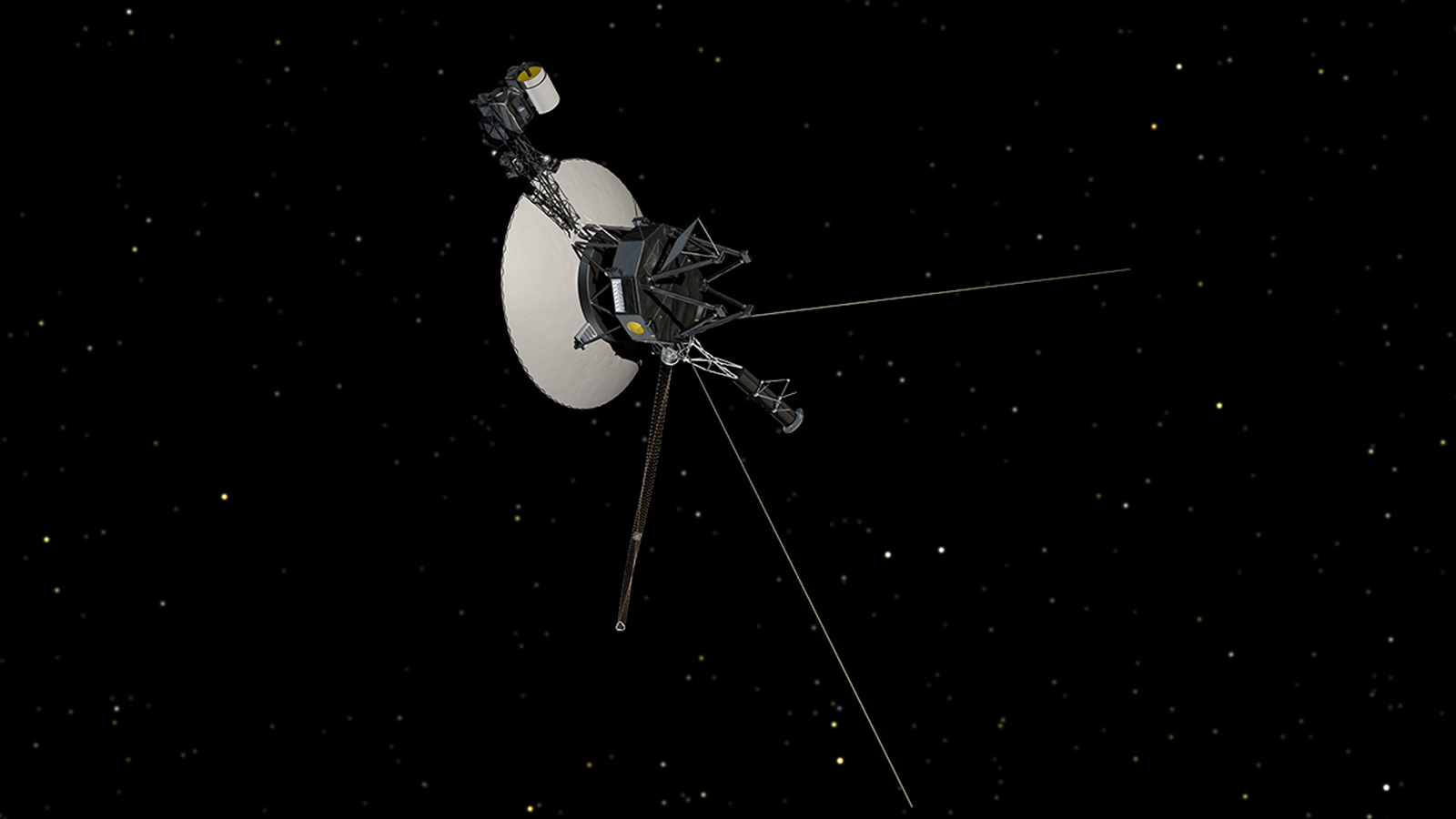
This artist's concept shows NASA's Voyager spacecraft against a backdrop of stars

five-mile-tall, geyser-like plume of dark material has been discovered erupting from the surface of Neptune's moon Triton in one of the images returned last month to the Jet Propulsion Laboratory, Pasadena, Calif., by NASA's Voyager 2 spacecraft.

five-mile-tall, geyser-like plume of dark material has been discovered erupting from the surface of Neptune's moon Triton in one of the images returned last month to the Jet Propulsion Laboratory, Pasadena, Calif., by NASA's Voyager 2 spacecraft.

The discovery comes just as the Neptune encounter -- Voyager 2's fourth and final planetary flyby in 12 years -- officially ends today (Oct. 2).

This is the first time geyser-like phenomena have been seen on any solar system object (other than Earth) since Voyager discovered eight active geysers shooting sulfur above the surface of Jupiter's moon, Io. The new finding -- Voyager's last hurrah in its journey past the planets -- augments Triton's emerging reputation as the most perplexing of all the dozens of moons Voyager 1 and 2 have explored.

Voyager's camera captured the eruption shooting dark particles high into Triton's thin atmosphere on August 24 from distance of 99,920 kilometers (about 62,000 miles).

Resembling smokestack, the narrow stem of the dark plume, measured using stereo images, rises vertically nearly eight kilometers (five miles), forming cloud that drifts 150 kilometers (90 miles) westward in Triton's winds.

The feature was recognized by examining several images taken from different angles and analyzed through stereoscopic techniques.

While Voyager scientists are still trying to determine the mechanism responsible for the eruption, one possibility being considered is that pressurized gas, probably nitrogen, rises from beneath the surface and carries aloft dark particles and possibly ice crystals. Whatever the cause, the plume takes the particles to an altitude where they are left suspended to form cloud that drifts westward.

Voyager 2's working life among the planets may be at an end, but the spacecraft and its twin, Voyager 1, are expected to continue returning information about the various fields and particles they encounter while approaching, and eventually crossing, the boundary of our solar system. The plutonium-based generators that provide electricity to the spacecraft are expected to keep alive the computers, science instruments and radio transmitter for up to 25 or 30 more years.

As of today, the long-lived project will be known as the Voyager Interstellar Mission.

The Voyager Project is managed for NASA's Office of Space Science by the Jet Propulsion Laboratory, Pasadena, Calif.


818-354-5011

1989-1267

Related News

Mars.

NASA’s Perseverance, Curiosity Panoramas Capture Two Sides of Mars

Mars.

NASA’s Curiosity Finds Organic Molecules Never Seen Before on Mars

Solar System.

NASA Shuts Off Instrument on Voyager 1 to Keep Spacecraft Operating

Asteroids and Comets.

NASA’s DART Mission Changed Orbit of Asteroid Didymos Around Sun

Mars.

NASA’s Curiosity Rover Sees Martian ‘Spiderwebs’ Up Close

Mars.

NASA’s Perseverance Now Autonomously Pinpoints Its Location on Mars

Mars.

NASA’s Perseverance Rover Completes First AI-Planned Drive on Mars

Solar System.

NASA’s Juno Measures Thickness of Europa’s Ice Shell

Solar System.

NASA Study Suggests Saturn’s Moon Titan May Not Have Global Ocean

Mars.

One of NASA’s Key Cameras Orbiting Mars Takes 100,000th Image

About JPL
Who We Are
Directors
Careers
Internships
The JPL Story
JPL Achievements
Documentary Series
JPL Annual Report
Executive Council
Missions
Current
Past
Future
All
News
All
Earth
Solar System
Stars and Galaxies
Eyes on the News
Subscribe to JPL News
Galleries
Images
Videos
Audio
Podcasts
Apps
Visions of the Future
Slice of History
Robotics at JPL
Events
Lecture Series
Speakers Bureau
Calendar
Visit
Public Tours
Virtual Tour
Directions and Maps
Topics
JPL Life
Solar System
Mars
Earth
Climate Change
Exoplanets
Stars and Galaxies
Robotics
More
Asteroid Watch
NASA's Eyes Visualizations
Universe - Internal Newsletter
Social Media
Accessibility at NASA
Contact Us
Get the Latest from JPL
Follow Us

JPL is a federally funded research and development center managed for NASA by Caltech.

More from JPL
Careers
Education
Science & Technology
Acquisition
JPL Store
Careers
Education
Science & Technology
Acquisition
JPL Store
Related NASA Sites
Basics of Spaceflight
NASA Kids Science - Earth
Earth / Global Climate Change
Exoplanet Exploration
Mars Exploration
Solar System Exploration
Space Place
NASA's Eyes Visualization Project
Voyager Interstellar Mission
NASA
Caltech
Privacy
Image Policy
FAQ
Feedback
Version: v3.0.29 - 4bc7967
Site Managers:Emilee Richardson, Alicia Cermak
Site Editors:Naomi Hartono, Steve Carney
CL#:21-0018