
JPL
Careers
Education
Science & Technology
JPL Logo
JPL Logo
Climate Change
.2 min read

Voyager 2 Detects Intense Radio Emissions

Jet Propulsion Laboratory https://www.jpl.nasa.gov/ Aug. 18, 1989
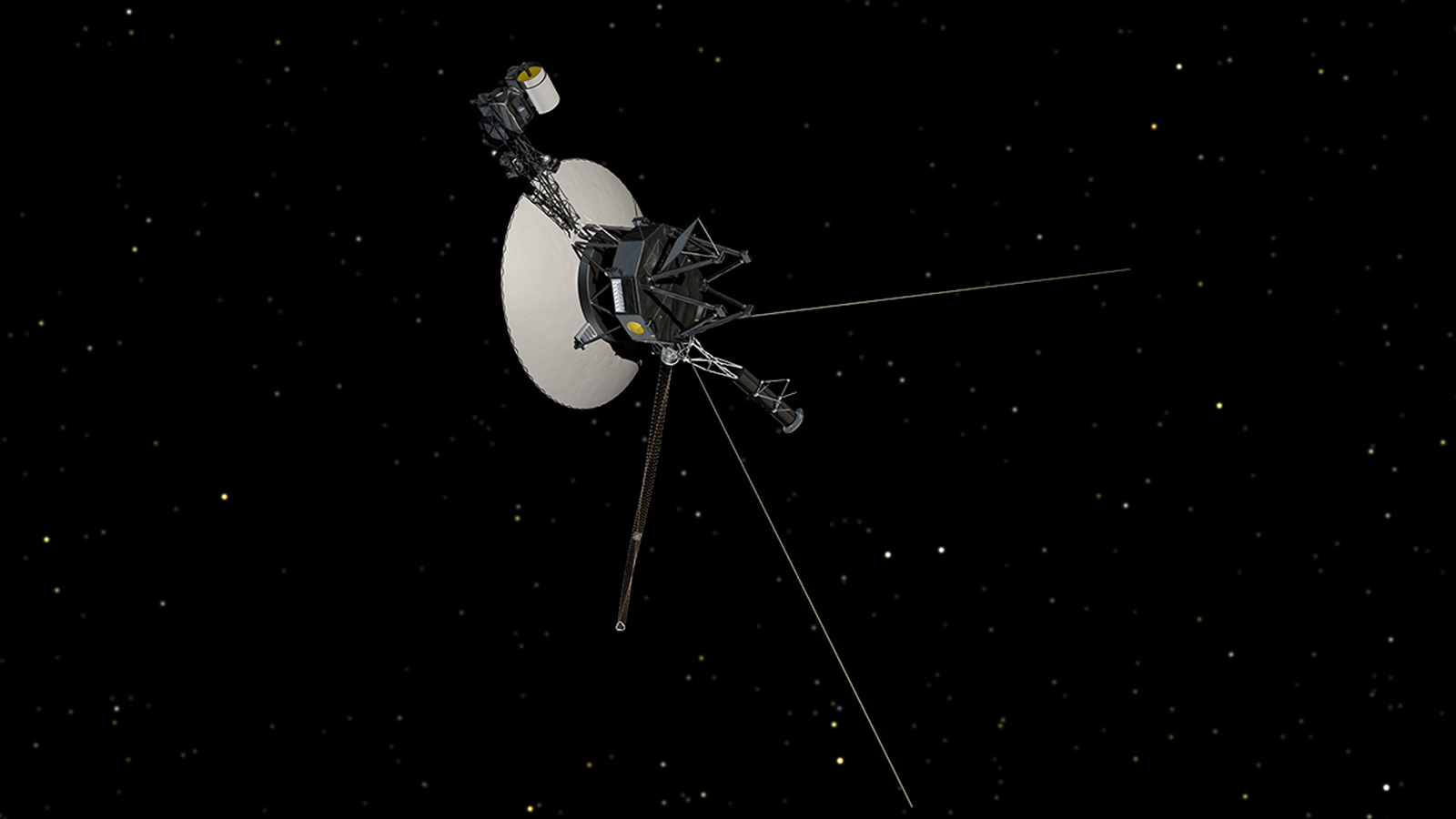
This artist's concept shows NASA's Voyager spacecraft against a backdrop of stars

NASA's Voyager 2 spacecraft has detected intense radio emissions from Neptune, indicating that the planet has magnetic field.

NASA's Voyager 2 spacecraft has detected intense radio emissions from Neptune, indicating that the planet has magnetic field.

The discovery, made by Voyager 2's planetary radio astronomy instrument team at NASA's Jet Propulsion Laboratory, Pasadena, Calif., greatly increases the likelihood that the spacecraft will discover wide range of interesting phenomena related to magnetic field, such as aurora and possible radiation-darkened ring arcs and moons around Neptune.

Voyager 2 will come within 4,850 kilometers (3,000 miles) of Neptune at 9 p.m. on Aug. 24.

The emissions are generated around planets by high-velocity, charged particles as they spiral along magnetic field lines into the planet's atmosphere.

At Neptune, "the radio emissions are very intense, very impulsive, and occur in limited range of frequency," said Dr. James Warwick, principal investigator on the planetary radio astronomy experiment. The emissions, he added, are polarized, "so we know we're dealing with magnetic field. The source is not lightning; it is related to energetic particles interacting in magnetic field."

A planetary magnetic field is girdle of magnetic field lines that surround planet. Such fields are thought to be generated by fluid motion in planet's core (molten iron in Earth's core, for example). Mercury, Earth, Jupiter, Saturn and Uranus have magnetic fields, while Venus and Mars do not. Whether Pluto has one or not is not known.

While the Neptunian radio emissions were only confirmed today, Warwick said that in looking back over Voyager data, the emissions were heard by the planetary radio astronomy instrument as early as Aug. 14. The emissions weren't immediately recognized as being associated with Neptune, however, because their character "was so different from what we were expecting," Warwick said.

As more data from the instrument is returned to Earth over coming days, Warwick's team will be able to precisely define Neptune's rotation -- the length of its day.

Early analysis indicates that Neptune's magnetic field is of an intensity similar to the magnetic fields of Earth and Uranus.

Voyager 2's close flyby over Neptune's northern hemisphere will allow the spacecraft's complement of instruments to determine Neptune's magnetic field structure and orientation.

The Voyager Mission is conducted for NASA's Office of Space Science by the Jet Propulsion Laboratory.


818-354-5011

1989-1261

Related News

Mars.

NASA’s Perseverance, Curiosity Panoramas Capture Two Sides of Mars

Mars.

NASA’s Curiosity Finds Organic Molecules Never Seen Before on Mars

Solar System.

NASA Shuts Off Instrument on Voyager 1 to Keep Spacecraft Operating

Asteroids and Comets.

NASA’s DART Mission Changed Orbit of Asteroid Didymos Around Sun

Mars.

NASA’s Curiosity Rover Sees Martian ‘Spiderwebs’ Up Close

Mars.

NASA’s Perseverance Now Autonomously Pinpoints Its Location on Mars

Mars.

NASA’s Perseverance Rover Completes First AI-Planned Drive on Mars

Solar System.

NASA’s Juno Measures Thickness of Europa’s Ice Shell

Solar System.

NASA Study Suggests Saturn’s Moon Titan May Not Have Global Ocean

Earth.

NASA, Partners Share First Data From New US-European Sea Satellite

About JPL
Who We Are
Directors
Careers
Internships
The JPL Story
JPL Achievements
Documentary Series
JPL Annual Report
Executive Council
Missions
Current
Past
Future
All
News
All
Earth
Solar System
Stars and Galaxies
Eyes on the News
Subscribe to JPL News
Galleries
Images
Videos
Audio
Podcasts
Apps
Visions of the Future
Slice of History
Robotics at JPL
Events
Lecture Series
Speakers Bureau
Calendar
Visit
Public Tours
Virtual Tour
Directions and Maps
Topics
JPL Life
Solar System
Mars
Earth
Climate Change
Exoplanets
Stars and Galaxies
Robotics
More
Asteroid Watch
NASA's Eyes Visualizations
Universe - Internal Newsletter
Social Media
Accessibility at NASA
Contact Us
Get the Latest from JPL
Follow Us

JPL is a federally funded research and development center managed for NASA by Caltech.

More from JPL
Careers
Education
Science & Technology
Acquisition
JPL Store
Careers
Education
Science & Technology
Acquisition
JPL Store
Related NASA Sites
Basics of Spaceflight
NASA Kids Science - Earth
Earth / Global Climate Change
Exoplanet Exploration
Mars Exploration
Solar System Exploration
Space Place
NASA's Eyes Visualization Project
Voyager Interstellar Mission
NASA
Caltech
Privacy
Image Policy
FAQ
Feedback
Version: v3.1.0 - 409b2d2
Site Managers:Emilee Richardson, Alicia Cermak
Site Editors:Naomi Hartono, Steve Carney
CL#:21-0018