

What appear to be fragments from the aftermath of massive impacts on Mars that occurred 4.5 billion years ago have been detected deep below the planet’s surface. The discovery was made thanks to NASA’s now-retired InSight lander, which recorded the findings before the mission’s end in 2022. The ancient impacts released enough energy to melt continent-size swaths of the early crust and mantle into vast magma oceans, simultaneously injecting the impactor fragments and Martian debris deep into the planet’s interior.
There’s no way to tell exactly what struck Mars: The early solar system was filled with a range of different rocky objects that could have done so, including some so large they were effectively protoplanets. The remains of these impacts still exist in the form of lumps that are as large as 2.5 miles (4 kilometers) across and scattered throughout the Martian mantle. They offer a record preserved only on worlds like Mars, whose lack of tectonic plates has kept its interior from being churned up the way Earth’s is through a process known as convection.
The finding was reported Thursday, Aug. 28, in a study published by the journal Science.
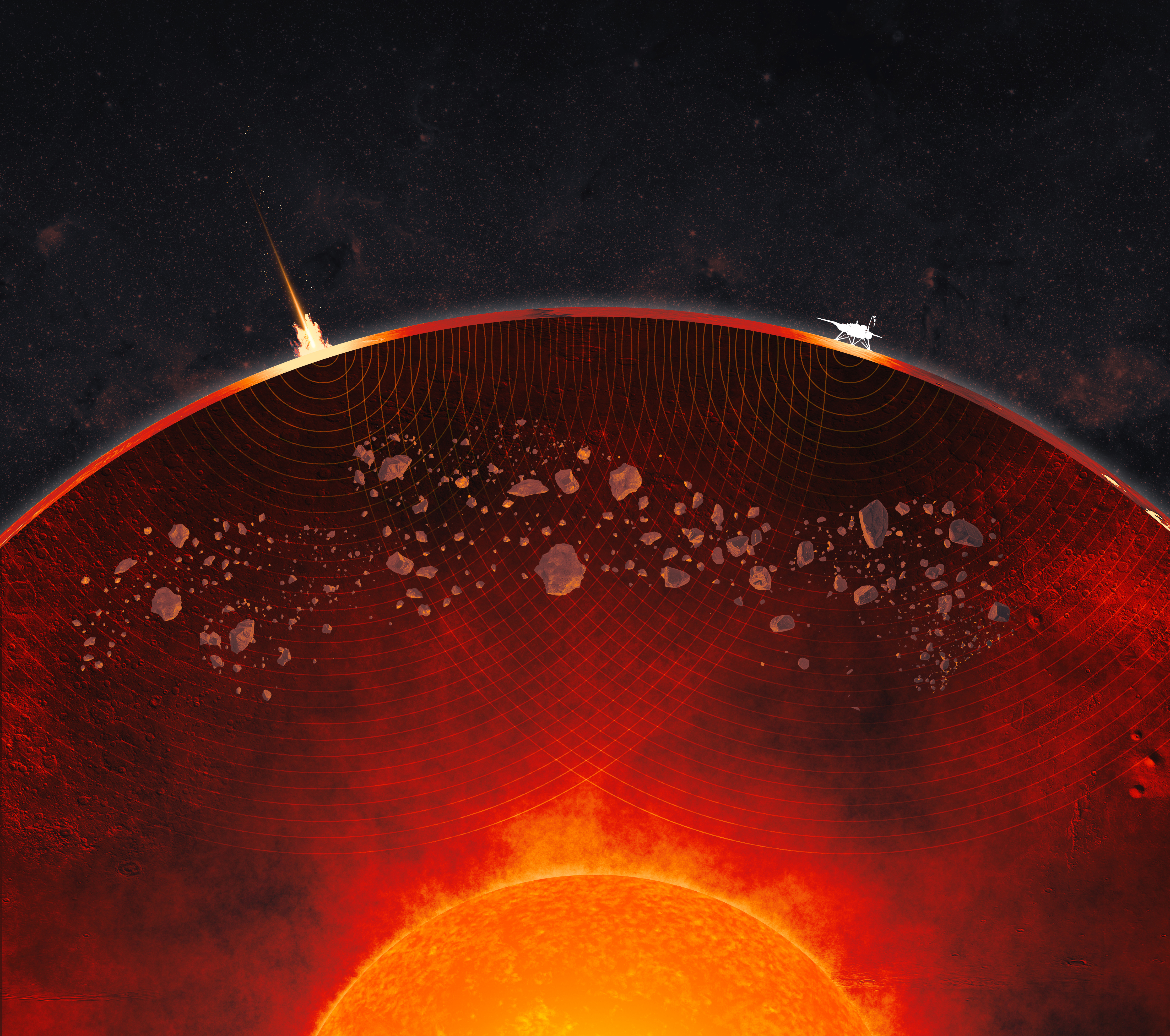
A cutaway view of Mars in this artist’s concept (not to scale) reveals debris from ancient impacts scattered through the planet’s mantle. On the surface at left, a meteoroid impact sends seismic signals through the interior; at right is NASA’s InSight lander. Credit: NASA/JPL-Caltech Full Image Details
“We’ve never seen the inside of a planet in such fine detail and clarity before,” said the paper’s lead author, Constantinos Charalambous of Imperial College London. “What we’re seeing is a mantle studded with ancient fragments. Their survival to this day tells us Mars’ mantle has evolved sluggishly over billions of years. On Earth, features like these may well have been largely erased.”
InSight, which was managed by NASA’s Jet Propulsion Laboratory in Southern California, placed the first seismometer on Mars’ surface in 2018. The extremely sensitive instrument recorded 1,319 marsquakes before the lander’s end of mission in 2022.
Quakes produce seismic waves that change as they pass through different kinds of material, providing scientists a way to study the interior of a planetary body. To date, the InSight team has measured the size, depth, and composition of Mars’ crust, mantle, and core. This latest discovery regarding the mantle’s composition suggests how much is still waiting to be discovered within InSight’s data.
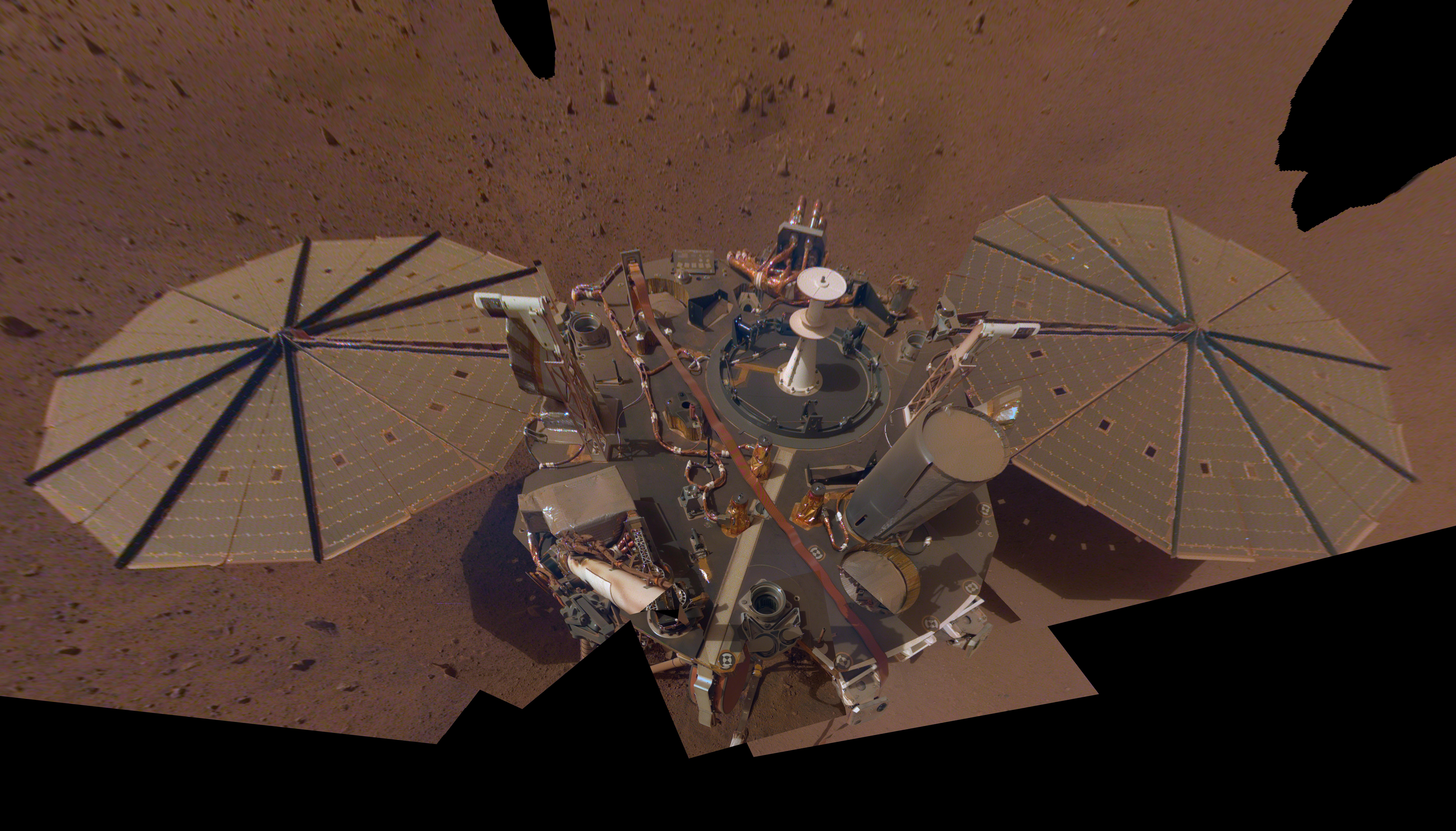
NASA’s InSight took this selfie in 2019 using a camera on its robotic arm. The lander also used its arm to deploy the mission’s seismometer, whose data was used in a 2025 study showing massive impacts left chunks of debris deep in the planet’s interior. Credit: NASA/JPL-Caltech Full Image Details
“We knew Mars was a time capsule bearing records of its early formation, but we didn’t anticipate just how clearly we’d be able to see with InSight,” said Tom Pike of Imperial College London, coauthor of the paper.
Quake hunting
Mars lacks the tectonic plates that produce the temblors many people in seismically active areas are familiar with. But there are two other types of quakes on Earth that also occur on Mars: those caused by rocks cracking under heat and pressure, and those caused by meteoroid impacts.
Of the two types, meteoroid impacts on Mars produce high-frequency seismic waves that travel from the crust deep into the planet’s mantle, according to a paper published earlier this year in Geophysical Research Letters. Located beneath the planet’s crust, the Martian mantle can be as much as 960 miles (1,550 kilometers) thick and is made of solid rock that can reach temperatures as high as 2,732 degrees Fahrenheit (1,500 degrees Celsius).
View This Article in 3D Space!
Scrambled signals
The new Science paper identifies eight marsquakes whose seismic waves contained strong, high-frequency energy that reached deep into the mantle, where their seismic waves were distinctly altered.
“When we first saw this in our quake data, we thought the slowdowns were happening in the Martian crust,” Pike said. “But then we noticed that the farther seismic waves travel through the mantle, the more these high-frequency signals were being delayed.”
Using planetwide computer simulations, the team saw that the slowing down and scrambling happened only when the signals passed through small, localized regions within the mantle. They also determined that these regions appear to be lumps of material with a different composition than the surrounding mantle.
Get the JPL Newsletter
Never miss a discovery! All the latest JPL news, delivered straight to your inbox.
With one riddle solved, the team focused on another: how those lumps got there.
Turning back the clock, they concluded that the lumps likely arrived as giant asteroids or other rocky material that struck Mars during the early solar system, generating those oceans of magma as they drove deep into the mantle, bringing with them fragments of crust and mantle.
Charalambous likens the pattern to shattered glass — a few large shards with many smaller fragments. The pattern is consistent with a large release of energy that scattered many fragments of material throughout the mantle. It also fits well with current thinking that in the early solar system, asteroids and other planetary bodies regularly bombarded the young planets.
On Earth, the crust and uppermost mantle is continuously recycled by plate tectonics pushing a plate’s edge into the hot interior, where, through convection, hotter, less-dense material rises and cooler, denser material sinks. Mars, by contrast, lacks tectonic plates, and its interior circulates far more sluggishly. The fact that such fine structures are still visible today, Charalambous said, “tells us Mars hasn’t undergone the vigorous churning that would have smoothed out these lumps.”
And in that way, Mars could point to what may be lurking beneath the surface of other rocky planets that lack plate tectonics, including Venus and Mercury.
More about InSight
JPL managed InSight for NASA’s Science Mission Directorate. InSight was part of NASA’s Discovery Program, managed by the agency’s Marshall Space Flight Center in Huntsville, Alabama. Lockheed Martin Space in Denver built the InSight spacecraft, including its cruise stage and lander, and supported spacecraft operations for the mission.
A number of European partners, including France’s Centre National d’Études Spatiales (CNES) and the German Aerospace Center (DLR), supported the InSight mission. CNES provided the Seismic Experiment for Interior Structure (SEIS) instrument to NASA, with the principal investigator at IPGP (Institut de Physique du Globe de Paris). Significant contributions for SEIS came from IPGP; the Max Planck Institute for Solar System Research (MPS) in Germany; the Swiss Federal Institute of Technology (ETH Zurich) in Switzerland; Imperial College London and Oxford University in the United Kingdom; and JPL. DLR provided the Heat Flow and Physical Properties Package (HP3) instrument, with significant contributions from the Space Research Center (CBK) of the Polish Academy of Sciences and Astronika in Poland. Spain’s Centro de Astrobiología (CAB) supplied the temperature and wind sensors.