
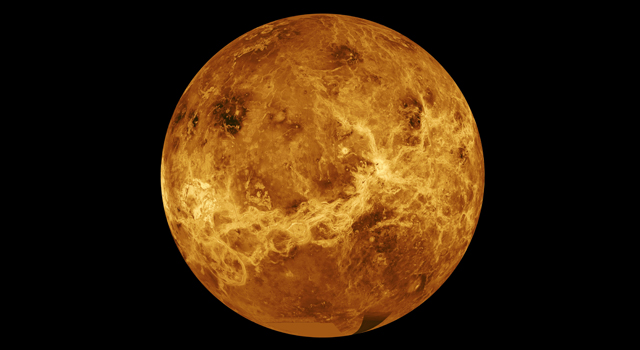
The Magellan spacecraft, mapping the surface of Venus with imaging radar, has discovered a lava flow that may represent a volcanic eruption similar to those currently taking place in Japan and the Philippines, a Magellan scientist said.
Dr. James Head of Brown University, a geologist on the Magellan science team, said the spacecraft has been mapping a planet dominated by volcanism.
Large volcanoes, long lava flows and rivers of lava have formed on the surface of Earth's nearest planetary neighbor, and may be continuing to form today, Head said.
Unusual volcanoes with petal-shaped flows have been imaged which are different from most other volcanoes on Venus. The lack of weathering or erosion due to lack of water on Venus allows scientists to view a whole preserved sequence of volcanism, Head said.
"For most volcanoes, we don't understand how the molten rock gets out of the ground because we can't see below the surface," he said. "On Venus, however, the relationships between the volcanoes and the tectonic fractures will help us understand the way in which molten rock gets out of the interior."
A recently discovered flow found in a highly fractured region may be significant in telling Magellan scientists where and how melting of rock is taking place in the interior of the planet, he said.
"This deposit may represent an eruption like those that are currently happening in Japan and the Philippines," Head said. "On Earth, the atmospheric pressure is such that when the gasrich molten material reaches the surface, the resulting eruption sends the material up into the atmosphere in plumes, spreading it over large areas as it falls out of the atmosphere.
"On Venus, the surface atmospheric pressure is about 90 times higher than on Earth and when the gas-rich molten material reaches the surface, it may not form into plumes, but instead may flow out over the surface. Therefore this may be an eruption like the one in the Philippines, but changed in its style by the very different conditions of the atmosphere," he said.
Magellan Project Scientist Dr. Steve Saunders said that over the next several mapping cycles, Magellan will re-image several volcanic regions with the same geometry as in the first mapping cycle.
"By comparing the images, we should be able to detect changes in the lava flows, indicating that a volcano has erupted and that Venus is indeed geologically active like the Earth," Saunders said.
A mapping cycle is 243 days, or one rotation of Venus on its axis. The second mapping cycle began May 15. Magellan is managed by the Jet Propulsion Laboratory for NASA's Office of Space Science and Applications, Washington, D.C.
818-354-5011