
JPL
Careers
Education
Science & Technology
JPL Logo
JPL Logo
Solar System
.2 min read

Four New Satellites of Saturn Found

Jet Propulsion Laboratory https://www.jpl.nasa.gov/ Feb. 1, 1982
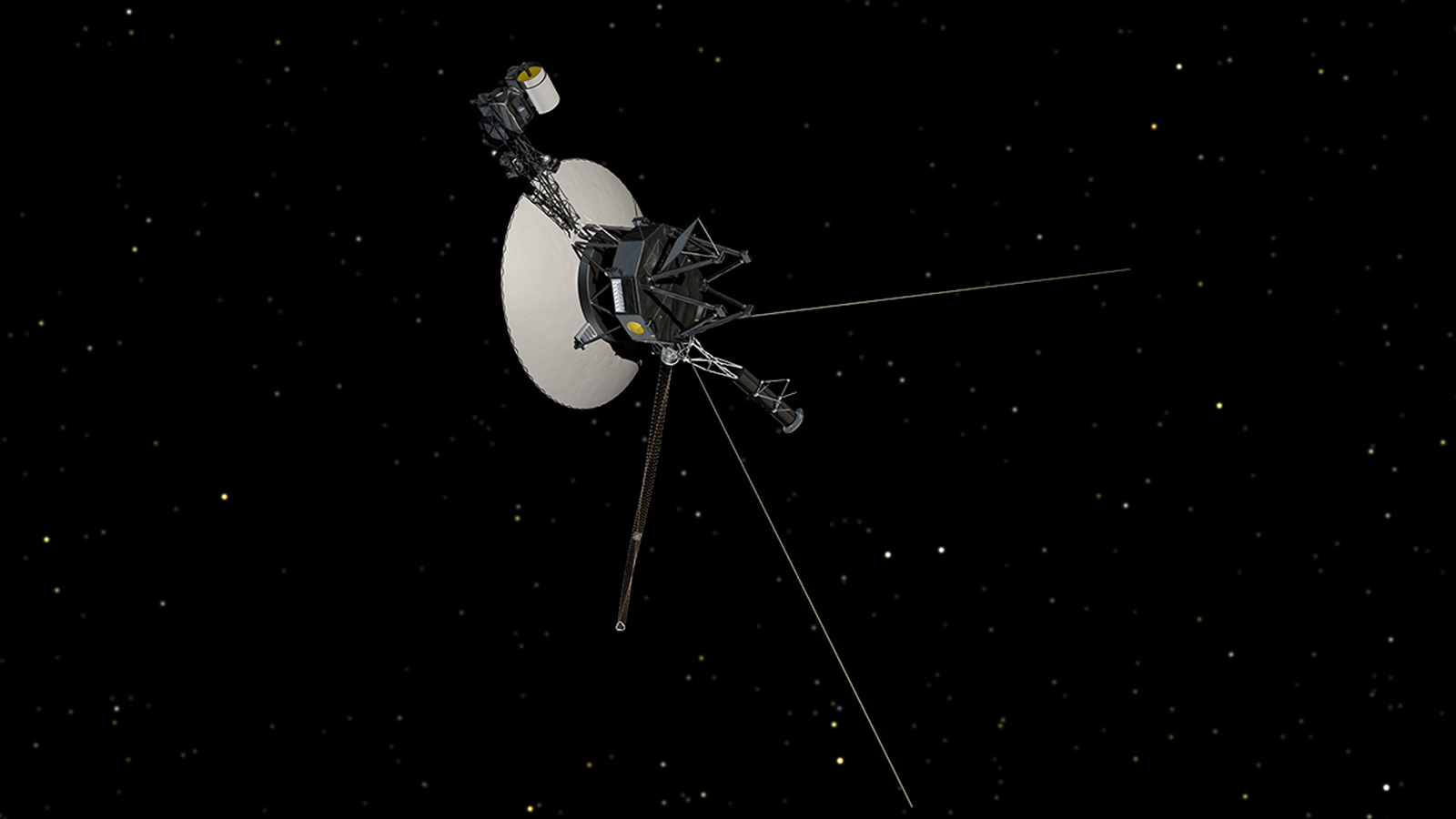
This artist's concept shows NASA's Voyager spacecraft against a backdrop of stars

Dr. Stephen P. Synnott of the Jet Propulsion Laboratory has found evidence for the existence of four, and possibly as many as six, new satellites of Saturn, using data from the Voyager 2 Saturn encounter.

Dr. Stephen P. Synnott of the Jet Propulsion Laboratory has found evidence for the existence of four, and possibly as many as six, new satellites of Saturn, using data from the Voyager 2 Saturn encounter.

The discoveries bring the number of known Saturnian satellites to between 21 and 23. The two "possible" satellites were seen in only one observation each, so their orbits are not yet confirmed.

The innermost satellite found by Synnott moves at about the same orbital distance from Saturn as the alreadyknown satellite, Mimas. The object was originally suggested by data from charged-particle instruments aboard Voyager 2. Synnott and JPL planetary scientist Richard Terrile found the satellite.

A third (and possibly fourth) companion of the satellite Tethys appear to move in what Synnott calls "horseshoe" orbit. Synnott says that he is sure an object is there. But he is not certain yet, because of resolution limits in the photos, whether it is one or two objects. Satellites in "horseshoe" orbits trade orbits as they approach each other.

Another satellite was found by Synnott at point about 60 degrees ahead of the satellite Dione. That is the second found in that region. The first was discovered in Earth-based observations in 1980.

Synnott found yet another satellite about 350,000 kilometers (217,000 miles) from Saturn, between the orbits of Tethys and Dione. It circles Saturn once in 2.44 days.

Synnott's final observation, faint streak in Voyager 2 photo, indicates satellite (the "possible sixth") may exist about 470,000 kilometers (292,000 miles) from Saturn, between the orbits of Dione and Rhea. Its period would be, Synnott calculates, 3.8 days.

The object that shares the orbit of Mimas is about 10 kilometers (6 miles) in diameter. All the others are about 15 to 20 kilometers (nine to 12 miles) in diameter.

Synnott, member of the Voyager navigation team, also found two new satellites at Jupiter in photos he studied after the Voyager encounters in 1979.

Two Voyager spacecraft were launched in 1977 to perform flyby encounters with Jupiter, in 1979, and Saturn in 1980 and 1981. The Voyager project is managed for NASA by the Jet Propulsion Laboratory.


818-354-5011

1982-0985

Related News

Mars.

NASA’s Perseverance, Curiosity Panoramas Capture Two Sides of Mars

Mars.

NASA’s Curiosity Finds Organic Molecules Never Seen Before on Mars

Solar System.

NASA Shuts Off Instrument on Voyager 1 to Keep Spacecraft Operating

Asteroids and Comets.

NASA’s DART Mission Changed Orbit of Asteroid Didymos Around Sun

Mars.

NASA’s Curiosity Rover Sees Martian ‘Spiderwebs’ Up Close

Mars.

NASA’s Perseverance Now Autonomously Pinpoints Its Location on Mars

Mars.

NASA’s Perseverance Rover Completes First AI-Planned Drive on Mars

Solar System.

NASA’s Juno Measures Thickness of Europa’s Ice Shell

Solar System.

NASA Study Suggests Saturn’s Moon Titan May Not Have Global Ocean

Mars.

One of NASA’s Key Cameras Orbiting Mars Takes 100,000th Image

About JPL
Who We Are
Directors
Careers
Internships
The JPL Story
JPL Achievements
Documentary Series
JPL Annual Report
Executive Council
Missions
Current
Past
Future
All
News
All
Earth
Solar System
Stars and Galaxies
Eyes on the News
Subscribe to JPL News
Galleries
Images
Videos
Audio
Podcasts
Apps
Visions of the Future
Slice of History
Robotics at JPL
Events
Lecture Series
Speakers Bureau
Calendar
Visit
Public Tours
Virtual Tour
Directions and Maps
Topics
JPL Life
Solar System
Mars
Earth
Climate Change
Exoplanets
Stars and Galaxies
Robotics
More
Asteroid Watch
NASA's Eyes Visualizations
Universe - Internal Newsletter
Social Media
Accessibility at NASA
Contact Us
Get the Latest from JPL
Follow Us

JPL is a federally funded research and development center managed for NASA by Caltech.

More from JPL
Careers
Education
Science & Technology
Acquisition
JPL Store
Careers
Education
Science & Technology
Acquisition
JPL Store
Related NASA Sites
Basics of Spaceflight
NASA Kids Science - Earth
Earth / Global Climate Change
Exoplanet Exploration
Mars Exploration
Solar System Exploration
Space Place
NASA's Eyes Visualization Project
Voyager Interstellar Mission
NASA
Caltech
Privacy
Image Policy
FAQ
Feedback
Version: v3.1.0 - 409b2d2
Site Managers:Emilee Richardson, Alicia Cermak
Site Editors:Naomi Hartono, Steve Carney
CL#:21-0018