
JPL
Careers
Education
Science & Technology
JPL Logo
JPL Logo
Mars
.2 min read

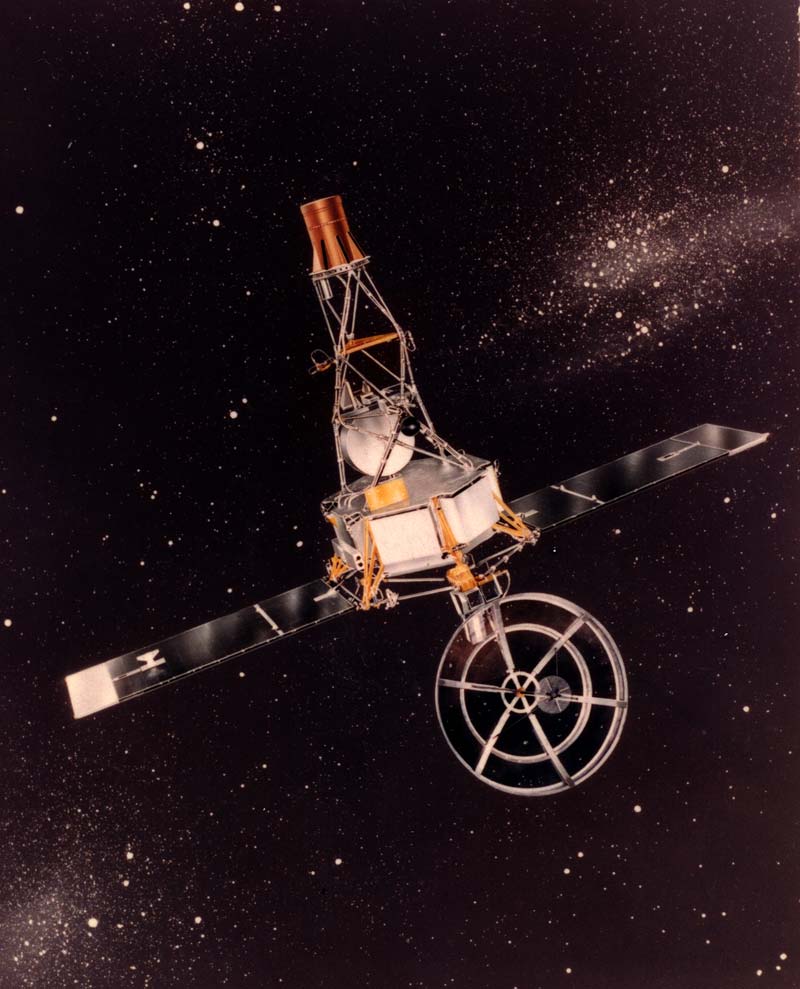
Equipment Checked as Mariner IV Heads to Mars

Jet Propulsion Laboratory https://www.jpl.nasa.gov/ Feb. 11, 1965

A series of commands were radioed 16-1/2 million miles to NASA's Mariner IV spacecraft early today by JPL engineers from the Mariner spaceflight operations center to check out spacecraft equipment that will be used if Mariner is still operating normally when it reaches Mars next July 14. The Goldstone station of the DSN was used to transmit the commands.

A series of commands were radioed 16-1/2 million miles to NASA's Mariner IV spacecraft early today by JPL engineers from the Mariner spaceflight operations center to check out spacecraft equipment that will be used if Mariner is still operating normally when it reaches Mars next July 14. The Goldstone station of the DSN was used to transmit the commands.

The twelve commands that were sent during an 8-1/2 hour period dropped the lens cover off the television camera, turned on a scanning platform that carries the camera and two Mars sensors, turned on portions of the television system (intentionally no pictures were taken), and checked out the capability of Mariner to perform the encounter sequence.

Commands to turn off the encounter equipment after the checkout were timed to preset the scan platform in a position to be pointing at Mars during the fly-by should the scan platform later fail to function and to set the camera shutter in a desired position.

The lens cover was dropped at this time rather than at planet encounter to shake loose any possible dust particles that might interfere with the Canopus sensor, a light sensing device that locks on the star Canopus to prevent the spacecraft from rolling.

Early in the mission, dust particles had reflected light into the sensor causing a response that ordered the spacecraft to break lock on Canopus and begin rolling in a new search for the star. If this occurred at encounter with Mars it would have been necessary to send commands to counteract the roll. At encounter, the Earth-spacecraft distance will be 134 million miles and it would take 12-1/2 minutes for a signal to reach Earth from the spacecraft to inform engineers that Canopus had been lost and another 12-1/2 minutes to reach the spacecraft with a command to counteract loss of Canopus. This time lag could seriously affect accomplishing mission objectives.


818-354-5011

1965-0316

Related News

Technology.

NASA Fires Up Powerful Lithium-Fed Thruster for Trips to Mars

Mars.

NASA’s Perseverance, Curiosity Panoramas Capture Two Sides of Mars

Mars.

NASA’s Curiosity Finds Organic Molecules Never Seen Before on Mars

Solar System.

NASA Shuts Off Instrument on Voyager 1 to Keep Spacecraft Operating

Technology.

NASA Unveils Initiatives to Achieve America’s National Space Policy

Asteroids and Comets.

NASA’s DART Mission Changed Orbit of Asteroid Didymos Around Sun

Mars.

NASA’s Curiosity Rover Sees Martian ‘Spiderwebs’ Up Close

Mars.

NASA’s Perseverance Now Autonomously Pinpoints Its Location on Mars

Mars.

NASA’s Perseverance Rover Completes First AI-Planned Drive on Mars

Technology.

Networks Keeping NASA’s Artemis II Mission Connected

About JPL
Who We Are
Directors
Careers
Internships
The JPL Story
JPL Achievements
Documentary Series
JPL Annual Report
Executive Council
Missions
Current
Past
Future
All
News
All
Earth
Solar System
Stars and Galaxies
Eyes on the News
Subscribe to JPL News
Galleries
Images
Videos
Audio
Podcasts
Apps
Visions of the Future
Slice of History
Robotics at JPL
Events
Lecture Series
Speakers Bureau
Calendar
Visit
Public Tours
Virtual Tour
Directions and Maps
Topics
JPL Life
Solar System
Mars
Earth
Climate Change
Exoplanets
Stars and Galaxies
Robotics
More
Asteroid Watch
NASA's Eyes Visualizations
Universe - Internal Newsletter
Social Media
Accessibility at NASA
Contact Us
Get the Latest from JPL
Follow Us

JPL is a federally funded research and development center managed for NASA by Caltech.

More from JPL
Careers
Education
Science & Technology
Acquisition
JPL Store
Careers
Education
Science & Technology
Acquisition
JPL Store
Related NASA Sites
Basics of Spaceflight
NASA Kids Science - Earth
Earth / Global Climate Change
Exoplanet Exploration
Mars Exploration
Solar System Exploration
Space Place
NASA's Eyes Visualization Project
Voyager Interstellar Mission
NASA
Caltech
Privacy
Image Policy
FAQ
Feedback
Version: v3.1.0 - 9d64141
Site Managers:Emilee Richardson, Alicia Cermak
Site Editors:Naomi Hartono, Steve Carney
CL#:21-0018