
JPL
Careers
Education
Science & Technology
JPL Logo
JPL Logo
Solar System
.

Ceres Bright Spots Seen Closer Than Ever

May 20, 2015
This image of Ceres is part of a sequence taken by NASA's Dawn spacecraft on May 16, 2015, from a distance of 4,500 miles (7,200 kilometers).› Full image and caption
Credit: NASA/JPL-Caltech/UCLA/MPS/DLR/IDA

NASA's Dawn mission captured a sequence of navigational images of dwarf planet Ceres from a distance of 4,500 miles (7,200 kilometers) on May 16, 2015.

NASA's Dawn mission captured a sequence of images, taken for navigation purposes, of dwarf planet Ceres on May 16, 2015. The image showcases the group of the brightest spots on Ceres, which continue to mystify scientists. It was taken from a distance of 4,500 miles (7,200 kilometers) and has a resolution of 2,250 feet (700 meters) per pixel.
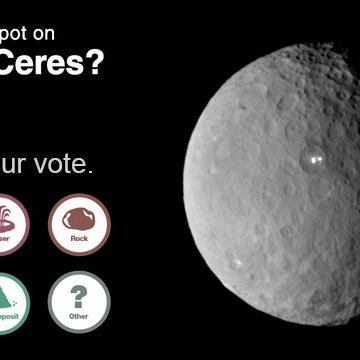
Guess what the bright spots are

"Dawn scientists can now conclude that the intense brightness of these spots is due to the reflection of sunlight by highly reflective material on the surface, possibly ice," Christopher Russell, principal investigator for the Dawn mission from the University of California, Los Angeles, said recently.

Dawn arrived at Ceres on March 6, marking the first time a spacecraft has orbited a dwarf planet. Previously, the spacecraft explored giant asteroid Vesta for 14 months from 2011 to 2012. Dawn has the distinction of being the only spacecraft to orbit two extraterrestrial targets.

The spacecraft has been using its ion propulsion system to maneuver to its second mapping orbit at Ceres, which it will reach on June 6. The spacecraft will remain at a distance of 2,700 miles (4,400 kilometers) from the dwarf planet until June 30. Afterward, it will make its way to lower orbits.

Dawn's mission is managed by NASA's Jet Propulsion Laboratory, Pasadena, California, for NASA's Science Mission Directorate in Washington. Dawn is a project of the directorate's Discovery Program, managed by NASA's Marshall Space Flight Center in Huntsville, Alabama. UCLA is responsible for overall Dawn mission science. Orbital ATK, Inc., in Dulles, Virginia, designed and built the spacecraft. The German Aerospace Center, the Max Planck Institute for Solar System Research, the Italian Space Agency and the Italian National Astrophysical Institute are international partners on the mission team. For a complete list of acknowledgements, visit:

http://dawn.jpl.nasa.gov/mission

For more information about the Dawn mission, visit:

http://dawn.jpl.nasa.gov

News Media Contact

Elizabeth Landau

Headquarters, Washington

202-358-0845

elandau@nasa.gov

2015-172

Related News

Mars .

Touchdown! NASA’s Mars Perseverance Rover Safely Lands on Red Planet

Mars .

Searching for Life in NASA’s Perseverance Mars Samples

Mars .

The Mars Relay Network Connects Us to NASA’s Martian Explorers

Mars .

NASA Invites Public to Share Thrill of Mars Perseverance Rover Landing

Mars .

InSight Is Meeting the Challenge of Winter on Dusty Mars

Mars .

Where Should Future Astronauts Land on Mars? Follow the Water

Mars .

Tricky Terrain: Helping to Assure a Safe Rover Landing

Asteroids and Comets .

NASA’s Psyche Mission Moves Forward, Passing Key Milestone

Mars .

NASA’s Perseverance Rover 22 Days From Mars Landing

Solar System .

NASA’s Deep Space Network Welcomes a New Dish to the Family

Explore More

Image .

Deep Jet Streams in Jupiter's Atmosphere

Image .

Power On: Psyche Spacecraft

Video .

What's Up - February 2021

Image .

Juno's Mission Goes On

Topic .

Solar System

Image .

Jupiter's Storm Oval BA As Viewed By An Artist

Image .

Jupiter North Pole Detail

Image .

A Hot Spot on Jupiter

Image .

A Jupiter Circumpolar Cyclone

Image .

Two Views of Jupiter Hot Spot

About JPL
Who We Are
Executive Council
Directors of JPL
JPL History
Documentary Series
Virtual Tour
Annual Reports
Missions
All
Current
Past
Future
News
All
Earth
Mars
Solar System
Universe
Technology
Galleries
Images
Videos
Audio
Podcasts
Infographics
Engage
JPL and the Community
Lecture Series
Public Tours
Events
Team Competitions
JPL Speakers Bureau
Topics
Solar System
Mars
Earth
Climate Change
Stars and Galaxies
Exoplanets
Technology
JPL Life
For Media
Contacts and Information
Press Kits
More
Asteroid Watch
Robotics at JPL
Subscribe to Newsletter
Universe Newsletter
Social Media
Get the Latest from JPL
Follow Us

JPL is a federally funded research and development center managed for NASA by Caltech.

More from JPL
Careers Education Science & Technology Acquisitions JPL Store
Careers
Education
Science & Technology
Acquisitions
JPL Store
Related NASA Sites
Basics of Spaceflight
Climate Kids
Earth / Global Climate Change
Exoplanet Exploration
Mars Exploration
Solar System Exploration
Space Place
NASA's Eyes Visualization Project
Voyager Interstellar Mission
NASA
Caltech
Privacy
Image Policy
FAQ
Feedback
Site Manager: Veronica McGregor
Site Editors: Tony Greicius, Randal Jackson, Naomi Hartono