
JPL
Careers
Education
Science & Technology
JPL Logo
JPL Logo
Image

Venus - Barton Crater
Jet Propulsion Laboratory https://www.jpl.nasa.gov/ Sept. 26, 1996
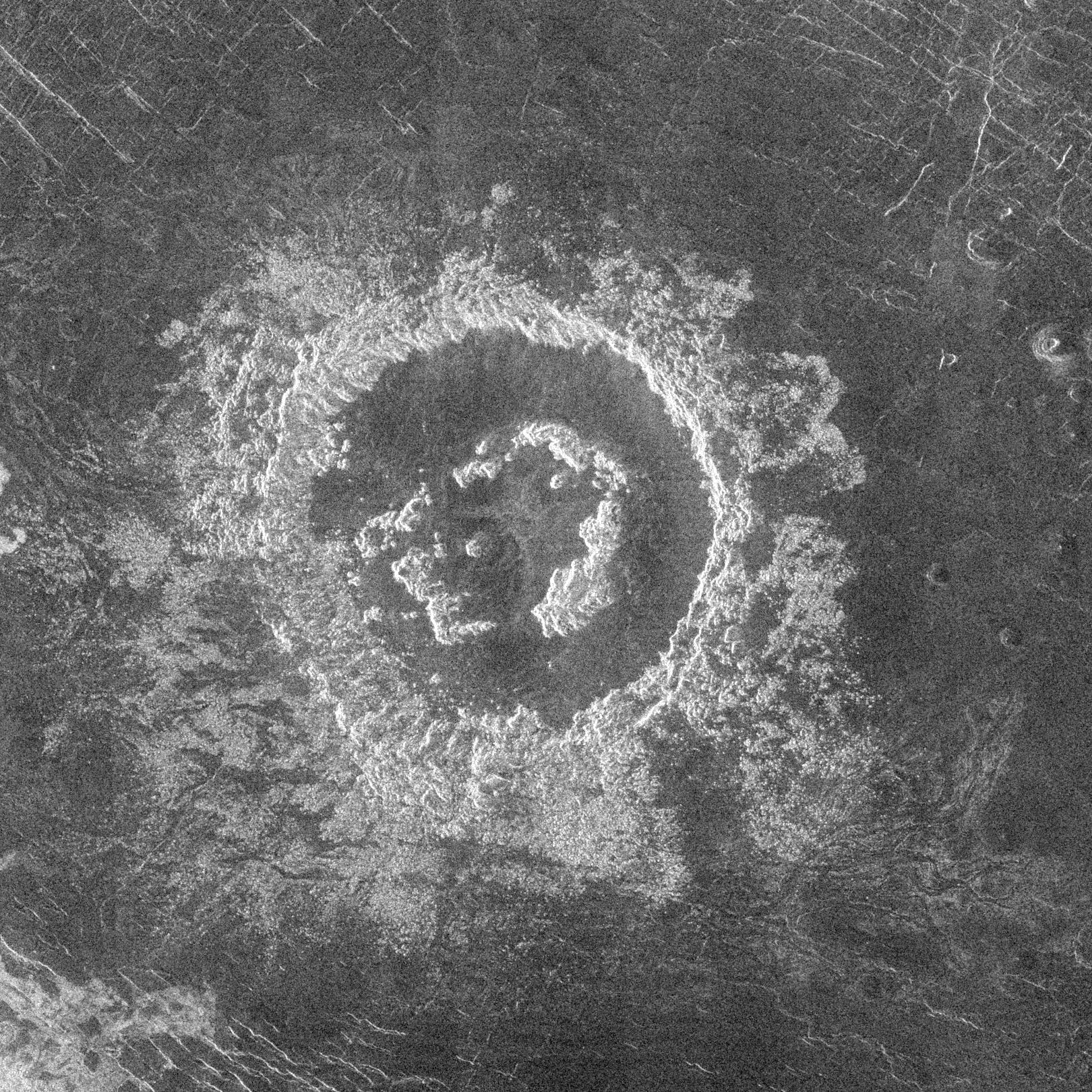
During orbits 404 through 414 on 19-20 September 1990, NASA's Magellan spacecraft imaged a peak-ring crater.

During orbits 404 through 414 on 19-20 September 1990, Magellan imaged a peak-ring crater that is 50 kilometers in diameter located at latitude 27.4 degrees north and longitude 337.5 degrees east. The name Barton has been proposed by the Magellan Science Team for this crater, after Clara Barton, founder of the Red Cross; however, the name is tentative pending approval by the International Astronomical Union.

Barton is just at the diameter size that Venus craters appear to begin to possess peak-rings instead of a single central peak or central peak complex like does 75 percent of the craters with diameters between 50 and about 15 kilometers. The floor of the crater is flat and radar-dark, indicating possible infilling by volcanic deposits sometime following the impact event. Barton's central peak ring is discontinuous and appears to have been disrupted or separated during or following the cratering process. The extremely blocky crater deposits (ejecta) surrounding Barton appear to be most extensive on the southwest to southeast (lower left to right) side of the crater.

Download JPG
Download TIFF
Mission
Target
  • Venus
Spacecraft
  • Magellan
Instrument
  • Radar System
Credit
NASA/JPL

Keep Exploring

Surface Warmth on a Venus Volcano

Venus Hemispherical Globes (with place names)

Venus Hemispherical Globes

Hemispheric View of Venus Centered at 180° East Longitude

Hemispheric View of Venus Centered at 0 Degrees East Longitude

Hemispheric View of Venus Centered at 270° East Longitude

Hemispheric View of Venus Centered at 90 Degrees East Longitude

Sedna Planitia (Right Member of a Synthetic Stereo Pair)

Magellan's Perspective View of Ovda Regio, 15° N, 77° E

Magellan's Perspective View of Ovda Regio, 0° S, 129° E

About JPL
Who We Are
Directors
Careers
Internships
The JPL Story
JPL Achievements
Documentary Series
JPL Annual Report
Executive Council
Missions
Current
Past
Future
All
News
All
Earth
Solar System
Stars and Galaxies
Eyes on the News
Subscribe to JPL News
Galleries
Images
Videos
Audio
Podcasts
Apps
Visions of the Future
Slice of History
Robotics at JPL
Events
Lecture Series
Speakers Bureau
Calendar
Visit
Public Tours
Virtual Tour
Directions and Maps
Topics
JPL Life
Solar System
Mars
Earth
Climate Change
Exoplanets
Stars and Galaxies
Robotics
More
Asteroid Watch
NASA's Eyes Visualizations
Universe - Internal Newsletter
Social Media
Accessibility at NASA
Contact Us
Get the Latest from JPL
Follow Us

JPL is a federally funded research and development center managed for NASA by Caltech.

More from JPL
Careers
Education
Science & Technology
Acquisition
JPL Store
Careers
Education
Science & Technology
Acquisition
JPL Store
Related NASA Sites
Basics of Spaceflight
NASA Kids Science - Earth
Earth / Global Climate Change
Exoplanet Exploration
Mars Exploration
Solar System Exploration
Space Place
NASA's Eyes Visualization Project
Voyager Interstellar Mission
NASA
Caltech
Privacy
Image Policy
FAQ
Feedback
Version: v3.1.0 - 9d64141
Site Managers:Emilee Richardson, Alicia Cermak
Site Editors:Naomi Hartono, Steve Carney
CL#:21-0018