
Slice of History - The First Rocket Motor Firing
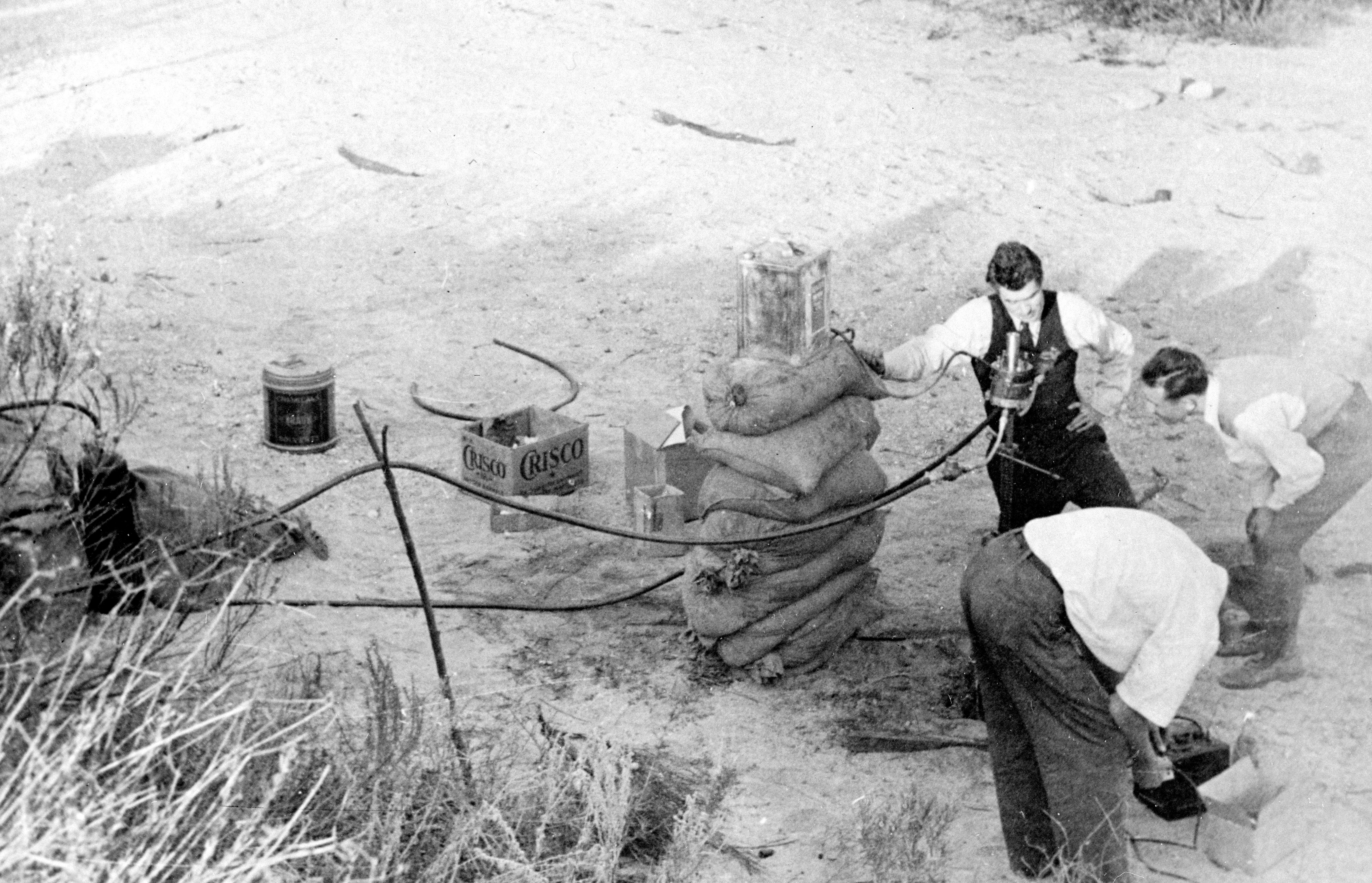
Between 1936 and 1937, a crudely constructed test set-up site in the Arroyo Seco hosted the first rocket motor firings that would lay the groundwork for nine decades of innovation at Jet Propulsion Laboratory. The area was primitive by any standard — wooden test frames, exposed wiring, and sandbag barriers assembled on the dusty chapparal terrain. There were no established facilities or formal procedures, only a desire from a set of Caltech graduate students to build, test, observe, and adapt.
The Caltech group's first tests of an alcohol-fueled rocket motor in the riverbed wilderness area took place on October 31, 1936. As the group improved their rocket motors, Caltech professor Theodore von Kármán persuaded the Army to fund development of jets mounted on heavy propeller planes to assist take-off from short runways. The Army helped Caltech acquire land in the Arroyo Seco for test pits and temporary workshops. Flight tests at nearby air bases proved the concept and tested the designs. By this time, World War II had begun and demand for the motors grew.
These tests proved foundational. The methods developed just beyond the current Lab's eastern edge — incremental testing, rapid iteration, and designing hardware around real-world constraints — became core principles that would later guide spacecraft propulsion systems, guidance technologies, and mission-critical hardware. What began as a rough outdoor firing area ultimately informed the way complex systems would be designed, tested, and trusted.
The Arroyo Seco site did more than host early experiments; it established a culture of engineering rigor rooted in hands-on learning. That culture would carry forward, enabling technologies that traveled far beyond the canyon walls and into deep space. CL#26-0346
The content presented here should be viewed in the context of the time period. Our intent is to present the history of JPL in a factual manner that uses primary resources and historical context. We recognize that some information or images do not reflect the current values, policies, and mission of JPL.
Want to learn more about the history of JPL?