
JPL
Careers
Education
Science & Technology
JPL Logo
JPL Logo
Image

Unlocking an Impact Crater's Clues

Jet Propulsion Laboratory https://www.jpl.nasa.gov/ Feb. 9, 2017
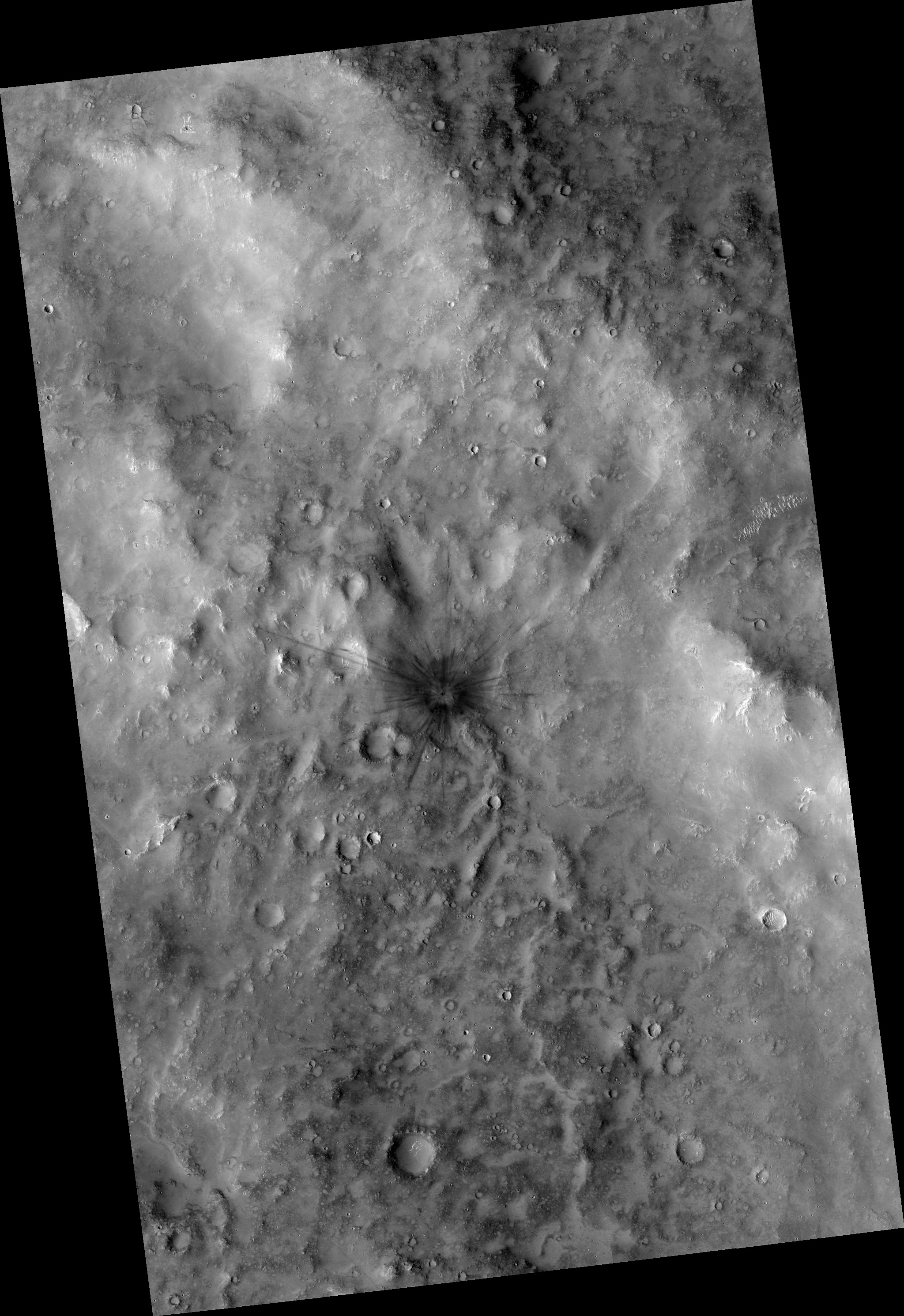
NASA's Mars Reconnaissance Orbiter has witnessed many surface changes over the past ten years, including hundreds of new craters formed by ongoing impacts. This particular crater is east of NASA's Spirit rover's final resting spot in Gusev Crater.
Click here for larger version of PIA21451
Map Projected Browse Image
Click on the image for larger version

Mars is a dynamic planet. HiRISE has witnessed many surface changes over the past ten years, including hundreds of new craters formed by ongoing impacts. Most of these impacts are likely caused by asteroids that have strayed into collision courses with Mars. The planet's much thinner atmosphere compared to Earth makes small asteroids less likely to burn up prior to hitting the Martian surface.

This new crater, which formed explosively at the point of impact, has a diameter of roughly 8 meters (about 25 feet), but its surrounding blast zone and ejecta extend over a kilometer (about one mile) beyond the crater itself. The materials exposed nearest the crater have distinctive yellowish and lighter grey appearances, while more distant ejected materials range from dark brown to bright bluish in an enhanced-color view. These varied materials may have originated from different layers penetrated by the impact.

This new impact was discovered using the lower-resolution Context Camera (CTX), also on board Mars Reconnaissance Orbiter. An older CTX image of this region from May 2012 shows a uniformly dust-covered surface, while a newer CTX image from September 2016 reveals the crater's dark blast zone. New craters on Mars are easiest to locate in such dust-coated terrains, where they provide opportunistic "road cuts"? that allow scientists to see beneath the dust blanket and determine the underlying rock compositions and textures.

This particular crater formed about 300 kilometers (roughly 200 miles) east of the Spirit rover's final resting spot in Gusev Crater.

The map is projected here at a scale of 25 centimeters (9.8 inches) per pixel. [The original image scale is 26.2 centimeters (10.3 inches) per pixel (with 1 x 1 binning); objects on the order of 79 centimeters (31 inches) across are resolved.] North is up.

The University of Arizona, Tucson, operates HiRISE, which was built by Ball Aerospace & Technologies Corp., Boulder, Colo. NASA's Jet Propulsion Laboratory, a division of Caltech in Pasadena, California, manages the Mars Reconnaissance Orbiter Project for NASA's Science Mission Directorate, Washington.

Download JPG
Download TIFF
Mission
Target
  • Mars
Spacecraft
  • Mars Reconnaissance Orbiter (MRO)
Instrument
  • High Resolution Imaging Science Experiment (HiRISE)
Credit
NASA/JPL-Caltech/Univ. of Arizona

Keep Exploring

SHARAD's View of Mars During a 'Very Large Roll'

MRO's 'Very Large Roll,' Animated

HiRISE Views Curiosity During a Drive

HiRISE Views Impact Crater Matching InSight's Seismic Data

MRO's HiRISE Views Frosty Martian Dunes

HiRISE Studies the Dust on InSight

Proposed Route of Perseverance's Northern Rim Science Campaign

Perseverance Reaches 'Lookout Hill'

HiRISE Views Mount Sharp's Boxwork

Dusty Water Ice in Mars' Dao Vallis

About JPL
Who We Are
Directors
Careers
Internships
The JPL Story
JPL Achievements
Documentary Series
JPL Annual Report
Executive Council
Missions
Current
Past
Future
All
News
All
Earth
Solar System
Stars and Galaxies
Eyes on the News
Subscribe to JPL News
Galleries
Images
Videos
Audio
Podcasts
Apps
Visions of the Future
Slice of History
Robotics at JPL
Events
Lecture Series
Speakers Bureau
Calendar
Visit
Public Tours
Virtual Tour
Directions and Maps
Topics
JPL Life
Solar System
Mars
Earth
Climate Change
Exoplanets
Stars and Galaxies
Robotics
More
Asteroid Watch
NASA's Eyes Visualizations
Universe - Internal Newsletter
Social Media
Accessibility at NASA
Contact Us
Get the Latest from JPL
Follow Us

JPL is a federally funded research and development center managed for NASA by Caltech.

More from JPL
Careers
Education
Science & Technology
Acquisition
JPL Store
Careers
Education
Science & Technology
Acquisition
JPL Store
Related NASA Sites
Basics of Spaceflight
NASA Kids Science - Earth
Earth / Global Climate Change
Exoplanet Exploration
Mars Exploration
Solar System Exploration
Space Place
NASA's Eyes Visualization Project
Voyager Interstellar Mission
NASA
Caltech
Privacy
Image Policy
FAQ
Feedback
Version: v3.0.29 - 4bc7967
Site Managers:Emilee Richardson, Alicia Cermak
Site Editors:Naomi Hartono, Steve Carney
CL#:21-0018