
JPL
Careers
Education
Science & Technology
JPL Logo
JPL Logo
Image

Boron in Calcium Sulfate Vein at 'Catabola,' Mars
Jet Propulsion Laboratory https://www.jpl.nasa.gov/ Dec. 13, 2016
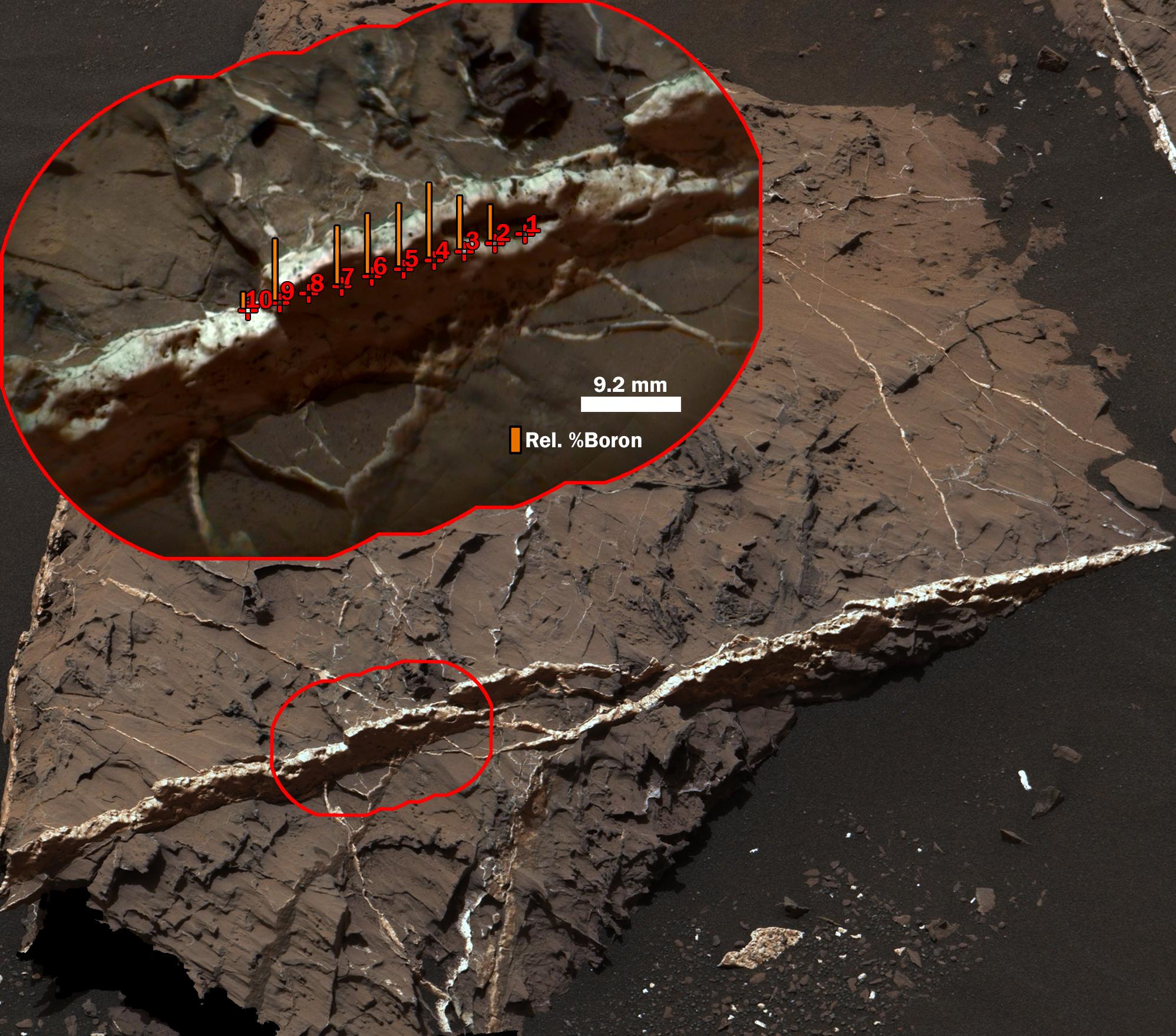
This two-part illustration shows the context of the erosion-resistant, raised vein, called 'Catabola,' in an image from NASA's Curiosity's Mast Camera. The highest concentration of boron measured on Mars.

The highest concentration of boron measured on Mars, as of late 2016, is in this mineral vein, called "Catabola," examined with the Chemistry and Camera (ChemCam) instrument on NASA's Curiosity rover on Aug, 25, 2016, during Sol 1441 of the mission.

This two-part illustration shows the context of the erosion-resistant, raised vein, in an image from Curiosity's Mast Camera (Mastcam), and a detailed inset image from ChemCam's remote micro-imager. The inset includes indicators of the boron content measured at 10 points along the vein that were analyzed with ChemCam's laser-firing spectrometer. The vein's main component is calcium sulfate. The highest boron content identified is less than one-tenth of one percent. The heights of the orange bars at each point indicate relative abundance of boron, compared with boron content at other points.

The scale bar for the inset is 9.2 millimeters, or about 0.36 inch. The ChemCam image is enhanced with color information from Mastcam.

Mastcam and ChemCam are two of 10 instruments in Curiosity's science payload. Malin Space Science Systems, San Diego, developed and operates Mastcam. The U.S. Department of Energy's Los Alamos National Laboratory, in Los Alamos, New Mexico, developed ChemCam in partnership with scientists and engineers funded by the French national space agency (CNES), the University of Toulouse and the French national research agency (CNRS).

ChemCam is one of 10 instruments in Curiosity's science payload. The U.S. Department of Energy's Los Alamos National Laboratory, in Los Alamos, New Mexico, developed ChemCam in partnership with scientists and engineers funded by the French national space agency (CNES), the University of Toulouse and the French national research agency (CNRS). More information about ChemCam is available at http://www.msl-chemcam.com/.

Presented at the 2016 AGU Fall Meeting on Dec. 13. in San Francisco, CA.

NASA's Jet Propulsion Laboratory, a division of Caltech in Pasadena, California, manages the Mars Science Laboratory Project and Mars Reconnaissance Orbiter Project for NASA's Science Mission Directorate, Washington.

For more information about Curiosity, visit http://www.nasa.gov/msl and http://mars.jpl.nasa.gov/msl.

Download JPG
Download TIFF
Mission
Target
  • Mars
Spacecraft
  • Mars Reconnaissance Orbiter (MRO)
  • Mars Science Laboratory (MSL)
Instrument
  • Chemistry and Camera (ChemCam)
  • Mastcam
Credit
NASA/JPL-Caltech/MSSS/LANL/CNES/IRAP/LPGNantes/CNRS/IAS

Keep Exploring

Curiosity Works Its Robotic Arm During Sunset

Curiosity’s ChemCam Views Summit and Cliffs Beyond Gale Crater

Curiosity’s ChemCam Views Ancient River Channel Peace Vallis

Curiosity Views Gale Crater’s Rim, Homing in on Ancient River Channel

Curiosity Captures Mars Landscape While Talking to an Orbiter

Curiosity Views a Martian Rock Shaped Like Coral

Curiosity's ChemCam Views a Rock Shaped Like Coral

Curiosity's First 360-Degree View of Boxwork Patterns

Curiosity Views a Fractured Boxwork Pattern Up Close

Curiosity Views Boxwork Patterns at a Distance

About JPL
Who We Are
Directors
Careers
Internships
The JPL Story
JPL Achievements
Documentary Series
JPL Annual Report
Executive Council
Missions
Current
Past
Future
All
News
All
Earth
Solar System
Stars and Galaxies
Eyes on the News
Subscribe to JPL News
Galleries
Images
Videos
Audio
Podcasts
Apps
Visions of the Future
Slice of History
Robotics at JPL
Events
Lecture Series
Speakers Bureau
Calendar
Visit
Public Tours
Virtual Tour
Directions and Maps
Topics
JPL Life
Solar System
Mars
Earth
Climate Change
Exoplanets
Stars and Galaxies
Robotics
More
Asteroid Watch
NASA's Eyes Visualizations
Universe - Internal Newsletter
Social Media
Accessibility at NASA
Contact Us
Get the Latest from JPL
Follow Us

JPL is a federally funded research and development center managed for NASA by Caltech.

More from JPL
Careers
Education
Science & Technology
Acquisition
JPL Store
Careers
Education
Science & Technology
Acquisition
JPL Store
Related NASA Sites
Basics of Spaceflight
NASA Kids Science - Earth
Earth / Global Climate Change
Exoplanet Exploration
Mars Exploration
Solar System Exploration
Space Place
NASA's Eyes Visualization Project
Voyager Interstellar Mission
NASA
Caltech
Privacy
Image Policy
FAQ
Feedback
Version: v3.1.3 - 5e83a9a
Site Managers:Emilee Richardson, Alicia Cermak
Site Editors:Naomi Hartono, Steve Carney
CL#:21-0018