
Enterprising Nebulae
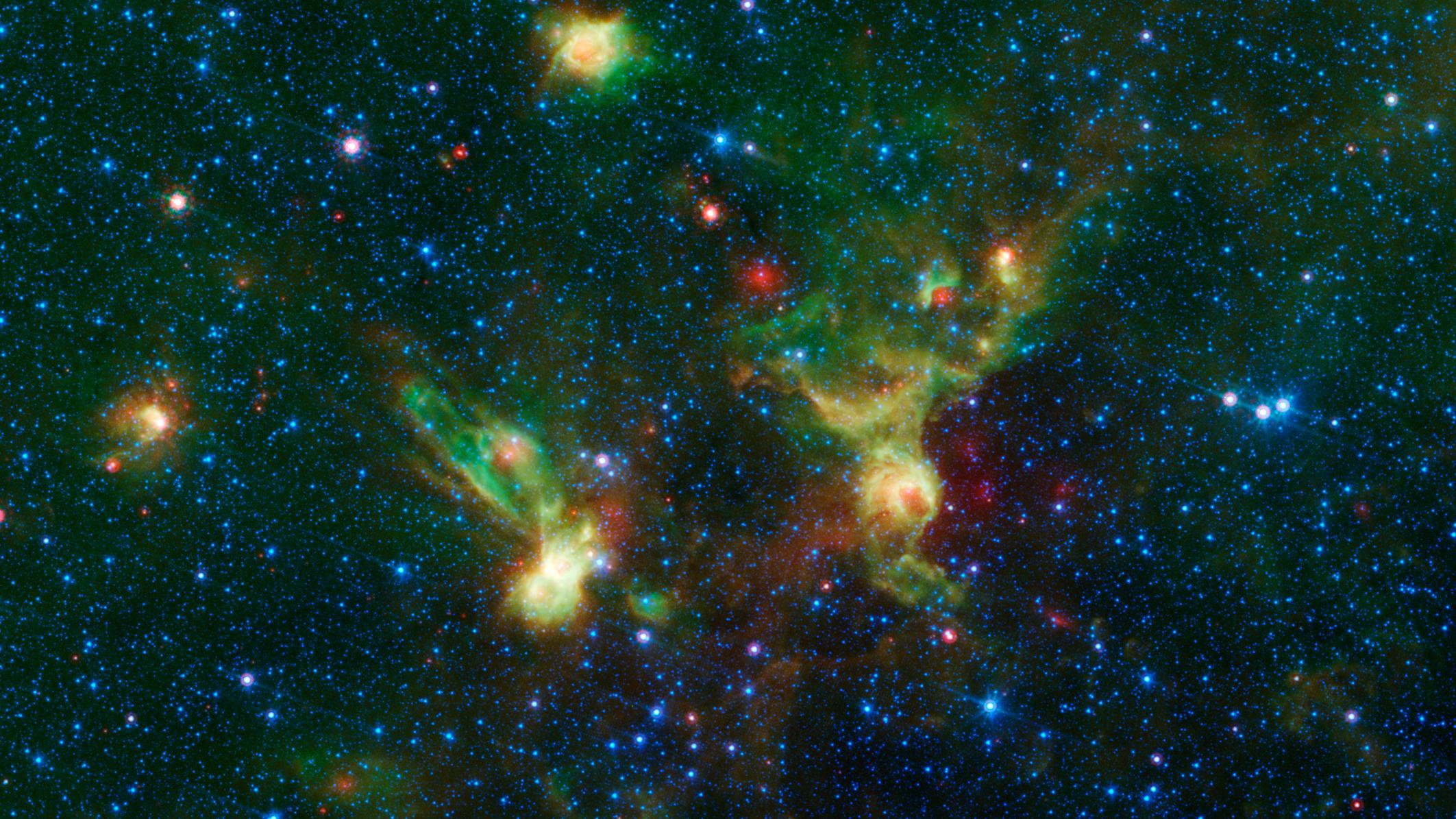
Just in time for the 50th anniversary of the TV series "Star Trek," which first aired September 8th,1966, this infrared image from NASA's Spitzer Space Telescope may remind fans of the historic show. Just as one might see the shapes of animals or other objects in clouds -- a phenomenon called pareidolia -- iconic starships from the series may seem to emerge in these nebulae./
With a little scrutiny (see Figure 1), you may see hints of the saucer and hull of the original USS Enterprise, captained by James T. Kirk, as if it were emerging from a dark nebula. To the left, its "Next Generation" successor, Jean-Luc Picard's Enterprise-D, flies off in the opposite direction.
Astronomically speaking, the region pictured here falls within the disk of our Milky Way galaxy, and displays two regions of star formation that are hidden behind a haze of dust when viewed in visible light. Spitzer's ability to peer deeper into dust clouds has revealed a myriad of stellar birthplaces like these, which are officially known only by their catalog numbers, IRAS 19340+2016 and IRAS19343+2026.
Trekkies, however, may prefer using the more familiar designations NCC-1701 and NCC-1701-D.
This image was assembled using data from Spitzer's biggest surveys of the Milky Way, called GLIMPSE and MIPSGAL. Light with a wavelength of 3.5 microns is shown in blue, 8.0 microns is green, and 24 microns in red. The green colors highlight organic molecules in the dust clouds, illuminated by starlight. Red colors are related to thermal radiation emitted from the very hottest areas of dust.
Movies
Enterprising Nebula Video (QT)
Enterprising Nebula Video (M4V)
JPL manages the Spitzer Space Telescope mission for NASA's Science Mission Directorate, Washington. Science operations are conducted at the Spitzer Science Center at Caltech in Pasadena, California. Spacecraft operations are based at Lockheed Martin Space Systems Company, Littleton, Colorado. Data are archived at the Infrared Science Archive housed at the Infrared Processing and Analysis Center at Caltech. Caltech manages JPL for NASA.
For more information about the Spitzer mission, visit http://www.nasa.gov/spitzer and http://spitzer.caltech.edu.