
Haulani Crater in Infrared
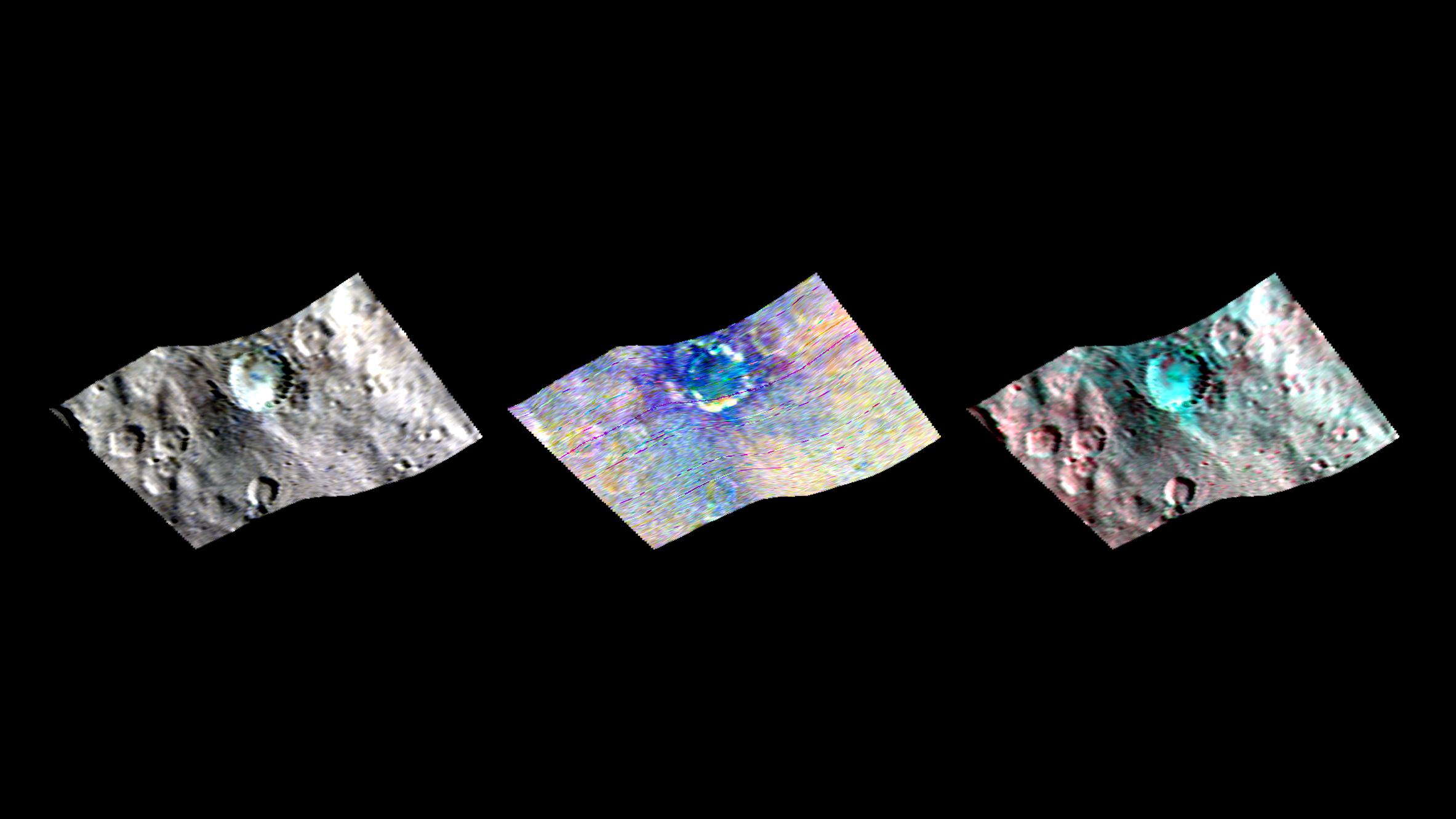
Ceres' Haulani Crater (21 miles, 34 kilometers wide) is shown in these views from the visible and infrared mapping spectrometer (VIR) aboard NASA's Dawn spacecraft. These views reveal variations in the region's brightness, mineralogy and temperature at infrared wavelengths.
The image at far left shows brightness variations in Haulani. Light with a wavelength of 1200 nanometers is shown in blue, 1900 nanometers in green and 2300 nanometers in red.
The view at center is a false color image, highlighting differences in the types of rock and ejected material around the crater. Scientists see this as evidence that the material in this area is not uniform, and that the crater's interior has a different composition than its surroundings. This is what scientists call a color ratio image (blue: 3200/3300 nanometers, green: 2900/3100 nanometers, red: 2600/2700 nanometers).
The image at right shows information related to temperature. Bluer regions are colder zones and redder regions are warmer. The colors demonstrate that the interior of Haulani appears colder than its surroundings. Light with a wavelength of 2700 nanometers is shown in blue, 2000 nanometers in green and 5000 nanometers in red.
These images were obtained during Dawn's high-altitude mapping orbit (HAMO) on Sept. 5, 2015, at a distance of 915 miles (1,470 kilometers) from Ceres. Image resolution is 1,210 feet (370 meters) per pixel.
Dawn's mission is managed by JPL for NASA's Science Mission Directorate in Washington. Dawn is a project of the directorate's Discovery Program, managed by NASA's Marshall Space Flight Center in Huntsville, Alabama. UCLA is responsible for overall Dawn mission science. Orbital ATK, Inc., in Dulles, Virginia, designed and built the spacecraft. The German Aerospace Center, the Max Planck Institute for Solar System Research, the Italian Space Agency and the Italian National Astrophysical Institute are international partners on the mission team. For a complete list of acknowledgments, see http://dawn.jpl.nasa.gov/mission.
For more information about the Dawn mission, visit http://dawn.jpl.nasa.gov.