JPL
Careers
Education
Science & Technology
JPL Logo
JPL Logo
Image

Bow Shocks in Space

Jet Propulsion Laboratory https://www.jpl.nasa.gov/ Jan. 5, 2016
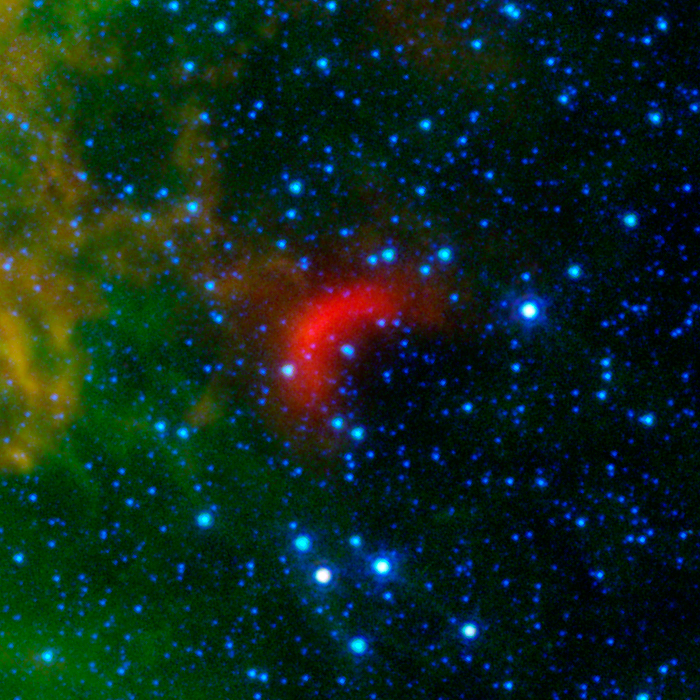
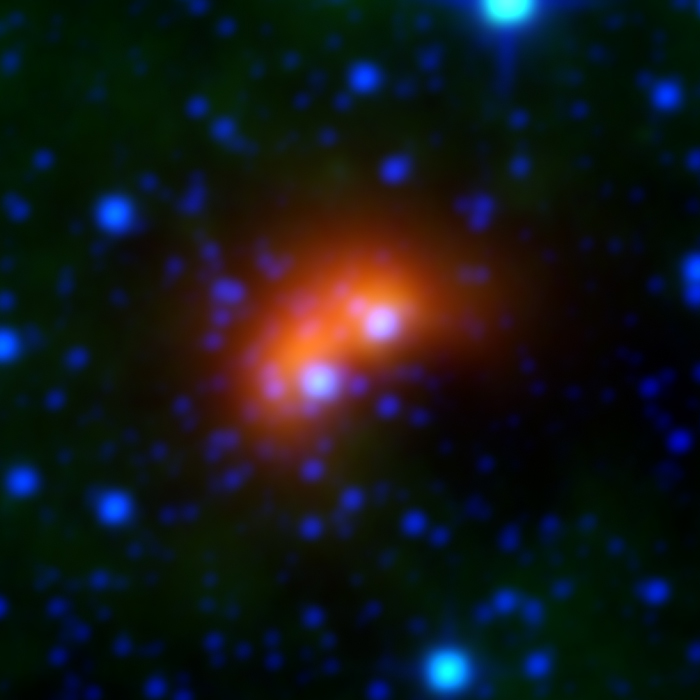
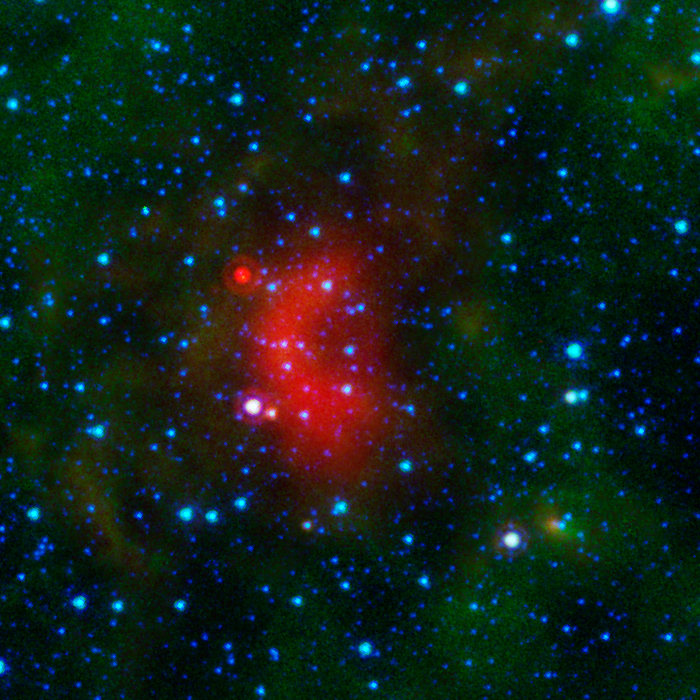
Bow shocks thought to mark the paths of massive, speeding stars are highlighted in these images from NASA's Spitzer Space Telescope and Wide-field Infrared Survey Explorer, or WISE.

click here for Figure 1 for PIA20062click here for Figure 2 for PIA20062click here for Figure 3 for PIA20062
Spitzer
High resolution TIFF file
Spitzer
High resolution TIFF file
WISE
High resolution TIFF file
Click on an individual image for larger views

Bow shocks thought to mark the paths of massive, speeding stars are highlighted in these images from NASA's Spitzer Space Telescope and Wide-field Infrared Survey Explorer, or WISE.

Cosmic bow shocks occur when massive stars zip through space, pushing material ahead of them in the same way that water piles up in front of a race boat. The stars also produce high-speed winds that smack into this compressed material. The end result is pile-up of heated material that glows in infrared light. In these images, infrared light has been assigned the colored red.

Green shows wispy dust in the region and blue shows stars.

The two images at left are from Spitzer, and the one on the right is from WISE.

The speeding stars thought to be creating the bow shocks can be seen at the center of each arc-shaped feature. The image at right actually consists of two bow shocks and two speeding stars. All the speeding stars are massive, ranging from about 8 to 30 times the mass of our sun.

NASA's Jet Propulsion Laboratory, Pasadena, Calif., manages the Spitzer Space Telescope and WISE missions for NASA's Science Mission Directorate, Washington.

For more information about Spitzer, visit http://www.nasa.gov/spitzer and http://spitzer.caltech.edu.

More information is online at http://www.nasa.gov/wise and http://wise.astro.ucla.edu and http://www.jpl.nasa.gov/wise.

Download JPG
Download TIFF
Mission
Instrument
  • Spitzer Space Telescope
  • WISE Telescope
Credit
NASA/JPL-Caltech/University of Wyoming

Keep Exploring

Orion Nebula in Infrared

Planetesimal Collison Around Star HD 166191 (Illustration)

Exoplanet XO-3b Illustration

Godzilla Nebula Imaged by Spitzer

Four Famous Nebulae

Hidden Supernova Spotted by Spitzer

Spitzer Image of Star Factory W51

Animation of Black Hole Disk Flare in OJ 287

Spitzer California Nebula Mosaic

Spitzer Brown Dwarf Wind (Artist's Concept)

About JPL
Who We Are
Directors
Careers
Internships
The JPL Story
JPL Achievements
Documentary Series
JPL Annual Report
Executive Council
Missions
Current
Past
Future
All
News
All
Earth
Solar System
Stars and Galaxies
Eyes on the News
Subscribe to JPL News
Galleries
Images
Videos
Audio
Podcasts
Apps
Visions of the Future
Slice of History
Robotics at JPL
Events
Lecture Series
Speakers Bureau
Calendar
Visit
Public Tours
Virtual Tour
Directions and Maps
Topics
JPL Life
Solar System
Mars
Earth
Climate Change
Exoplanets
Stars and Galaxies
Robotics
More
Asteroid Watch
NASA's Eyes Visualizations
Universe - Internal Newsletter
Social Media
Accessibility at NASA
Contact Us
Get the Latest from JPL
Follow Us

JPL is a federally funded research and development center managed for NASA by Caltech.

More from JPL
Careers
Education
Science & Technology
Acquisition
JPL Store
Careers
Education
Science & Technology
Acquisition
JPL Store
Related NASA Sites
Basics of Spaceflight
NASA Kids Science - Earth
Earth / Global Climate Change
Exoplanet Exploration
Mars Exploration
Solar System Exploration
Space Place
NASA's Eyes Visualization Project
Voyager Interstellar Mission
NASA
Caltech
Privacy
Image Policy
FAQ
Feedback
Version: v3.1.0 - 409b2d2
Site Managers:Emilee Richardson, Alicia Cermak
Site Editors:Naomi Hartono, Steve Carney
CL#:21-0018