
JPL
Careers
Education
Science & Technology
JPL Logo
JPL Logo
Image

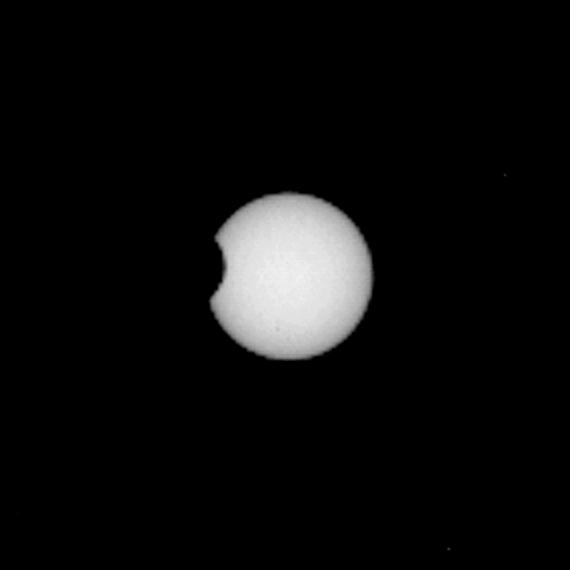
Phobos in Transit

Jet Propulsion Laboratory https://www.jpl.nasa.gov/ Sept. 19, 2012
Mars has two small, asteroid-sized moons named Phobos and Deimos. This frame from an animation shows the point of view of the rover, located near the equator of Mars, as these moons occasionally pass in front of, or 'transit,' the disk of the sun.

Mars has two small, asteroid-sized moons named Phobos and Deimos. From the point of view of the rover, located near the equator of Mars, these moons occasionally pass in front of, or "transit," the disk of the sun. These transit events are the Martian equivalent of partial solar eclipses on Earth because the outline of the moons does not completely cover the sun (in contrast, Earth's moon does block the entire sun during a total solar eclipse). These eclipses, like those on Earth, occur in predictable "seasons" a few times each Mars year.

As part of a multi-mission campaign, NASA's Curiosity rover is observing these transits, the first of which involved the moon Phobos grazing the sun's disk. The event was observed on Martian day, or sol, 37 (September 13, 2012) using Curiosity's Mast Camera, or Mastcam, equipped with special filters for directly observing the sun. In a series of high-resolution video frames acquired at about three frames per second for about two minutes, the outline of part of Phobos blocked about five percent of the sun.

This animation shows the transit as viewed by the Mastcam 100-millimiter camera (M-100) in nine frames. Another version of the animation is available (click on the image above), consisting of 20 frames taken by the Mastcam 34-millimeter camera (M-34), which has about one-third the resolution of the M-100. In total, 256 frames were taken by the M-100 and 384 frames for the M-34.

The transit was also observed by Curiosity's Rover Environmental Monitoring Stations (REMS) instrument, which saw about a five percent drop in the sun's ultraviolet radiation during the event.

Mission scientists use these events to very accurately determine the orbital parameters of the Martian moons. Phobos, for example, orbits very close to Mars and is slowly spiraling in to Mars because of tidal forces. These forces change the orbital position of Phobos over time, and accurate measurements of those changes can provide information about the internal structure of that moon and how it dissipates energy. Deimos orbits much farther away and is slowly spiraling out.

NASA's Mars Exploration Rover Opportunity will also attempt to observe a different set of Phobos and Deimos transits, seen from the other side of the planet, in Meridiani Planum.

Download JPG
Download TIFF
Mission
Target
  • Mars
Spacecraft
  • Curiosity
Instrument
  • Mastcam
Credit
NASA/JPL-Caltech/MSSS

Keep Exploring

Curiosity Works Its Robotic Arm During Sunset

Curiosity’s ChemCam Views Ancient River Channel Peace Vallis

Curiosity Views Gale Crater’s Rim, Homing in on Ancient River Channel

Curiosity’s ChemCam Views Summit and Cliffs Beyond Gale Crater

Curiosity Captures Mars Landscape While Talking to an Orbiter

Curiosity's ChemCam Views a Rock Shaped Like Coral

Curiosity Views a Martian Rock Shaped Like Coral

Curiosity Views Boxwork Patterns at a Distance

Curiosity Views a Fractured Boxwork Pattern Up Close

Curiosity's First 360-Degree View of Boxwork Patterns

About JPL
Who We Are
Directors
Careers
Internships
The JPL Story
JPL Achievements
Documentary Series
JPL Annual Report
Executive Council
Missions
Current
Past
Future
All
News
All
Earth
Solar System
Stars and Galaxies
Eyes on the News
Subscribe to JPL News
Galleries
Images
Videos
Audio
Podcasts
Apps
Visions of the Future
Slice of History
Robotics at JPL
Events
Lecture Series
Speakers Bureau
Calendar
Visit
Public Tours
Virtual Tour
Directions and Maps
Topics
JPL Life
Solar System
Mars
Earth
Climate Change
Exoplanets
Stars and Galaxies
Robotics
More
Asteroid Watch
NASA's Eyes Visualizations
Universe - Internal Newsletter
Social Media
Accessibility at NASA
Contact Us
Get the Latest from JPL
Follow Us

JPL is a federally funded research and development center managed for NASA by Caltech.

More from JPL
Careers
Education
Science & Technology
Acquisition
JPL Store
Careers
Education
Science & Technology
Acquisition
JPL Store
Related NASA Sites
Basics of Spaceflight
NASA Kids Science - Earth
Earth / Global Climate Change
Exoplanet Exploration
Mars Exploration
Solar System Exploration
Space Place
NASA's Eyes Visualization Project
Voyager Interstellar Mission
NASA
Caltech
Privacy
Image Policy
FAQ
Feedback
Version: v3.1.0 - 409b2d2
Site Managers:Emilee Richardson, Alicia Cermak
Site Editors:Naomi Hartono, Steve Carney
CL#:21-0018