
Glittering Trail in Saturn's F Ring

 |  |  |
| Animation 1 | Animation 2 (closeup) | Closed Captioned |
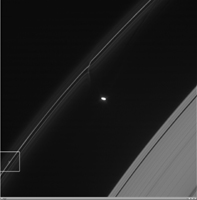
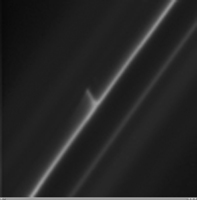
One of the glittering trails caused by small objects punching through Saturn's F ring is highlighted in this movie from NASA's Cassini spacecraft. These trails show how the F ring, the outermost of Saturn's main rings, is constantly changing.
This movie covers seven hours and 23 minutes on Jan. 30, 2009. The moon Prometheus, which averages 53 miles or 86 kilometers across, is the bright body in the middle of the frames. The delicate F ring is the collection of lines initially on the left; the A ring is visible as the denser set of lines initially on the right.
The trail, made of icy particles dragged out of Saturn's F ring, is highlighted in a box that starts at the bottom left. When it first appears, it is about 47 miles (75 kilometers) long. By the end of the sequence, it has stretched to about 155 miles (250 kilometers) long. The object that created the trail is about a half mile (1 kilometer) in diameter. The F ring has a radius of about 87,129 miles (140,220 kilometers).
Also available are a close-up video of the trail and a web video explaining these trails.
Scientists think the trails, also called "mini-jets" by Cassini scientists, are created when small objects about half a mile (1 kilometer) in diameter punch through the F ring and drag icy ring particles behind them. The objects creating the trails were likely originally formed by the pull of the moon Prometheus on tiny F ring particles.
As the moon works its way around Saturn, its gravitational attraction sometimes parts channels in the icy particles of Saturn's F ring and sometimes pushes together sticky snowballs. The moon's continued progress around Saturn pulls some of the snowballs apart over time and adds material to others. These trails appear to be the telltale signs of surviving, evolved snowballs that strike through the F ring on their own. Scientists have been able to use Cassini images to track the objects and be sure they have different orbits from the F ring. The collisions occur at gentle speeds, on the order of 4 mph (2 meters per second).
The images for the video were obtained by Cassini's narrow-angle imaging camera. A longer version of these images with a different projection that focuses on Prometheus, can be seen PIA15501. Other examples of trails like this are available at PIA15502, PIA15503 and PIA15504.
The Cassini-Huygens mission is a cooperative project of NASA, the European Space Agency and the Italian Space Agency. NASA's Jet Propulsion Laboratory, a division of the California Institute of Technology in Pasadena, manages the mission for NASA's Science Mission Directorate, Washington, D.C. The Cassini orbiter was designed, developed and assembled at JPL. The imaging operations center is based at the Space Science Institute in Boulder, Colo.
For more information about the Cassini-Huygens mission visit http://saturn.jpl.nasa.gov and http://www.nasa.gov/cassini. The Cassini imaging team homepage is at http://ciclops.org.