
Clay Minerals in Craters and Escarpments on Mars

 |  |  |  | |
Impact cratering and erosion combine to reveal the composition of the Martian underground by exposing materials from the subsurface. Investigation of exposed clay minerals at thousands of Martian sites by the Compact Reconnaissance Imaging Spectrometer for Mars (CRISM) on NASA's Mars Reconnaissance Orbiter suggests a long period of wet, warm conditions, mostly underground.
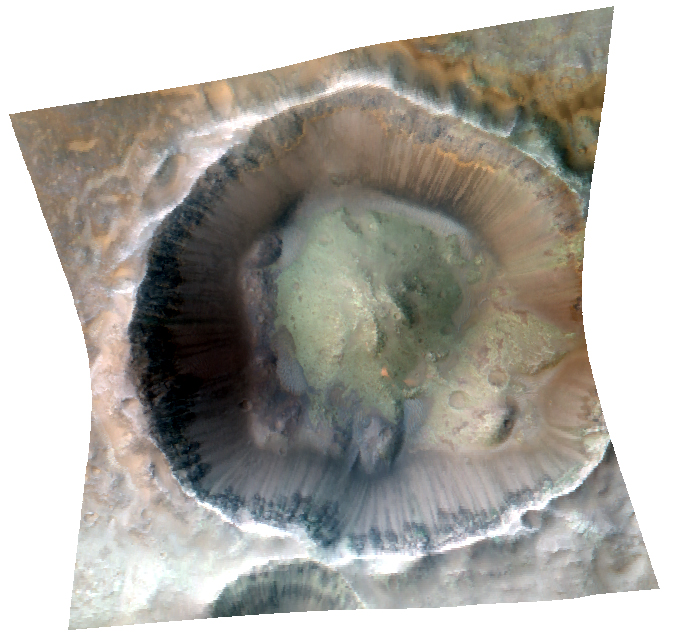
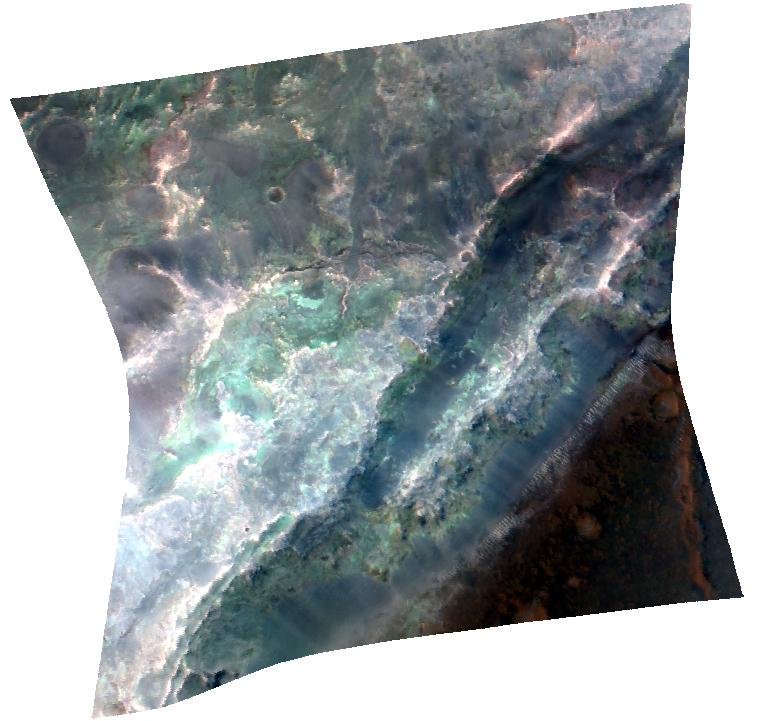
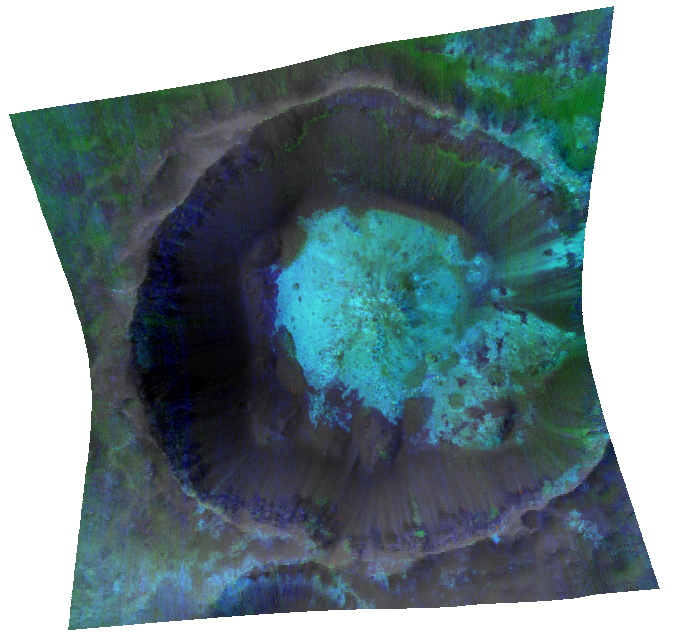
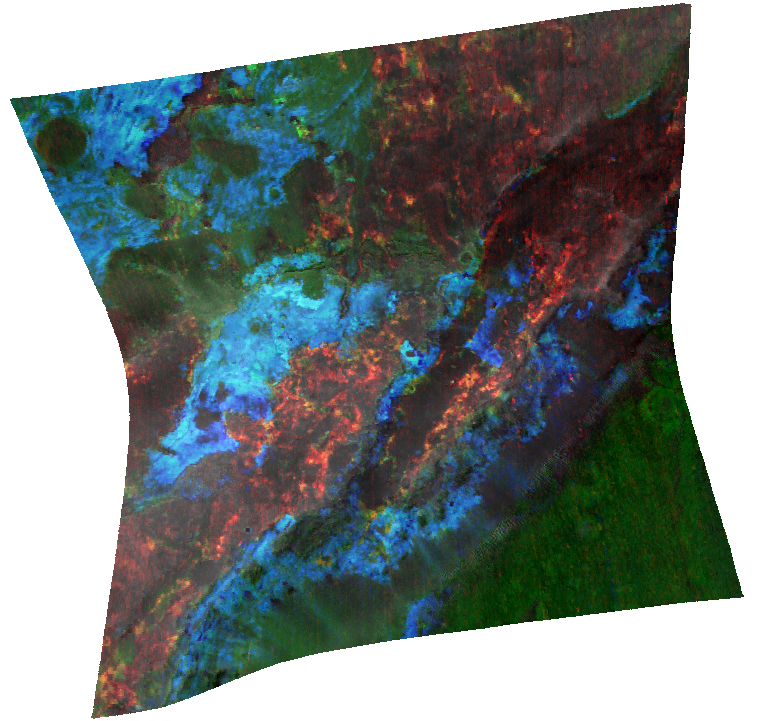
Infrared light indicates terrains of different composition in false-color infrared images (top) of a crater (left) and an escarpment (right). Each of the scenes is about 6 miles (10 kilometers) wide. The lower images of the same sites show how distinctive absorption bands permit identification and mapping of specific minerals. In the lower images, iron-magnesium clays are mapped in blue. These are the most common clays on Mars, occupying large sections of the deep crust and mostly formed by subsurface water. These clays are beneath unaltered volcanic layers that contain the mineral olivine (green). The site shown in the image on the right also contains aluminum clays (red), which formed by waters near the surface. These clays are uncommon on Mars but are sometimes located on top of iron-magnesium clays in a distinctive stratigraphy, indicating formation later in time.
These two example sites, out of thousands where CRISM has observed clay minerals, are at 10.65 degrees south latitude, 98.22 degrees east longitude (left pair) and 22.06 degrees north latitude, 74.63 degrees east latitude (right pair).
In the top two images, the false color comes from presenting observed brightnesses in three different wavelengths of invisible infrared wavelengths -- 2,529 nanometers, 1,506 nanometers and 1,080 nanometers -- as red, green and blue, respectively, composited into color images.
In the bottom two images, colors are assigned to absorption-band characteristics: infrared frequencies at which the materials on the Mars surface are less bright compared to their brightness at other frequencies. The data presented as red are pixel-by-pixel absorption-band depths at 2,210 nanometers, the data presented as green are broad absorption-band depths near 1,000 nanometers, and the data presented as blue are the absorption-band depths at 2,300 nanometers. These color data were then overlain and merged with the brightness at 770 nanometers to show the relationship of detected minerals with underlying topography. For more information on mineral mapping and more CRISM images, see http://crism-map.jhuapl.edu .
NASA's Jet Propulsion Laboratory, a division of the California Institute of Technology, Pasadena, manages the Mars Reconnaissance Orbiter for the NASA Science Mission Directorate, Washington. Lockheed Martin Space Systems, Denver, built the spacecraft. The Johns Hopkins University Applied Physics Laboratory led the effort to build the CRISM instrument and operates CRISM in coordination with an international team of researchers from universities, government and the private sector.