
Schematic of Sample Analysis at Mars (SAM) Instrument

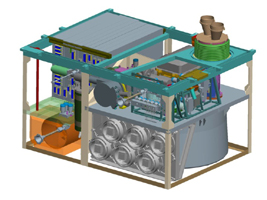
Unannotated Schematic
Click on the image for larger version
The Sample Analysis at Mars (SAM) instrument, largest of the 10 science instruments for NASA's Mars Science Laboratory mission, will examine samples of Martian rocks, soil and atmosphere for information about chemicals that are important to life and other chemical indicators about past and present environments.
NASA's Goddard Space Flight Center, Greenbelt, Md., built SAM. The instrument actually includes three different laboratory instruments for analyzing chemistry, plus mechanisms for handling and processing samples. SAM will examine gases from the Martian atmosphere, as well as gases that ovens and solvents pull from powdered rock and soil samples.
This schematic illustration shows major components of the microwave-oven-size instrument, which was installed into the mission's rover, Curiosity, in January 2011.
The quadrupole mass spectrometer identifies gases by the molecular weight and electrical charge of their ionized states. It will check for several elements important for life as we know it, including carbon, nitrogen, sulfur and oxygen contained in volatile molecules.
The tunable laser spectrometer uses absorption of light at specific wavelengths to measure concentrations of selected chemicals, such as methane, carbon dioxide and water vapor. It also identifies the proportions of different isotopes in those gases. Isotopes are variants of the same element with different atomic weights, and their ratios can provide clues about the planet's history.
The gas chromotograph separates different gases from a mixture to aid identification. It has its own detector but also feeds the separated fractions to the quadrupole mass spectrometer and the tunable laser spectrometer for more detailed analysis.
The solid sample inlet tubes are where the rover's robotic arm will deliver powdered samples that the rover drills from rocks or scoops from soil. The inlet is a highly polished funnel that vibrates to get all of the sample material down into a cup at the bottom of the tube.
The sample manipulation system has a wheel of small cups for moving the powdered samples to the next steps in analysis. Fifty-nine of the system's 74 cups are quartz cups that can be heated to very high temperature for pulling gases from the powder. Six others are calibration materials. The other nine are for samples treated with a combination of solvents and lower heating rather than high heat.
The chemical separation and processing laboratory includes valves, pumps, carrier-gas reservoirs and regulators, pressure monitors, chemical scrubbers, and two ovens that can heat samples to about 1,000 degrees Celsius (1,800 degrees Fahrenheit).
The atmospheric inlets admit gases from the Martian atmosphere for analysis.
The wide range pump, about 4 centimeters (1.6 inches) across, spins at up to 100,000 revolutions per minute for moving gases out of the system between analyses of different samples.
NASA will launch Curiosity from Florida between Nov. 25 and Dec. 18, 2011, together with other parts of the Mars Science Laboratory spacecraft for delivering the rover to the surface of Mars in August, 2012. During a prime mission lasting one Mars year (two Earth years), researchers will use the rover in one of the most intriguing areas of Mars to investigate whether conditions there have been favorable for microbial life and favorable for preserving evidence about whether life has existed.
NASA's Jet Propulsion Laboratory, a division of the California Institute of Technology in Pasadena, manages the Mars Science Laboratory mission for the NASA Science Mission Directorate, Washington.