
Lightning Flashing on Saturn

 |  |
| Figure 1 Montage | Movies No Audio With Audio |
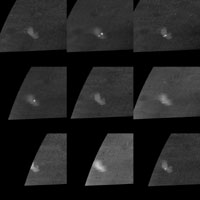
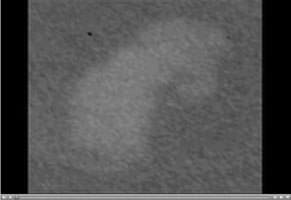
This image from NASA's Cassini spacecraft -- the first of its kind -- shows lightning on Saturn's night side flashing in a cloud that is illuminated by light from Saturn's rings.
The cloud, whose longest dimension is about 3,000 kilometers (1,900 miles), does not change perceptibly over the 16 minutes of observations covered by the 10-second movie. The lightning flashes are the bright spots within the cloud, and are about 300 kilometers in diameter. The lightning strikes last for short periods of time (less than one second before the time line of the movie was compressed).
The energy output of the visible light from the lightning is comparable to the brightest lightning flashes on Earth.
At Saturn, there are three types of clouds that might produce lightning. The top layer is made of ammonia ice; the middle layer is made of a compound of hydrogen sulfide and ammonia; the bottom layer is water. The light has to diffuse up through this cloud system, which is over 100 kilometers (60 miles) thick. The width of the lightning spot at the top of the cloud is proportional to the depth where the flash originated. The observed widths indicate that the lightning is originating either in the hydrogen-sulfide-ammonia cloud or in the water ice cloud. The lightning does not appear to originate at the deepest levels of the cloud system, where water is liquid.
Included here is a three-by-three montage of nine frames showing some of the lightning flashes.
The movie uses data from two Cassini instruments: the visible light cameras of the imaging science subsystem (ISS) and the radio and plasma wave science (RPWS) instrument. The movie compresses 16 minutes of narrow-angle-camera ISS images down to 10 seconds. The images show the storm cloud and its surroundings, but changes in the shape of such a large cloud over such a short time are imperceptible. The lightning flashes appear as short bursts of light within the cloud.
The sound track (movie with audio) gives synthetic lightning sounds at the times the radio signals from the lightning were recorded by the RPWS instrument. The radio signals themselves are at frequencies above the range detectable by the human ear, so the sound of thunder would not be appropriate. The imaging team instead chose electrical spark sounds to represent the radio signals.
Both the ISS team and RPWS team have gaps in their observations during the 16 minutes the movie covers, so some radio signals do not have a flash to go with them and vice versa.
The ISS instrument saw lightning for the first time during the August 2009 northern spring equinox. The RPWS instrument has been detecting lightning at radio wavelengths since Cassini's arrival at Saturn in 2004. Now, seeing the lightning allows scientists to pinpoint its location and measure the optical properties of the flash. Saturnian lightning has interesting differences from lightning on Earth. While Cassini has been observing, only one storm has been active at any one time, and all the storms have been at the same latitude, around 35 degrees south latitude. The storms turn on and off on a timescale of several months. The storm in this movie occurs at this same latitude even after the change of Saturnian seasons at equinox.
This movie is a concatenation of nine images taken in visible light with the Cassini spacecraft narrow-angle camera on Nov. 30, 2009. This view is centered on terrain at about 35 degrees south latitude, 45 degrees west longitude. The view was obtained at a distance of approximately 2.6 million kilometers (1.6 million miles) from Saturn. The images were re-projected to a simple cylindrical map projection with a scale of 30 kilometers (19 miles) per pixel.
The Cassini-Huygens mission is a cooperative project of NASA, the European Space Agency and the Italian Space Agency. The Jet Propulsion Laboratory, a division of the California Institute of Technology in Pasadena, manages the mission for NASA's Science Mission Directorate in Washington. The Cassini orbiter and its two onboard cameras were designed, developed and assembled at JPL. The imaging team is based at the Space Science Institute, Boulder, Colo. The radio and plasma wave team is based at the University of Iowa, Iowa City.
For more information about the Cassini-Huygens mission visit http://www.nasa.gov/cassini and http://saturn.jpl.nasa.gov. The Cassini imaging team homepage is at http://ciclops.org. The radio and plasma wave team homepage is at http://www-pw.physics.uiowa.edu/cassini/.