
Shadow from the Dark Side

Click on the image for movie
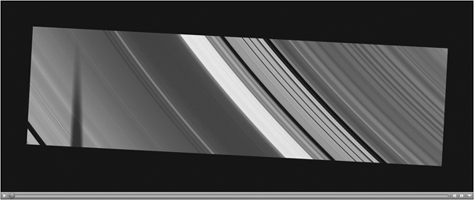
The shadow of Saturn's moon Tethys seems to disappear as it crosses the planet's rings, demonstrating variations in the density of particles across the rings.
These images, which were combined to create a mosaic and a movie, show Saturn's A ring on the left, Cassini Division in the middle and dense outer B ring on the right. The Cassini spacecraft looks toward the unilluminated side of the rings in these frames from about 49 degrees above the ringplane.
The densest parts of the B ring do not let much sunlight pass through to the spacecraft's camera. Consequently, one might expect these dense areas to appear dark because they are on the dark side of the rings and also because the moon's shadow is draped across them. However, these dense areas may appear brighter than expected in this geometry most likely from Saturnshine reflecting from them: denser regions should look brighter in Saturnshine than other regions. As a result, the moon's shadow appears cut off and diminished in these areas.
Seventeen images, each taken about 2 minutes and 17 seconds apart, were combined to create this mosaic and movie. Contiguous images were stitched together to create the mosaic showing the whole swath of the rings across which the moon's shadow passed. Tethys itself is not shown.
The novel illumination geometry created as the Saturnian system approaches equinox allows moons orbiting in or near the plane of Saturn's equatorial rings to cast shadows onto the rings. These scenes are possible only during the few months before and after Saturn's equinox which occurs only once in about 15 Earth years. To see similar movie and mosaic of Mimas' shadow moving across the unlit side of the rings, see PIA11660.
These images have been processed, and background stars have been removed. The images were taken in visible light with the Cassini spacecraft narrow-angle camera on April 29, 2009. The view was acquired at a distance of approximately 1.3 million kilometers (808,000 miles) from Saturn and at a Sun-Saturn-spacecraft, or phase, angle of 52 degrees. Image scale is 8 kilometers (5 miles) per pixel.
The Cassini-Huygens mission is a cooperative project of NASA, the European Space Agency and the Italian Space Agency. The Jet Propulsion Laboratory, a division of the California Institute of Technology in Pasadena, manages the mission for NASA's Science Mission Directorate, Washington, D.C. The Cassini orbiter and its two onboard cameras were designed, developed and assembled at JPL. The imaging operations center is based at the Space Science Institute in Boulder, Colo.
For more information about the Cassini-Huygens mission visit http://saturn.jpl.nasa.gov/. The Cassini imaging team homepage is at http://ciclops.org.