
JPL
Careers
Education
Science & Technology
JPL Logo
JPL Logo
Image

Light Travels Through AIRS Optics

Jet Propulsion Laboratory https://www.jpl.nasa.gov/ Sept. 17, 2008
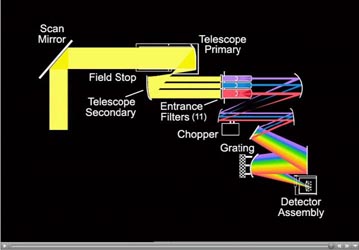
Light energy is collected by the optics system on the Atmospheric Infrared Sounder (AIRS) instrument and digitized.

Click here for annotated version of PIA11170
Click on image to view the movie

This animation shows how light energy is collected by the optics system on the Atmospheric Infrared Sounder (AIRS) instrument and digitized.

Energy from the scene is directed by the scan mirror into the AIRS telescope. The telescope collects the Earth scene energy and defines the instantaneous field of view (the 1.1 degree spot on the ground as opposed to the +/- 50 degree earth scan field of view). Filters located at the entrance to the spectrometer separate the energy into 11 different spectral ranges. Optical elements direct this energy to a grating which disperses the energy into a continuum of frequencies. The detector elements then collect discrete spectralranges of (i.e. frequencies) of energy which define the 2378 AIRS infrared spectral channels. The signals from the detectors are digitized, formatted, etc. and transmitted to the spacecraft which broadcast the data to the ground.

About AIRS
The Atmospheric Infrared Sounder, AIRS, in conjunction with the Advanced Microwave Sounding Unit, AMSU, senses emitted infrared and microwave radiation from Earth to provide a three-dimensional look at Earth's weather and climate. Working in tandem, the two instruments make simultaneous observations all the way down to Earth's surface, even in the presence of heavy clouds. With more than 2,000 channels sensing different regions of the atmosphere, the system creates a global, three-dimensional map of atmospheric temperature and humidity, cloud amounts and heights, greenhouse gas concentrations, and many other atmospheric phenomena. Launched into Earth orbit in 2002, the AIRS and AMSU instruments fly onboard NASA's Aqua spacecraft and are managed by NASA's Jet Propulsion Laboratory in Pasadena, Calif., under contract to NASA. JPL is a division of the California Institute of Technology in Pasadena.

More information about AIRS can be found at http://airs.jpl.nasa.gov.

Download JPG
Download TIFF
Mission
Spacecraft
  • Aqua
Instrument
  • Atmospheric Infrared Sounder (AIRS)
Credit
NASA/JPL

Keep Exploring

NASA's AIRS Instrument Captures Hurricane Helene

California Atmospheric River Storms Captured by NASA's AIRS

NASA's AIRS Instrument Tracks Volcanic Sulfur Dioxide Plume from Mauna Loa Eruption

Hurricane Ian Captured in Infrared by AIRS

AIRS Images Typhoon Hinnamnor Ahead of Landfall

State Low-Humidity Thresholds for Flu Outbreaks

AIRS Temperature Anomalies

Hurricane Nicholas Before and After Landfall

Hurricane Ida Before Landfall

July 2021 Heat Wave Surface Temperature

About JPL
Who We Are
Directors
Careers
Internships
The JPL Story
JPL Achievements
Documentary Series
JPL Annual Report
Executive Council
Missions
Current
Past
Future
All
News
All
Earth
Solar System
Stars and Galaxies
Eyes on the News
Subscribe to JPL News
Galleries
Images
Videos
Audio
Podcasts
Apps
Visions of the Future
Slice of History
Robotics at JPL
Events
Lecture Series
Speakers Bureau
Calendar
Visit
Public Tours
Virtual Tour
Directions and Maps
Topics
JPL Life
Solar System
Mars
Earth
Climate Change
Exoplanets
Stars and Galaxies
Robotics
More
Asteroid Watch
NASA's Eyes Visualizations
Universe - Internal Newsletter
Social Media
Accessibility at NASA
Contact Us
Get the Latest from JPL
Follow Us

JPL is a federally funded research and development center managed for NASA by Caltech.

More from JPL
Careers
Education
Science & Technology
Acquisition
JPL Store
Careers
Education
Science & Technology
Acquisition
JPL Store
Related NASA Sites
Basics of Spaceflight
NASA Kids Science - Earth
Earth / Global Climate Change
Exoplanet Exploration
Mars Exploration
Solar System Exploration
Space Place
NASA's Eyes Visualization Project
Voyager Interstellar Mission
NASA
Caltech
Privacy
Image Policy
FAQ
Feedback
Version: v3.0.29 - 4bc7967
Site Managers:Emilee Richardson, Alicia Cermak
Site Editors:Naomi Hartono, Steve Carney
CL#:21-0018