
JPL
Careers
Education
Science & Technology
JPL Logo
JPL Logo
Image

Cauldron of Light

Jet Propulsion Laboratory https://www.jpl.nasa.gov/ May 29, 2008
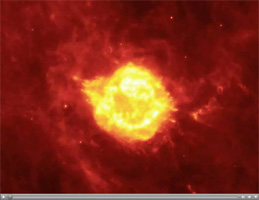
A seething cauldron of light appears to bubble and ooze around the remains of a giant star that astronomers have been watching tear itself apart for the last 300 years. Different observations taken over three years by NASA's Spitzer Space Telescope.

Click here for animation of PIA10724 Cauldron of Light
Click on image to view the animation

In this animation, a seething cauldron of light appears to bubble and ooze around the remains of a giant star that astronomers have been watching tear itself apart for the last 300 years. This movie flips quickly between different observations taken over three years by NASA's Spitzer Space Telescope.

Beginning in the center, the well-studied Cassiopeia A supernova remnant is shown. Cassiopeia A is the remnant of a once massive star that died in a violent supernova explosion. It consists of a dead star, called a neutron star, and a surrounding shell of material that was blasted off as the star died.

Panning outward, "light echoes" create the illusion of motion in the clouds, as different areas of the material are lit up in succession by the light flash of the supernova. A light echo occurs when a star explodes, acting like a cosmic flashbulb. The light from this explosion zips through nearby dust clumps, illuminating and heating them up slightly. This brief period of warming causes them to glow in infrared, like a chain of Christmas bulbs lighting up one by one. The result is an optical illusion, in which the dust appears to be flying outward at the speed of light.

In reality, the clouds are stationary, at least in the brief time over which these observations were taken. The inclination of the clouds cause some light echoes to appear to expand away from the supernova remnant, while others move towards it or boil in many directions with seeming turbulence.

Download JPG
Download TIFF
Mission
Target
  • Cassiopeia A
Credit
NASA/JPL-Caltech/MPIA

Keep Exploring

Orion Nebula in Infrared

Planetesimal Collison Around Star HD 166191 (Illustration)

Exoplanet XO-3b Illustration

Godzilla Nebula Imaged by Spitzer

Four Famous Nebulae

Hidden Supernova Spotted by Spitzer

Spitzer Image of Star Factory W51

Animation of Black Hole Disk Flare in OJ 287

Spitzer California Nebula Mosaic

Spitzer Brown Dwarf Wind (Artist's Concept)

About JPL
Who We Are
Directors
Careers
Internships
The JPL Story
JPL Achievements
Documentary Series
JPL Annual Report
Executive Council
Missions
Current
Past
Future
All
News
All
Earth
Solar System
Stars and Galaxies
Eyes on the News
Subscribe to JPL News
Galleries
Images
Videos
Audio
Podcasts
Apps
Visions of the Future
Slice of History
Robotics at JPL
Events
Lecture Series
Speakers Bureau
Calendar
Visit
Public Tours
Virtual Tour
Directions and Maps
Topics
JPL Life
Solar System
Mars
Earth
Climate Change
Exoplanets
Stars and Galaxies
Robotics
More
Asteroid Watch
NASA's Eyes Visualizations
Universe - Internal Newsletter
Social Media
Accessibility at NASA
Contact Us
Get the Latest from JPL
Follow Us

JPL is a federally funded research and development center managed for NASA by Caltech.

More from JPL
Careers
Education
Science & Technology
Acquisition
JPL Store
Careers
Education
Science & Technology
Acquisition
JPL Store
Related NASA Sites
Basics of Spaceflight
NASA Kids Science - Earth
Earth / Global Climate Change
Exoplanet Exploration
Mars Exploration
Solar System Exploration
Space Place
NASA's Eyes Visualization Project
Voyager Interstellar Mission
NASA
Caltech
Privacy
Image Policy
FAQ
Feedback
Version: v3.0.29 - 4bc7967
Site Managers:Emilee Richardson, Alicia Cermak
Site Editors:Naomi Hartono, Steve Carney
CL#:21-0018