
JPL
Careers
Education
Science & Technology
JPL Logo
JPL Logo
Image

Galaxy Evolution Explorer Celebrates Five Years in Space

Jet Propulsion Laboratory https://www.jpl.nasa.gov/ April 28, 2008
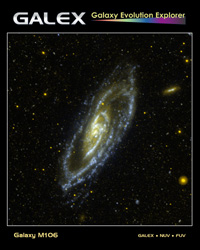
Since its launch five years ago, the Galaxy Evolution Explorer has photographed hundreds of millions of galaxies in ultraviolet light. M106 is one of those galaxies, 22 light years away.

Click here for poster version of PIA10600
Poster Version

Since its launch five years ago, the Galaxy Evolution Explorer has photographed hundreds of millions of galaxies in ultraviolet light. M106 is one of those galaxies, and from 22 light years away, it strikes a pose in blue and gold for this new commemorative portrait.

The galaxy's extended arms are the blue filaments that curve around its edge, creating its outer disk. Tints of blue in M106's arms reveal hot, young massive stars. Traces of gold toward the center show an older stellar population and indicate the presence of obscuring dust.

From 24 million light-years away, neighboring galaxy NGC 4248 also makes a memorable appearance, sitting just right of M106. The irregular galaxy looks like a yellow smudge, with a bluish-white bar in the center. The galaxy's outer golden glow indicates a population of older stars, while the blue central region shows a younger stellar demographic.

Dwarf galaxy UGC 7365 emerges at the bottom center of this image, as a faint yellow smudge directly below M106. This galaxy is not forming any new stars, and looks much smaller than M106 despite being closer to Earth, at 14 million light-years away.

Over the past five years, the Galaxy Evolution Explorer has imaged half a billion objects over 27,000 square degrees of sky —equivalent to an area that would be covered by 138,000 full moons. The telescope orbits Earth every 94 minutes and travels approximately 408,470 million miles per day. Its overarching question is: how do galaxies grow and change over 10 billion years of cosmic history?

M106, also known as NGC 4258, is located in the constellation Canes Venatici. This image is a two-color composite, where far-ultraviolet light is blue, and near-ultraviolet light is red.

Download JPG
Download TIFF
Mission
Spacecraft
  • GALEX Orbiter
Credit
NASA/JPL-Caltech

Keep Exploring

The Blue Ring Nebula

Geometry of the Blue Ring Nebula (Animation)

Flaring Red Dwarf Star (Illustration)

Pulsar Candidate in Andromeda

Frankenstein Galaxy

Andromeda in High-Energy X-rays

After the Explosion: Investigating Supernova Sites

Galaxies Grow from Inside Out

Big Brother to the Milky Way

Galaxy's Pencil-Thin Profile

About JPL
Who We Are
Directors
Careers
Internships
The JPL Story
JPL Achievements
Documentary Series
JPL Annual Report
Executive Council
Missions
Current
Past
Future
All
News
All
Earth
Solar System
Stars and Galaxies
Eyes on the News
Subscribe to JPL News
Galleries
Images
Videos
Audio
Podcasts
Apps
Visions of the Future
Slice of History
Robotics at JPL
Events
Lecture Series
Speakers Bureau
Calendar
Visit
Public Tours
Virtual Tour
Directions and Maps
Topics
JPL Life
Solar System
Mars
Earth
Climate Change
Exoplanets
Stars and Galaxies
Robotics
More
Asteroid Watch
NASA's Eyes Visualizations
Universe - Internal Newsletter
Social Media
Accessibility at NASA
Contact Us
Get the Latest from JPL
Follow Us

JPL is a federally funded research and development center managed for NASA by Caltech.

More from JPL
Careers
Education
Science & Technology
Acquisition
JPL Store
Careers
Education
Science & Technology
Acquisition
JPL Store
Related NASA Sites
Basics of Spaceflight
NASA Kids Science - Earth
Earth / Global Climate Change
Exoplanet Exploration
Mars Exploration
Solar System Exploration
Space Place
NASA's Eyes Visualization Project
Voyager Interstellar Mission
NASA
Caltech
Privacy
Image Policy
FAQ
Feedback
Version: v3.1.0 - 409b2d2
Site Managers:Emilee Richardson, Alicia Cermak
Site Editors:Naomi Hartono, Steve Carney
CL#:21-0018