
Mississippi Delta, Radar Image with Colored Height

Click on the image for the animation
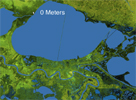
About the animation: This simulated view of the potential effects of storm surge flooding on Lake Pontchartrain and the New Orleans area was generated with data from the Shuttle Radar Topography Mission. Although it is protected by levees and sea walls against storm surges of 18 to 20 feet, much of the city is below sea level, and flooding due to storm surges caused by major hurricanes is a concern. The animation shows regions that, if unprotected, would be inundated with water. The animation depicts flooding in one-meter increments.
About the image: The geography of the New Orleans and Mississippi delta region is well shown in this radar image from the Shuttle Radar Topography Mission. In this image, bright areas show regions of high radar reflectivity, such as from urban areas, and elevations have been coded in color using height data also from the mission. Dark green colors indicate low elevations, rising through yellow and tan, to white at the highest elevations.
New Orleans is situated along the southern shore of Lake Pontchartrain, the large, roughly circular lake near the center of the image. The line spanning the lake is the Lake Pontchartrain Causeway, the world's longest over water highway bridge. Major portions of the city of New Orleans are below sea level, and although it is protected by levees and sea walls, flooding during storm surges associated with major hurricanes is a significant concern.
Data used in this image were acquired by the Shuttle Radar Topography Mission aboard the Space Shuttle Endeavour, launched on Feb. 11, 2000. The mission used the same radar instrument that comprised the Spaceborne Imaging Radar-C/X-Band Synthetic Aperture Radar that flew twice on the Space Shuttle Endeavour in 1994. The Shuttle Radar Topography Mission was designed to collect 3-D measurements of the Earth's surface. To collect the 3-D data, engineers added a 60-meter (approximately 200-foot) mast, installed additional C-band and X-band antennas, and improved tracking and navigation devices. The mission is a cooperative project between NASA, the National Geospatial-Intelligence Agency of the U.S. Department of Defense and the German and Italian space agencies. It is managed by NASA's Jet Propulsion Laboratory, Pasadena, Calif., for NASA's Science Mission Directorate, Washington, D.C.
Location: 30 degrees North latitude, 90 degrees East longitude
Orientation: North toward the top, Mercator projection
Size: 222.6 by 192.8 kilometers (138.3 by 119.8 miles)
Image Data: Radar image and colored Shuttle Radar Topography Mission elevation model
Date Acquired: February 2000