
Small Volcano in Terra Cimmeria
Jet Propulsion Laboratory https://www.jpl.nasa.gov/ June 26, 2002

(Released 26 June 2002)
The Science
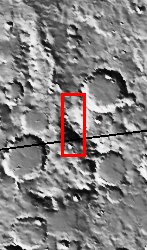
This positive relief feature (see MOLA context) in the ancient highlands of Mars appears to be a heavily eroded volcanic center. The top of this feature appears to be under attack by the erosive forces of the martian wind. Light-toned streaks are visible, trending northeast to southwest, and may be caused by scouring of the terrain, or they may be dune forms moving sand. The northeast portion of the caldera area looks as though a layer of material is being removed to expose a slightly lighter-toned surface underneath. The flanks of this feature are slightly less cratered than the surrounding terrain, which could be explained in two ways: 1) this feature may be younger than the surrounding area, and has had less time to accumulate meteorite impacts, or 2) the slopes that are observed today may be so heavily eroded that the original, cratered surfaces are now gone, exposing relatively uncratered rocks. Although most of Terra Cimmeria has low albedo, some eastern portions, such as shown in this image, demonstrate an overall lack of contrast that attests to the presence of a layer of dust mantling the surface. This dust, in part, is responsible for the muted appearance and infill of many of the craters at the northern and southern ends of this image
The Story
This flat-topped volcano pops out from the surface, the swirls of its ancient lava flows running down onto the ancient highlands of Mars. Its smooth top appears to be under attack by the erosive forces of the martian wind.
How can you tell? Click on the image above for a close-up look. You'll see some light-toned streaks that run in a northeast-southwest direction. They are caused either by the scouring of the terrain or dunes of moving sand. Either way, the wind likely plays upon the volcano's surface. Look also for the subtle, nearly crescent shaped feature at the northeast portion of the volcano's cap. It looks as if a layer of material has been removed by the wind, exposing a slightly lighter-toned surface underneath.
The sides of the volcano are less cratered than the rest of the terrain. Perhaps that means it is younger than the surrounding area and has had less time to accumulate meteorite impacts. On the other hand, perhaps erosion has scrubbed away the original cratered surfaces. It's a little hard to tell which possibility holds the key to the history of this area.
Although most of Terra Cimmeria can look relatively darker (has a low albedo or low "reflective power") than some other Martian areas, its eastern portions sometimes have an overall lack of contrast as seen in the above image. A layer of dust blankets the surface here, causing it to look muted. Many of the craters in the northern and southern ends of the image also seem subdued, as dust has partly filled in the stark holes they once created.
The Cimmerians who give their name to this region were an ancient, little-known people of southern Russia mentioned in Assyrian inscriptions and by Homer.