
Northern Arabia Etched Terrain
Jet Propulsion Laboratory https://www.jpl.nasa.gov/ June 17, 2002

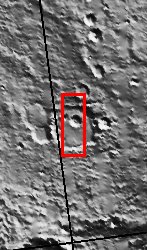
(Released 23 May 2002)
The Science
Many places on Mars display scabby, eroded landscapes that commonly are referred to as etched terrain. These places have a ragged, tortured look that reveals a geologic history of intense deposition and erosion. This THEMIS image shows such a place. Here a 10 km diameter crater is superposed on the floor of a 40 km diameter crater, most of which is outside of the image but apparent in the MOLA context image. The rugged crater rim material intermingles with low, flat-topped mesas and layers with irregular outlines along with dune-like ridges on many of the flat surfaces. The horizontal layers that occur throughout the scene at different elevations are evidence of repeated episodes of deposition. The apparent ease with which these deposits have been eroded, most likely by wind, suggests that they are composed of poorly consolidated material. Air-fall sediments are the likely candidate for this material rather than lava flows. The dune-like ridges are probably inactive granule ripples produced from the interaction of wind and erosional debris. The large interior crater displays features that are the result of deposition and subsequent erosion. Its raised rim is barely discernible due to burial while piles and blocks of slumped material along the interior circumference attest to the action of erosion. Some of the blocks retain the same texture as the surrounding undisrupted surface. It appears as if the crater had been buried long enough for the overlying material to be eroded into the texture seen today. Then at some point this overburden foundered and collapsed into the crater. Continuing erosion has caused the upper layer to retreat back from what was probably the original rim of the crater, producing the noncircular appearance seen today. The length of time represented by this sequence of events as well as the conditions necessary to produce them are unknown.
The Story
Have you ever seen an ink etching, where the artistic cross-hatching of lines creates the image of a town or a landscape? Click on the large THEMIS image above, and you'll see why this scabby, eroded landscape is known as etched terrain. Etched terrain is found in lots of areas of Mars. These places have a ragged, tortured look that reveals a geologic history where material has been deposited and eroded away with great intensity over time.
Much of the terrain looks like peeling, layered-on paint. In a sense, that's what it's all about. Deposits of dust and dirt settled down from the air in layer after uneven layer, while the wind kept eroding it away. Dune-like ridges also mark the surface in tiny ripples. Unlike the loose sand dunes we're familiar with on Earth, these ridges are probably harder and more stationary, They are produced by long-term interactions between the sculpting, knife-like action of the Martian wind and the deposited materials of dust and "dirt" on the surface.
What we can also see in this image is a six-mile-wide crater. If you look at the context image to the right, you can see that it is actually a crater within a crater. The larger crater is about 24 miles wide in diameter. (Students! How many times bigger is the larger crater than the one that lies inside of it? If you look at the context image, you can get a really good sense of what "four times bigger" really means.)
What's interesting about this crater is that it doesn't have typical features known to many craters: it isn't nice-and-neatly round and its raised rim is barely noticeable. That's because there's been a whole lot of depositing and eroding going on here too. After the impact crater formed, it was probably entirely buried by deposits over time. In fact, it was probably buried long enough for the overlying material to be eroded into the texture seen today. At some point, the load on top foundered and collapsed into the crater.
Around the inside circumference of the crater, you can see piles of slumped material (material that has slid downslope). Some of these blocks of material have the same texture as surrounding terrain that hasn't been disrupted. That's because of continuing erosion acting on all of these features. In the upper layers, continuing erosion has also caused a retreat from the original rim of the crater, producing the noncircular shape seen today.