
Hadriaca Patera
Jet Propulsion Laboratory https://www.jpl.nasa.gov/ June 4, 2002

(Released 17 May 2002)
The Science
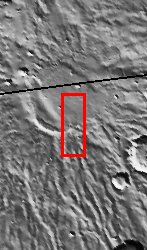
Although the largest volcanoes on Mars (and the solar system) are located in the geologically young Tharsis region, there are many other martian volcanoes that display equally interesting features, such as Hadriaca Patera, shown in this image. Hadriaca Patera is located to the northeast of the Hellas Planitia impact basin in the southern hemisphere. Unlike the Tharsis volcanoes, Hadriaca Patera has very low relief, standing only about 1-2 km above the surrounding plains. Many scientists believe that Hadriaca Patera and other patera volcanoes (e.g., Tyrrhena) had significant interaction with subsurface water that produced mostly explosive ash deposits (pyroclastic flows), rather than just lava flows. Nearby sources of water might have included Dao Vallis on the southern flank of the volcano. The upper portion of this image shows relatively smooth terrain located in the central caldera, which has been nearly filled in with late-stage lava flows. The lower half of the image shows lobate flows as well as furrows in the ash deposits that make up the volcano's southern flank; these erosional furrows may have formed by surface runoff or sapping by groundwater. Just below the center of the image, a few small sinuous troughs are visible, and may be collapsed lava tubes or collapse features related to subsurface water. The number of impact craters on a planetary surface is commonly used as a proxy for the age of the surface -- an old surface has had time to accumulate more craters than a young surface. The relatively small number of large craters in the image indicates that the surface in this area is younger than the nearby heavily cratered ancient terrains outside the Hellas basin, but there are more craters on this surface than would be found on the average volcanic surface in Tharsis (there are some very large old craters on the volcano's flank to the southeast of this image). Paterae in general are older than the Tharsis volcanoes. At the far right edge of the central portion of the image, an ovoid-shaped crater is visible. Such craters are believed to form by extremely low-angle impact events.
The Story
If you look at the context image to the right, you'll see a large round circle. That's the ancient mouth of the volcano, not a crater. This volcano is named Hadriaca Patera. Even though Mars is known as the home of the largest volcanoes in the solar system, this mile-high volcano isn't very tall compared to its cousins in a region of Mars called Tharsis.
As a result, you might think that paterae volcanoes like this one are relatively undistinguished as Martian volcanoes go, but it turns out they are probably much older. The number of craters on the surface in the area tells us so. Older surfaces have had time to accumulate many more craters. Not all craters, however, are almost perfectly round. Look for the egg-shaped crater (far right edge of the central portion of the image). Crater shapes like this one are caused when an impacting body comes in toward the surface at an extremely low angle.
More than being older, paterae volcanoes are really interesting to scientists because they may have interacted with subsurface water. With that "ingredient," these volcanoes spat out explosive ash deposits instead of just lava flows. Mars may look calm now, but wow! It sure wasn't in the past.
There are many signs of the volcano's past activity. In the upper portion of the image, the mouth of the volcano has been filled in with late-stage lava flows. Down below, a layering of flows is further scored with erosional furrows formed either by surface runoff or when groundwater eroded the surface from underneath, causing it to sink. Near the center of the image, collapsed lava tubes (or other collapse features related to subsurface water) texture the surface as well.