
JPL
Careers
Education
Science & Technology
JPL Logo
JPL Logo
Image

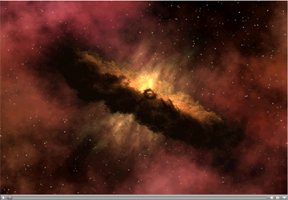
Genesis of a Comet (Artist's Concept)

Jet Propulsion Laboratory https://www.jpl.nasa.gov/ July 1, 2005
This artist's concept depicts one of the most widely accepted theories pertaining to the origin of comets. This image is courtesy of NASA's Spitzer Science Center at the California Institute of Technology, Pasadena, Calif.

Quick Time Movie for PIA02107 Genesis of a Comet

This artist's animation depicts one of the most widely accepted theories pertaining to the origin of comets.

The simulation opens with a protoplanetary disk, which will eventually turn into a solar system. The fiery yellow ball in the center represents a star like our Sun.

Like a raindrop forming in a cloud, a star forms in a diffuse gas cloud in deep space. As the star grows, its gravitational pull draws in dust and gas from the surrounding molecular cloud to form a swirling disk called a "protoplanetary disk." This disk eventually further consolidates to form planets, moons, asteroids and comets.

As the animation zooms into the disk, micron-size particles of dust can be seen sticking together to form centimeter- and millimeter-sized rocks. As the rocks become more massive, gravity takes over, forcing other surrounding pebbles and dust particles to collide with the larger rocks. The process continues until a comet is born.

Since comets form far from their star in the icy regions of the planetary system, molecules, such as water, carbon dioxide and methane, freeze onto the micron-sized dust particles and rocks before they collide to form a comet.

Once a solar system is formed, the gravitational pull from large planets manipulates a comet's orbit and brings it into the inner solar system. As the comet approaches its star, sunlight warms and transforms the frozen gas on and just below the comet's surface directly into vapor, effectively bypassing the liquid phase. This process is called sublimation.

Sublimation of the molecules beneath the surface forces streams of gas and dust to jet out of the comet, creating an aura or "coma" around the rock. Interactions between ingredients in the coma with surrounding sunlight and solar winds eventually create the comet's tail, pictured here at the end of the animation.

This movie is courtesy of NASA's Spitzer Science Center at the California Institute of Technology, Pasadena, Calif.

Download JPG
Download TIFF
Mission
Target
  • Comet
Credit
NASA/JPL-Caltech

Keep Exploring

Orion Nebula in Infrared

Planetesimal Collison Around Star HD 166191 (Illustration)

Exoplanet XO-3b Illustration

Godzilla Nebula Imaged by Spitzer

Four Famous Nebulae

Hidden Supernova Spotted by Spitzer

Spitzer Image of Star Factory W51

Animation of Black Hole Disk Flare in OJ 287

Spitzer California Nebula Mosaic

Spitzer Brown Dwarf Wind (Artist's Concept)

About JPL
Who We Are
Directors
Careers
Internships
The JPL Story
JPL Achievements
Documentary Series
JPL Annual Report
Executive Council
Missions
Current
Past
Future
All
News
All
Earth
Solar System
Stars and Galaxies
Eyes on the News
Subscribe to JPL News
Galleries
Images
Videos
Audio
Podcasts
Apps
Visions of the Future
Slice of History
Robotics at JPL
Events
Lecture Series
Speakers Bureau
Calendar
Visit
Public Tours
Virtual Tour
Directions and Maps
Topics
JPL Life
Solar System
Mars
Earth
Climate Change
Exoplanets
Stars and Galaxies
Robotics
More
Asteroid Watch
NASA's Eyes Visualizations
Universe - Internal Newsletter
Social Media
Accessibility at NASA
Contact Us
Get the Latest from JPL
Follow Us

JPL is a federally funded research and development center managed for NASA by Caltech.

More from JPL
Careers
Education
Science & Technology
Acquisition
JPL Store
Careers
Education
Science & Technology
Acquisition
JPL Store
Related NASA Sites
Basics of Spaceflight
NASA Kids Science - Earth
Earth / Global Climate Change
Exoplanet Exploration
Mars Exploration
Solar System Exploration
Space Place
NASA's Eyes Visualization Project
Voyager Interstellar Mission
NASA
Caltech
Privacy
Image Policy
FAQ
Feedback
Version: v3.1.0 - 409b2d2
Site Managers:Emilee Richardson, Alicia Cermak
Site Editors:Naomi Hartono, Steve Carney
CL#:21-0018