
Large Martian Dust Devils Caught in the Act

141 c
What is 8 kilometers (5 miles) high, forms in the mid-afternoon, and cannot be found the next day?
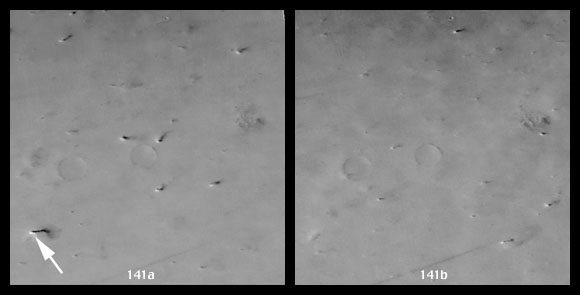
A Martian dust devil! The arrow in the left image (MOC2-141a, above) points to the tallest (8 km, 5 mi) of several dust devils spied by the Mars Global Surveyor MOC Wide Angle camera during its global geodesy campaign in May.
The above two pictures (MOC2-141a and MOC2-141b, top row) are centered near 36°N, 159°W in northern Amazonis Planitia. Each image covers an area 88 kilometers (55 miles) across, and each shows similar features on the ground, such as the two partially-buried craters at the center left.
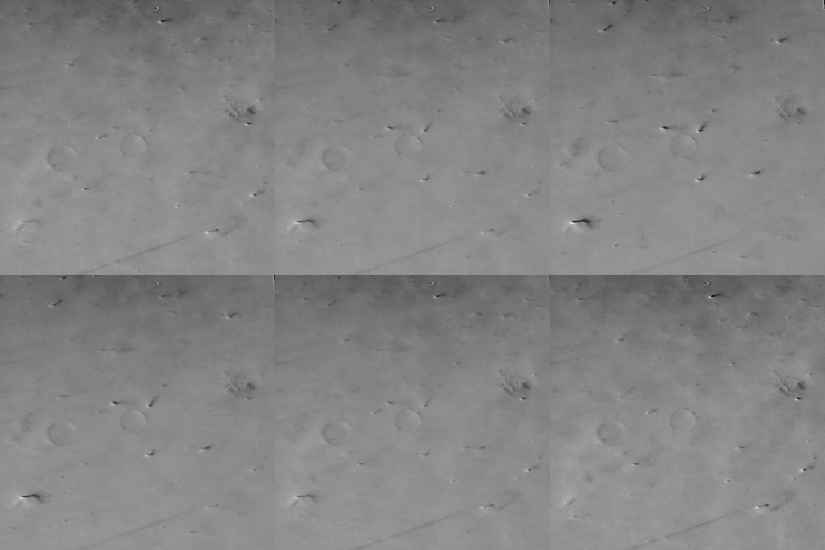
Each image also shows features that are not found in the other image. These are dust devils. Each scene is illuminated by sunlight from the lower left-- thus each towering dust devil casts a long, dark shadow that points toward the right/upper right. The "movie" (lower row, MOC2-141c) shows a comparison of the two images. When viewing the "movie," note that permanent features such as the two partly buried craters do not move, but the dust devils in one image do not appear in the other. Different dust devils are seen in each of the two images. Other variations in apparent surface brightness are also seen when the two images are compared--these are thought to be places where smaller, ground-hugging dust plumes are also being "kicked-up" by the wind.
The pictures were taken 2 days apart--the first on May 13, 1999, the second on May 15, 1999. Large dust devils were known to occur in this region because they were seen in Viking images 20 years ago, but the new and repeated coverage by MOC gives more information about the dust devil's shape and occurrence. Dust devils are columnar vortices of wind that move across the landscape, pick up dust, and look somewhat like miniature tornadoes. For more information on dust devils, see MOC image release MOC2-60 from July 1998, "SUV Tracks on Mars? The Devil is in the Details."
Malin Space Science Systems and the California Institute of Technology built the MOC using spare hardware from the Mars Observer mission. MSSS operates the camera from its facilities in San Diego, CA. The Jet Propulsion Laboratory's Mars Surveyor Operations Project operates the Mars Global Surveyor spacecraft with its industrial partner, Lockheed Martin Astronautics, from facilities in Pasadena, CA and Denver, CO.