
Martian Mystery: Do Some Materials Flow Uphill?

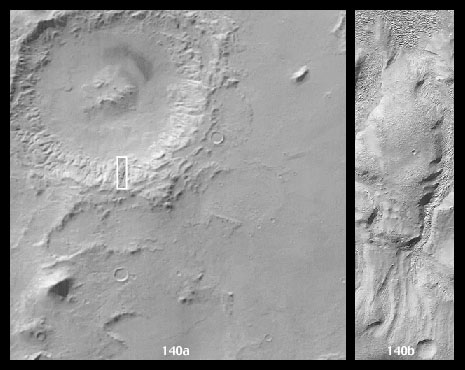
Some of the geological features of Mars defy conventional, or simple, explanations. A recent example is on the wall of a 72 kilometer-wide (45 mile-wide) impact crater in Promethei Terra. The crater (above left) is located at 39°S, 247°W. Its inner walls appear in low-resolution images to be deeply gullied.
A high resolution Mars Orbiter Camera (MOC) image shows that each gully on the crater's inner wall contains a tongue of material that appears to have flowed (to best see this, click on the icon—above right—and examine the full image). Ridges and grooves that converge toward the center of each gully and show a pronounced curvature are oriented in a manner that seems to suggest that material has flowed from the top toward the bottom of the picture. This pattern is not unlike pouring pancake batter into a pan... the viscous fluid will form a steep, lobate margin and spread outward across the pan. The ridges and grooves seen in the image are also more reminiscent of the movement of material out and away from a place of confinement, as opposed to the types of features seen when they flow into a more confined area. Mud and lava-flows, and even some glaciers, for the most part behave in this manner. From these observations, and based solely on the appearance, one might conclude that the features formed by moving from the top of the image towards the bottom.
But this is not the case! The material cannot have flowed from the top towards the bottom of the area seen in the high resolution image (above, right), because the crater floor (which is the lowest area in the image) is at the top of the picture. The location and correct orientation of the high resolution image is shown by a white box in the context frame on the left. Since gravity pulls the material in the gullies downhill—not uphill—the pattern of ridges and grooves found on these gully-filling materials is puzzling. An explanation may lie in the nature of the material (e.g., how viscous was the pancake batter-like material?) and how rapidly it moved, but for now this remains an unexplained martian phenomenon.
The context image (above, left) was taken by the MOC red wide angle camera at the same time that the MOC narrow angle camera obtained the high resolution view (above, right). Context images such as this provide a simple way to determine the location of each new high resolution view of the planet. Both images are illuminated from the upper left. The high resolution image covers an area 3 km (1.9 mi) across.
Malin Space Science Systems and the California Institute of Technology built the MOC using spare hardware from the Mars Observer mission. MSSS operates the camera from its facilities in San Diego, CA. The Jet Propulsion Laboratory's Mars Surveyor Operations Project operates the Mars Global Surveyor spacecraft with its industrial partner, Lockheed Martin Astronautics, from facilities in Pasadena, CA and Denver, CO.