
JPL
Careers
Education
Science & Technology
JPL Logo
JPL Logo
Image

The Galilean Satellites
Jet Propulsion Laboratory https://www.jpl.nasa.gov/ May 8, 1998
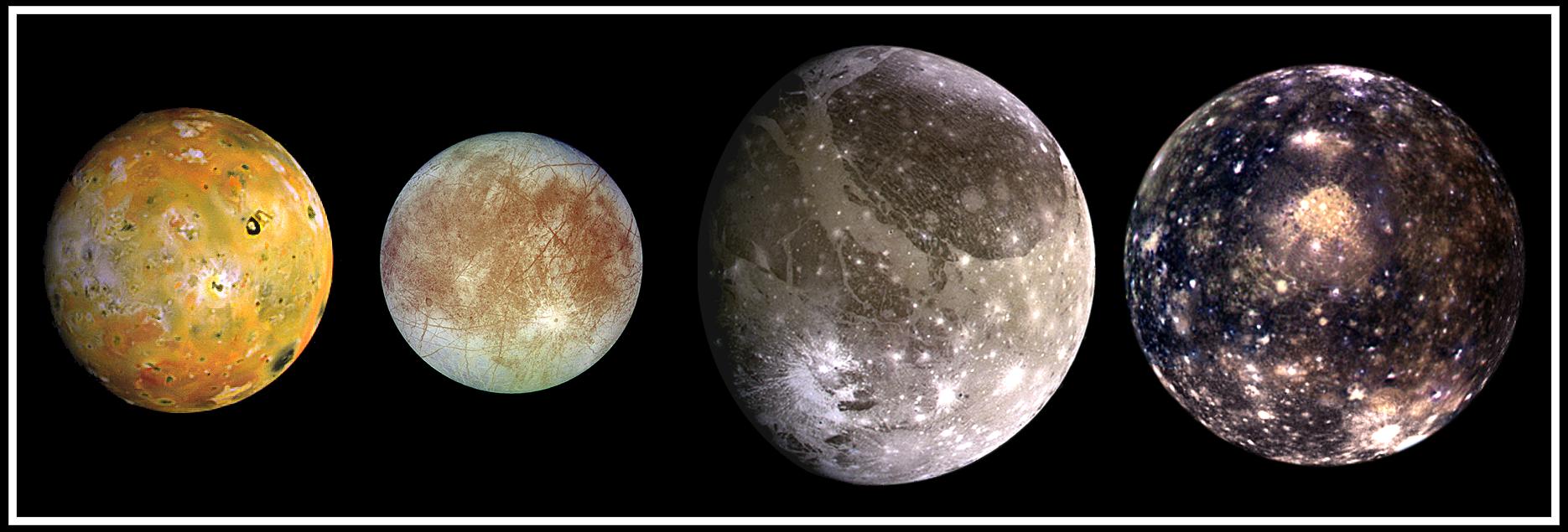
This composite includes the four largest moons of Jupiter which are known as the Galilean satellites. Shown from left to right are Io, closest to Jupiter, followed by Europa, Ganymede, and Callisto.

This composite includes the four largest moons of Jupiter which are known as the Galilean satellites. The Galilean satellites were first seen by the Italian astronomer Galileo Galilei in 1610. Shown from left to right in order of increasing distance from Jupiter, Io is closest, followed by Europa, Ganymede, and Callisto.

The order of these satellites from the planet Jupiter helps to explain some of the visible differences among the moons. Io is subject to the strongest tidal stresses from the massive planet. These stresses generate internal heating which is released at the surface and makes Io the most volcanically active body in our solar system. Europa appears to be strongly differentiated with a rock/iron core, an ice layer at its surface, and the potential for local or global zones of water between these layers. Tectonic resurfacing brightens terrain on the less active and partially differentiated moon Ganymede. Callisto, furthest from Jupiter, appears heavily cratered at low resolutions and shows no evidence of internal activity.

North is to the top of this composite picture in which these satellites have all been scaled to a common factor of 10 kilometers (6 miles) per picture element.

The Solid State Imaging (CCD) system aboard NASA's Galileo spacecraft acquired the Io and Ganymede images in June 1996, the Europa images in September 1996, and the Callisto images in November 1997.

Launched in October 1989, the spacecraft's mission is to conduct detailed studies of the giant planet, its largest moons and the Jovian magnetic environment.

The Jet Propulsion Laboratory, Pasadena, CA manages the mission for NASA's Office of Space Science, Washington, DC.

This image and other images and data received from Galileo are posted on the World Wide Web, on the Galileo mission home page at URL http://galileo.jpl.nasa.gov.

Download JPG
Download TIFF
Mission
Target
  • Io
Spacecraft
  • Galileo Orbiter
Instrument
  • Solid-State Imaging
Credit
NASA/JPL/DLR

Keep Exploring

Map of Water Signatures at Europa's Manannán Crater

Conamara Color Closeup

Europa's Surface: Up-Close Topography

Europa Close-Up

Three Views of Europa

Crisscrossing Bands

Chaos Near Agenor Linea

Chaos Transition

Galileo in High Bay 1

Europa's Plumes Located near 'Warm Spot' on Europa

About JPL
Who We Are
Directors
Careers
Internships
The JPL Story
JPL Achievements
Documentary Series
JPL Annual Report
Executive Council
Missions
Current
Past
Future
All
News
All
Earth
Solar System
Stars and Galaxies
Eyes on the News
Subscribe to JPL News
Galleries
Images
Videos
Audio
Podcasts
Apps
Visions of the Future
Slice of History
Robotics at JPL
Events
Lecture Series
Speakers Bureau
Calendar
Visit
Public Tours
Virtual Tour
Directions and Maps
Topics
JPL Life
Solar System
Mars
Earth
Climate Change
Exoplanets
Stars and Galaxies
Robotics
More
Asteroid Watch
NASA's Eyes Visualizations
Universe - Internal Newsletter
Social Media
Accessibility at NASA
Contact Us
Get the Latest from JPL
Follow Us

JPL is a federally funded research and development center managed for NASA by Caltech.

More from JPL
Careers
Education
Science & Technology
Acquisition
JPL Store
Careers
Education
Science & Technology
Acquisition
JPL Store
Related NASA Sites
Basics of Spaceflight
NASA Kids Science - Earth
Earth / Global Climate Change
Exoplanet Exploration
Mars Exploration
Solar System Exploration
Space Place
NASA's Eyes Visualization Project
Voyager Interstellar Mission
NASA
Caltech
Privacy
Image Policy
FAQ
Feedback
Version: v3.0.29 - 0a615a4
Site Managers:Emilee Richardson, Alicia Cermak
Site Editors:Naomi Hartono, Steve Carney
CL#:21-0018