
JPL
Careers
Education
Science & Technology
JPL Logo
JPL Logo
Image

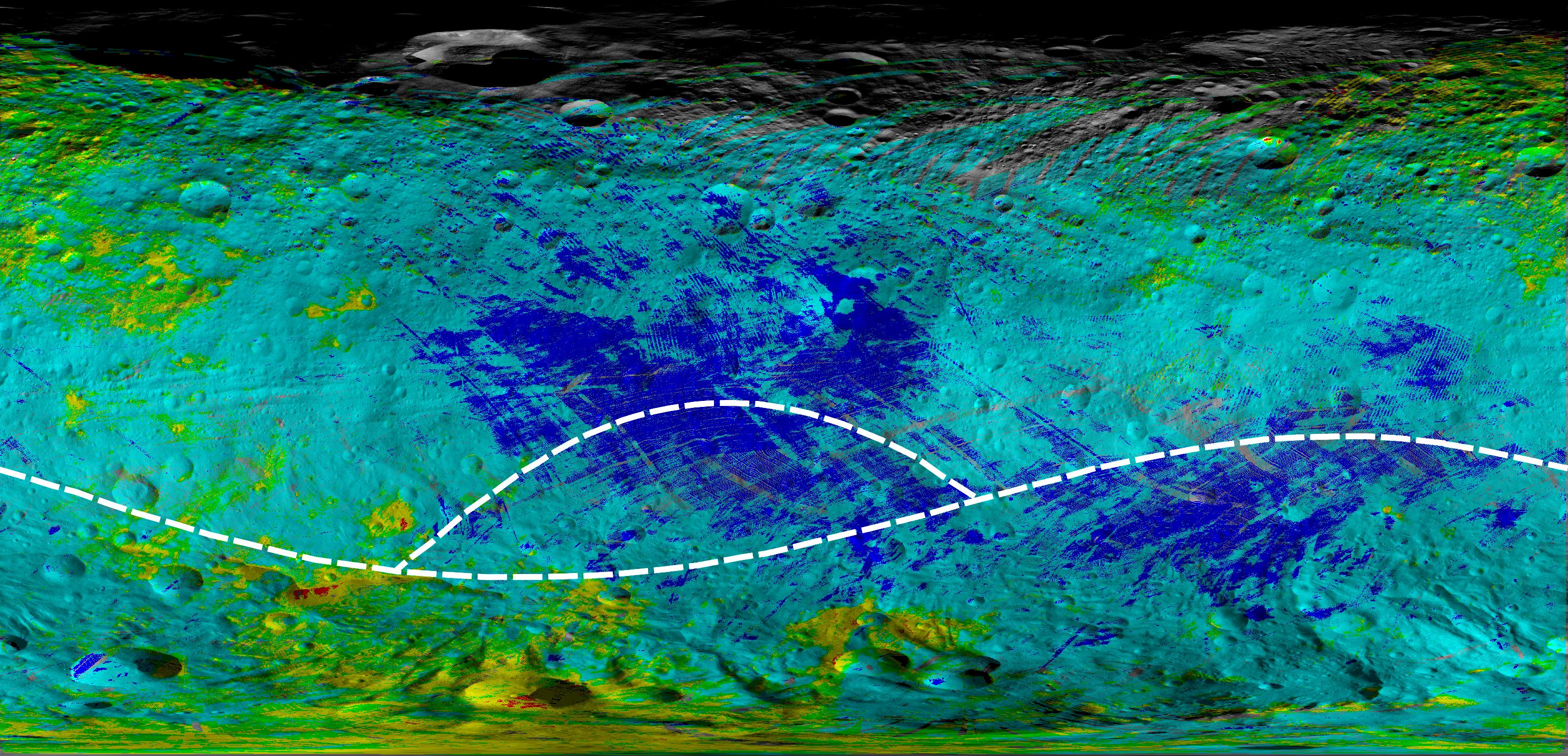
Map of Rock Properties at Giant Asteroid Vesta
Jet Propulsion Laboratory https://www.jpl.nasa.gov/ Nov. 6, 2013
This colorized map from NASA's Dawn mission shows the types of rocks and minerals distributed around the surface of the giant asteroid Vesta.

This colorized map from NASA's Dawn mission shows the types of rocks and minerals distributed around the surface of the giant asteroid Vesta. In this color scheme, red shows diogenite, a type of mineral thought to be formed through magmatic processes deep in the crust. Green shows howardite, a type of surface rock that is made of broken bits of different materials that are excavated, ejected and mixed by meteor impacts. These types of rocks are the most abundant observed on Vesta's surface. Blue shows eucrite, a type of rock formed in the crust of Vesta that isn't as deep down as diogenite. For example, Vesta's equatorial region is replete with eucrites. Yellow areas show regions with diogenite and howardite. The yellow and red areas have large quantities of the magnesium-and silicate-rich mineral diogenite, especially in the southern hemisphere. Cyan areas show regions with eucrite and howardite. Many howardite, eucrite and diogenite meteorites have been found on Earth, and earlier work from Dawn confirmed theories that they came from Vesta.

The location of two craters, Arruntia and Bellicia, are noted in the annotated version. At these craters, scientists unexpectedly found the mineral olivine. The outlines of the giant craters Rheasilvia and Veneneia are also noted. Scientists thought they'd find olivine in those locations but have not.

The data for this map were obtained by Dawn's visible and infrared mapping spectrometer (VIR) during Dawn's orbital measurements of Vesta from 2011 to 2012.

The Dawn mission to Vesta and Ceres is managed by the Jet Propulsion Laboratory, for NASA's Science Mission Directorate, Washington, D.C. It is a project of the Discovery Program managed by NASA's Marshall Space Flight Center, Huntsville, Ala. UCLA is responsible for overall Dawn mission science. Orbital Sciences Corporation of Dulles, Va., designed and built the Dawn spacecraft. The visible and infrared mapping spectrometer was provided by the Italian Space Agency and is managed by Italy's National Institute for Astrophysics, Rome, in collaboration with Selex Galileo, where it was built.

More information about Dawn is online at http://www.nasa.gov/dawn and http://dawn.jpl.nasa.gov.

Download JPG
Download TIFF
Mission
Target
  • Vesta
Spacecraft
  • Dawn
Instrument
  • Visible and Infrared Spectrometer (VIR)
Credit
NASA/JPL-Caltech/UCLA/ASI/INAF

Keep Exploring

Fluid Flow in Ceres Due to Core Heating

Highlighting Bright Areas of Ceres' Occator Crater

Dawn Stereo Anaglyph of Southeast Floor and Rim of Occator Crater, Ceres

Dawn Stereo Anaglyph of Hydrothermal Pits and Domes in Occator Crater, Ceres

Dawn Stereo Anaglyph of Hydrothermal Deposits at Occator Crater, Ceres

Dawn Stereo Anaglyph of Impact Melt Deposits at Occator Crater, Ceres

Close-up of Occator Crater

View of Ceres' Limb

Dantu Crater

Blocks Sliding Down Occator Crater's Southeastern Wall

About JPL
Who We Are
Directors
Careers
Internships
The JPL Story
JPL Achievements
Documentary Series
JPL Annual Report
Executive Council
Missions
Current
Past
Future
All
News
All
Earth
Solar System
Stars and Galaxies
Eyes on the News
Subscribe to JPL News
Galleries
Images
Videos
Audio
Podcasts
Apps
Visions of the Future
Slice of History
Robotics at JPL
Events
Lecture Series
Speakers Bureau
Calendar
Visit
Public Tours
Virtual Tour
Directions and Maps
Topics
JPL Life
Solar System
Mars
Earth
Climate Change
Exoplanets
Stars and Galaxies
Robotics
More
Asteroid Watch
NASA's Eyes Visualizations
Universe - Internal Newsletter
Social Media
Accessibility at NASA
Contact Us
Get the Latest from JPL
Follow Us

JPL is a federally funded research and development center managed for NASA by Caltech.

More from JPL
Careers
Education
Science & Technology
Acquisition
JPL Store
Careers
Education
Science & Technology
Acquisition
JPL Store
Related NASA Sites
Basics of Spaceflight
NASA Kids Science - Earth
Earth / Global Climate Change
Exoplanet Exploration
Mars Exploration
Solar System Exploration
Space Place
NASA's Eyes Visualization Project
Voyager Interstellar Mission
NASA
Caltech
Privacy
Image Policy
FAQ
Feedback
Version: v3.1.0 - 409b2d2
Site Managers:Emilee Richardson, Alicia Cermak
Site Editors:Naomi Hartono, Steve Carney
CL#:21-0018