
JPL
Careers
Education
Science & Technology
JPL Logo
JPL Logo
Image

Fantastic Four Galaxies with Planet (Artist Concept)
Jet Propulsion Laboratory https://www.jpl.nasa.gov/ Aug. 6, 2007
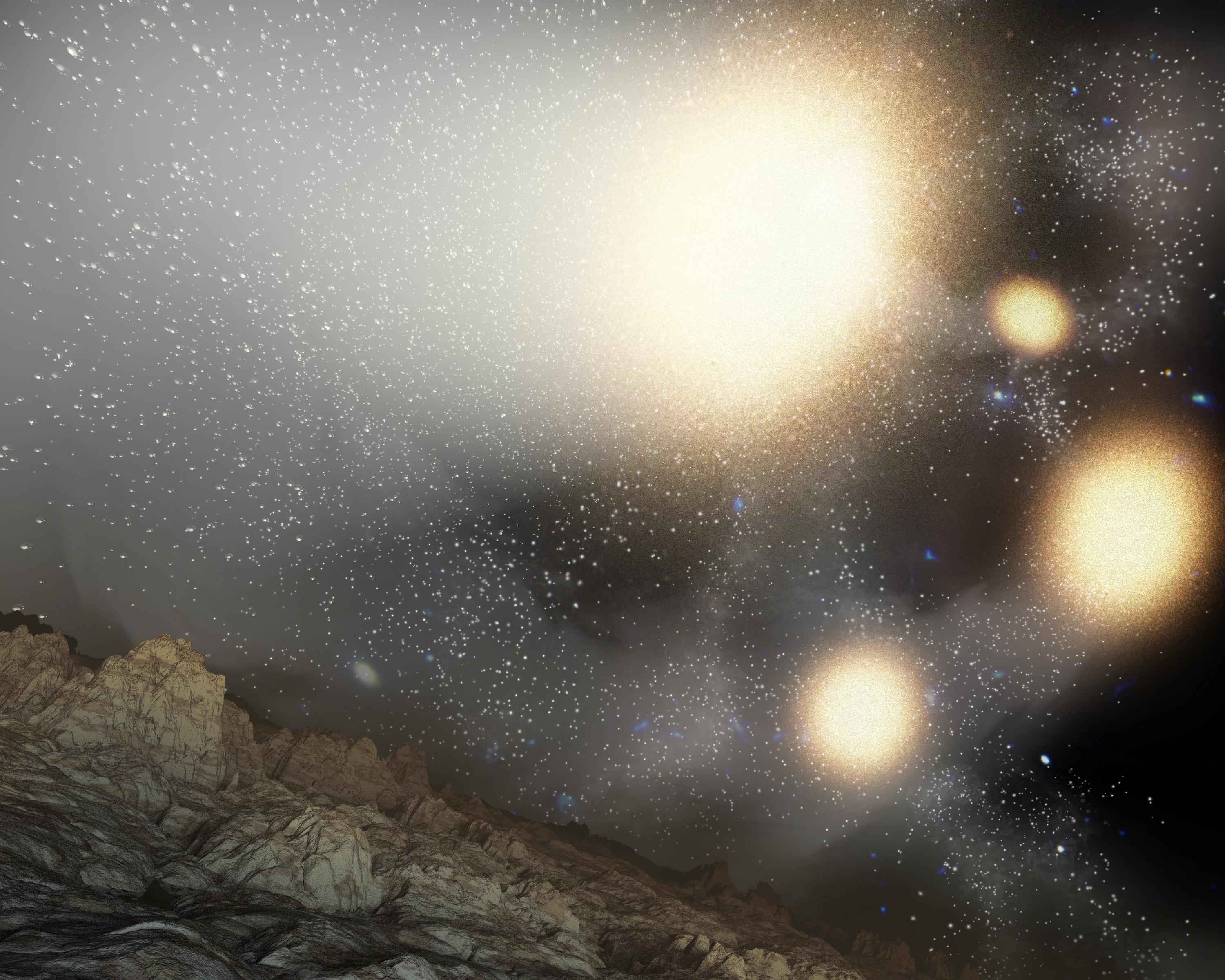
This artist's concept shows what the night sky might look like from a hypothetical planet around a star tossed out of an ongoing four-way collision between big galaxies.

This artist's concept shows what the night sky might look like from a hypothetical planet around a star tossed out of an ongoing four-way collision between big galaxies (yellow blobs). NASA's Spitzer Space Telescope spotted this "quadruple merger" of galaxies within a larger cluster of galaxies located nearly 5 billion light-years away.

Though the galaxies appear intact, gravitational disturbances have caused them to stretch and twist, flinging billions of stars into space -- nearly three times as many stars as are in our Milky Way galaxy. The tossed stars are visible in the large plume emanating from the central, largest galaxy. If any of these stars have planets, their night skies would be filled with the monstrous merger, along with other galaxies in the cluster (smaller, bluish blobs).

This cosmic smash-up is the largest known merger between galaxies of a similar size. While three of the galaxies are about the size of our Milky Way galaxy, the fourth (center of image) is three times as big. All four of the galaxies, as well as most other galaxies in the huge cluster, are blob-shaped ellipticals instead of spirals like the Milky Way.

Ultimately, in about one hundred million years or so, the four galaxies will unite into one. About half of the stars kicked out during the merger will fall back and join the new galaxy, making it one of the biggest galaxies in the universe.

Download JPG
Download TIFF
Mission
Target
  • CL0958+4702
Credit
NASA/JPL-Caltech/Harvard-Smithsonian CfA

Keep Exploring

Orion Nebula in Infrared

Planetesimal Collison Around Star HD 166191 (Illustration)

Exoplanet XO-3b Illustration

Godzilla Nebula Imaged by Spitzer

Four Famous Nebulae

Hidden Supernova Spotted by Spitzer

Spitzer Image of Star Factory W51

Animation of Black Hole Disk Flare in OJ 287

Spitzer California Nebula Mosaic

Spitzer Brown Dwarf Wind (Artist's Concept)

About JPL
Who We Are
Directors
Careers
Internships
The JPL Story
JPL Achievements
Documentary Series
JPL Annual Report
Executive Council
Missions
Current
Past
Future
All
News
All
Earth
Solar System
Stars and Galaxies
Eyes on the News
Subscribe to JPL News
Galleries
Images
Videos
Audio
Podcasts
Apps
Visions of the Future
Slice of History
Robotics at JPL
Events
Lecture Series
Speakers Bureau
Calendar
Visit
Public Tours
Virtual Tour
Directions and Maps
Topics
JPL Life
Solar System
Mars
Earth
Climate Change
Exoplanets
Stars and Galaxies
Robotics
More
Asteroid Watch
NASA's Eyes Visualizations
Universe - Internal Newsletter
Social Media
Accessibility at NASA
Contact Us
Get the Latest from JPL
Follow Us

JPL is a federally funded research and development center managed for NASA by Caltech.

More from JPL
Careers
Education
Science & Technology
Acquisition
JPL Store
Careers
Education
Science & Technology
Acquisition
JPL Store
Related NASA Sites
Basics of Spaceflight
NASA Kids Science - Earth
Earth / Global Climate Change
Exoplanet Exploration
Mars Exploration
Solar System Exploration
Space Place
NASA's Eyes Visualization Project
Voyager Interstellar Mission
NASA
Caltech
Privacy
Image Policy
FAQ
Feedback
Version: v3.0.29 - 4bc7967
Site Managers:Emilee Richardson, Alicia Cermak
Site Editors:Naomi Hartono, Steve Carney
CL#:21-0018