JPL
Careers
Education
Science & Technology
JPL Logo
JPL Logo
Image

Dust from Mars Drilling: Tailings and Discard Piles

Jet Propulsion Laboratory https://www.jpl.nasa.gov/ April 8, 2013
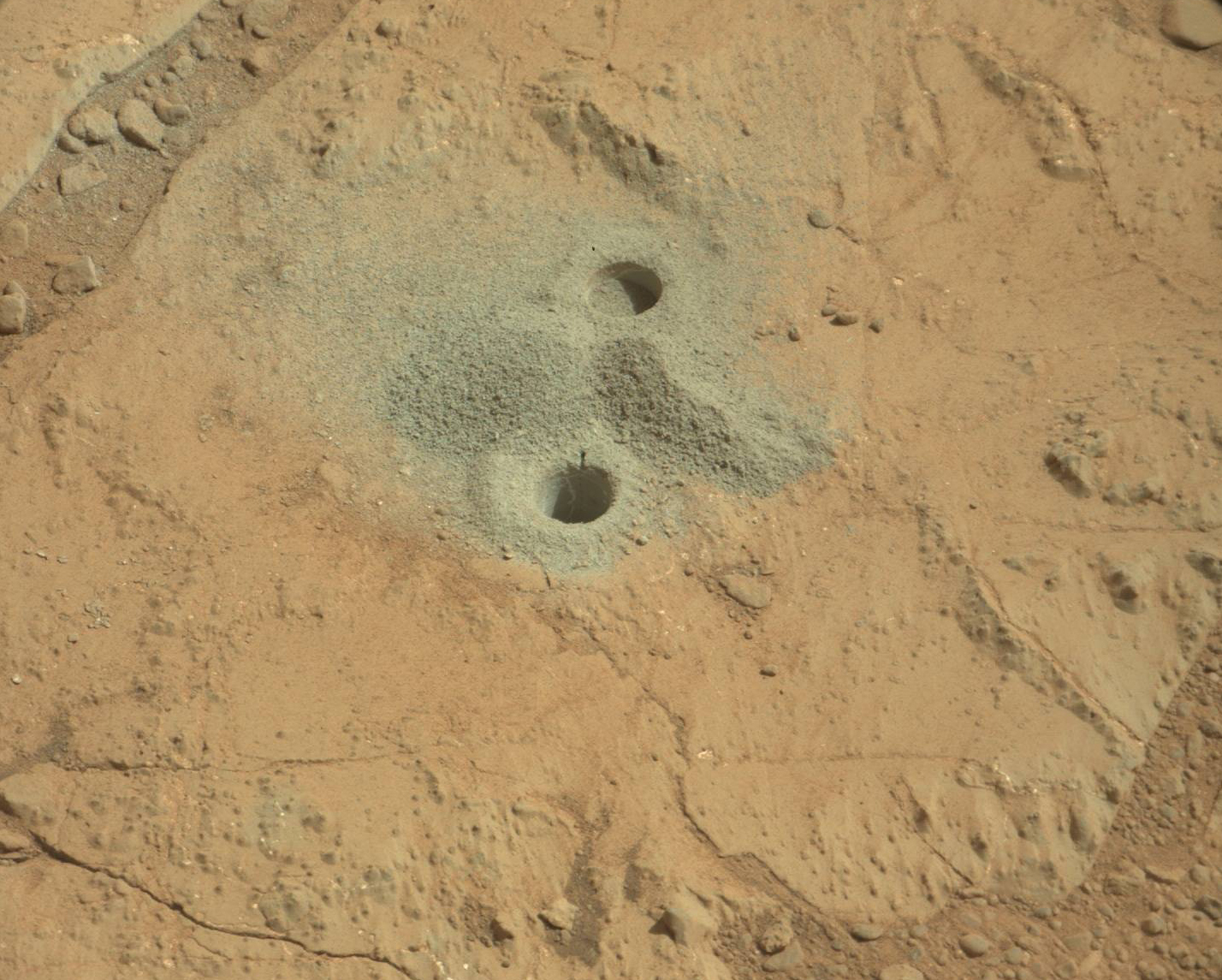
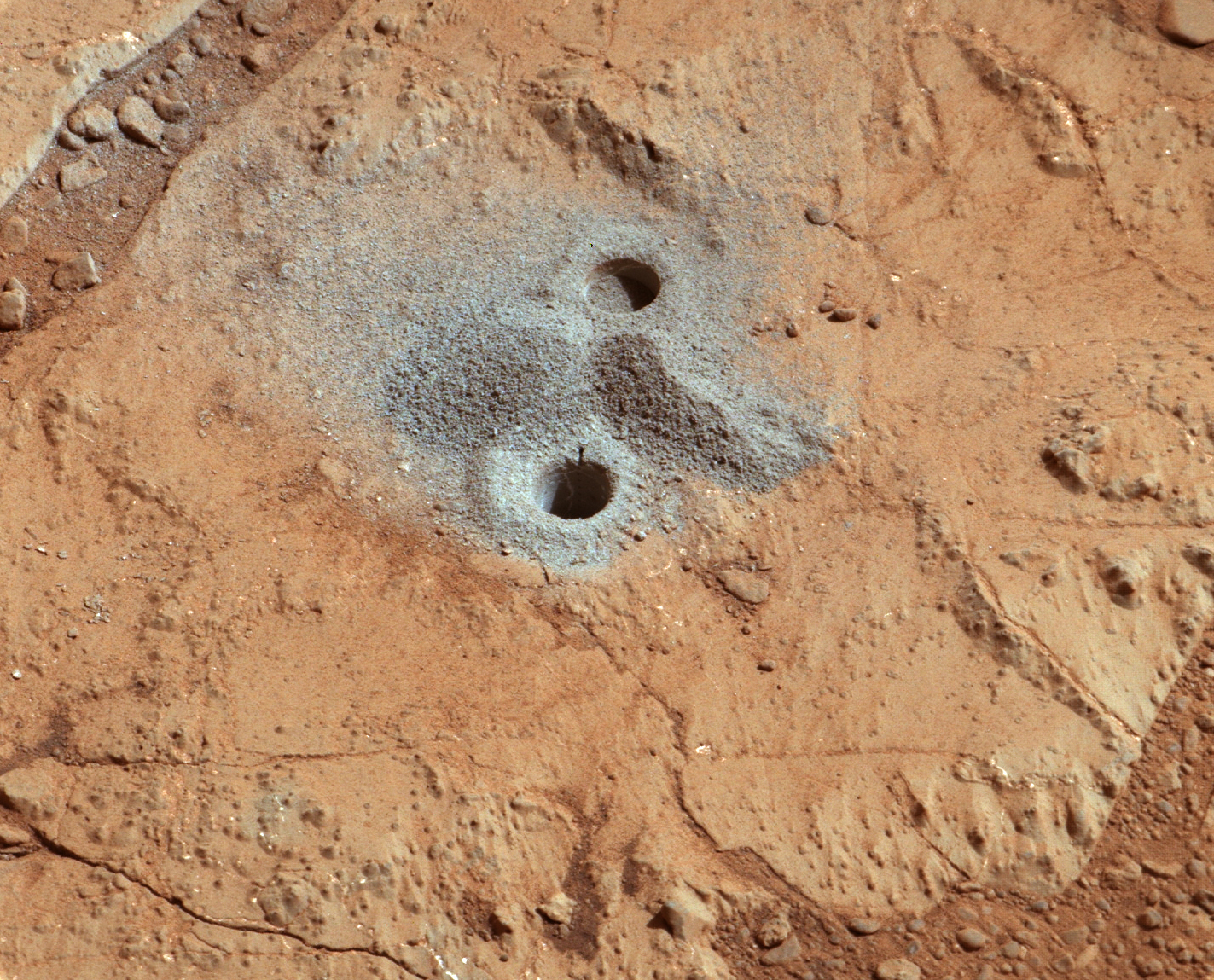
This image shows the first holes into rock drilled by NASA's Mars rover Curiosity, with drill tailings around the holes plus piles of powdered rock collected from the deeper hole and later discarded.

click here for larger view of figure 1 for PIA16815click here for larger view of figure 2 for PIA16815
Figure 1Figure 2
Click on an individual image for larger views

This image shows the first holes into rock drilled by NASA's Mars rover Curiosity, with drill tailings around the holes plus piles of powdered rock collected from the deeper hole and later discarded after other portions of the sample had been delivered to analytical instruments inside the rover. The image was taken by the telephoto-lens camera of the rover's Mast Camera (Mastcam) instrument in early afternoon of the 229th Martian day, or sol, of Curiosity's work on Mars (March 29, 2013). The site is on a patch of flat rock called "John Klein" in the "Yellowknife Bay" area of Mars' Gale Crater.

Each of the drill holes is about 0.6 inch (1.6 centimeters) in diameter. The one toward the top of the image was drilled on Sol 180 (Feb. 6, 2013) as a "mini drill" preparatory test. That test went to a depth of 0.8 inch (2 centimeters) without collecting any rock powder. The nearer hole is from the first rock-drilling ever to collect a sample on Mars. Curiosity drilled this hole 2.5 inches (6.4 centimeters) deep on Sol 182 (Feb. 8, 2013).

Analysis of the collected John Klein rock sample by the Chemistry and Mineralogy (CheMin) and Sample Analysis at Mars (SAM) instruments inside Curiosity produced evidence of an ancient wet environment that provided favorable conditions for microbial life, including elemental ingredients for life plus a chemical energy gradient such as some terrestrial microbes exploit as an energy source.

The sample processing and delivery tool on Curiosity, called the Collection and Handling for In-situ Martian Rock Analysis, or CHIMRA, put the collected powder through a sieve to screen out particles larger than 0.006 inch (150 microns) across, and then delivered portions of the sieved material to the instruments. After delivering a few portions for analysis over the course of several weeks, CHIMRA released both the material that had not passed through the sieve and the leftover sieved material, dropping them in two piles near the drill hole on Sol 229 (March 29, 2013). In this image from a few minutes later, the unsieved material forms a mound to the left of a line between the two holes and the leftover sieved sample material forms a mound to the right.

The image has been white-balanced to show what the rock material would look like if it were on Earth. Two unannotated versions, white-balanced and raw color (showing what the rock material looks like on Mars to the camera) are available as Figure 1 and Figure 2.

Malin Space Science Systems, San Diego, developed, built and operates Mastcam. NASA's Jet Propulsion Laboratory, Pasadena, Calif., manages the Mars Science Laboratory Project and the mission's Curiosity rover for NASA's Science Mission Directorate in Washington. The rover was designed and built at JPL, a division of the California Institute of Technology in Pasadena.

More information about Curiosity is online at http://www.nasa.gov/msl and http://mars.jpl.nasa.gov/msl/.

Download JPG
Download TIFF
Mission
Target
  • Mars
Spacecraft
  • Curiosity
Instrument
  • Mastcam
Credit
NASA/JPL-Caltech/MSSS

Keep Exploring

Curiosity Works Its Robotic Arm During Sunset

Curiosity’s ChemCam Views Ancient River Channel Peace Vallis

Curiosity’s ChemCam Views Summit and Cliffs Beyond Gale Crater

Curiosity Views Gale Crater’s Rim, Homing in on Ancient River Channel

Curiosity's ChemCam Views a Rock Shaped Like Coral

Curiosity Views a Martian Rock Shaped Like Coral

Curiosity Captures Mars Landscape While Talking to an Orbiter

Curiosity's First 360-Degree View of Boxwork Patterns

Curiosity Views a Fractured Boxwork Pattern Up Close

Curiosity Views Boxwork Patterns at a Distance

About JPL
Who We Are
Directors
Careers
Internships
The JPL Story
JPL Achievements
Documentary Series
JPL Annual Report
Executive Council
Missions
Current
Past
Future
All
News
All
Earth
Solar System
Stars and Galaxies
Eyes on the News
Subscribe to JPL News
Galleries
Images
Videos
Audio
Podcasts
Apps
Visions of the Future
Slice of History
Robotics at JPL
Events
Lecture Series
Speakers Bureau
Calendar
Visit
Public Tours
Virtual Tour
Directions and Maps
Topics
JPL Life
Solar System
Mars
Earth
Climate Change
Exoplanets
Stars and Galaxies
Robotics
More
Asteroid Watch
NASA's Eyes Visualizations
Universe - Internal Newsletter
Social Media
Accessibility at NASA
Contact Us
Get the Latest from JPL
Follow Us

JPL is a federally funded research and development center managed for NASA by Caltech.

More from JPL
Careers
Education
Science & Technology
Acquisition
JPL Store
Careers
Education
Science & Technology
Acquisition
JPL Store
Related NASA Sites
Basics of Spaceflight
NASA Kids Science - Earth
Earth / Global Climate Change
Exoplanet Exploration
Mars Exploration
Solar System Exploration
Space Place
NASA's Eyes Visualization Project
Voyager Interstellar Mission
NASA
Caltech
Privacy
Image Policy
FAQ
Feedback
Version: v3.1.0 - 409b2d2
Site Managers:Emilee Richardson, Alicia Cermak
Site Editors:Naomi Hartono, Steve Carney
CL#:21-0018